

Commentary
From Sudan to Ukraine, UAVs have upended warfighting tactics and become one of the most destructive weapons of conflict.
Jon Bateman, Steve Feldstein
{
  "authors": [
    "Marc Pierini"
  ],
  "type": "commentary",
  "centerAffiliationAll": "",
  "centers": [
    "Carnegie Endowment for International Peace",
    "Carnegie Europe"
  ],
  "englishNewsletterAll": "",
  "nonEnglishNewsletterAll": "",
  "primaryCenter": "Carnegie Europe",
  "programAffiliation": "",
  "programs": [],
  "projects": [],
  "regions": [
    "Türkiye",
    "United States",
    "Middle East",
    "Israel",
    "Palestine",
    "Russia",
    "Europe"
  ],
  "topics": [
    "EU",
    "Global Governance",
    "Foreign Policy"
  ]
}
Erdoğan and Trump’s meeting served both leaders’ domestic and personal agendas. For Europe, it highlights how America’s transactional approach risks sidelining allies and empowering authoritarians.
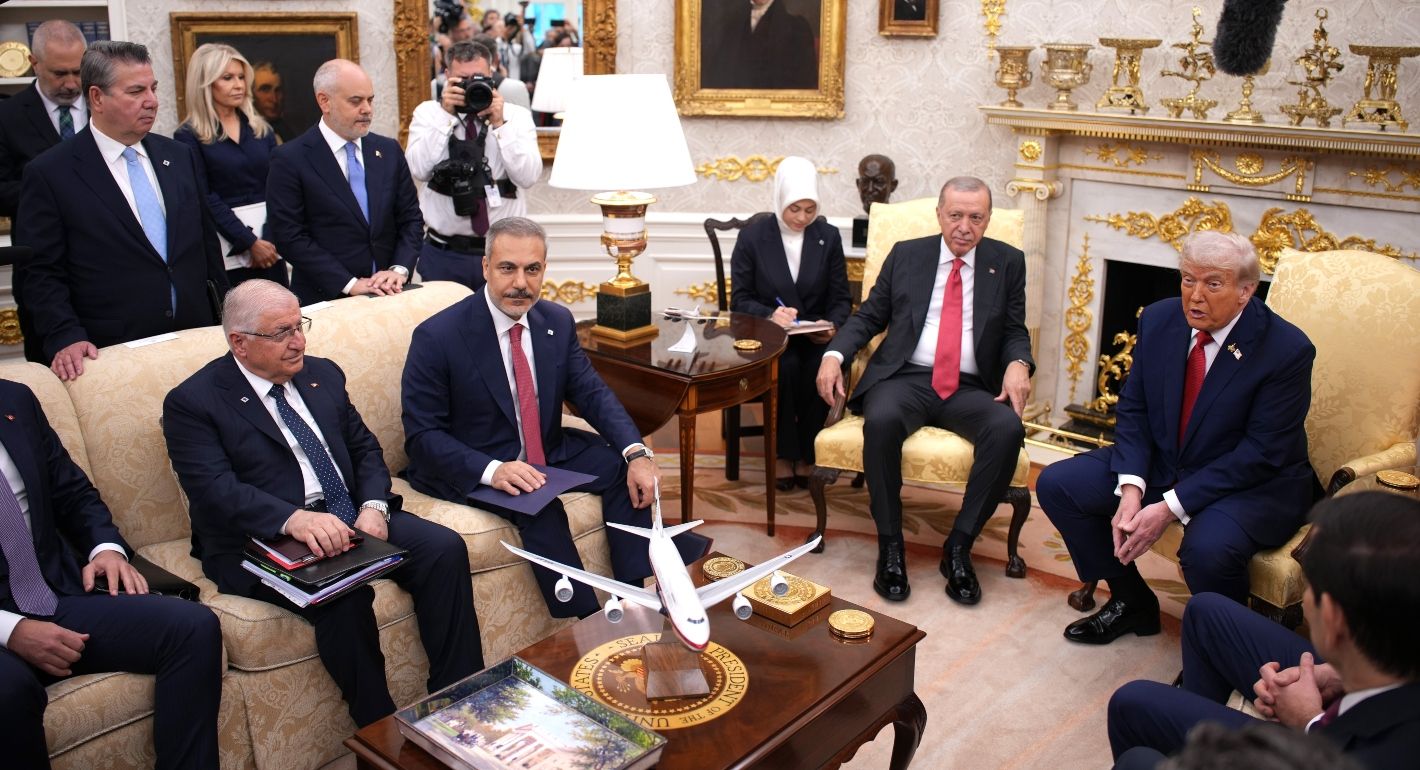
The September 25 meeting between the Turkish and U.S. presidents appeared to go very smoothly by current Oval Office standards. Careful choreography allowed the two leaders to hide their deep disagreements and instead play a tough-guy duet, in which affinities and friendly words were mixed with Trumpian pique. For Turkey’s Recep Tayyip Erdoğan, who travels with a friends-only press corps and keeps the media in check at home, it was the ideal moment. For Donald Trump, diplomacy through big business was the order of the day. Both men looked happy.
Turkey’s president had long waited for his Oval Office moment, as he was not hosted at the White House for the entire presidency of Joe Biden. Against his usual proclivities, Erdoğan kept his toughest statements to himself, reserving his views on the Israeli genocide in Gaza, the Hamas “resistance,” and Turkey’s links with Russia for other venues: With the Turkish leader’s Washington visit coming on the heels of his speech at the UN General Assembly, the tough talk had already been delivered in New York and the contentious issues widely discussed between top-level staffers. Similarly, Erdoğan saved the official Turkish narrative for his interview with Fox News on September 23—a narrative that continued after his return to Ankara to shore up his image as a respected leader.
Indeed, Erdoğan was in dire need of the much-prized Oval Office media session to hide his grave domestic woes, especially as under Trump, White House meetings have become a long-running television show. Back home, muted footage with voice-over commentary allowed Erdoğan to portray the visit as a major success: Turkey’s president in conversation with his U.S. counterpart while still in command of his most antagonistic positions. It looked like an instant win.
Trump had opted for a friendly macho get-together. As Tom Barrack, U.S. ambassador to Turkey and special envoy for Syria, put it on the eve of the meeting, the president was “tired” of never-ending disagreements with Ankara about its use of Russian S-400 missiles or the absence of Turkish sanctions against Russia. Instead, Trump decided to “give Erdoğan what he needed most: legitimacy.”
Live from the Oval Office, Trump welcomed his so-called friend with a mix of remarks: praise for Erdoğan’s strong leadership at home and in the Middle East, including in Syria; a castigating quip about Turkey’s “rigged elections”; regret over Ankara’s purchases of Russian oil; and talk of big U.S.-Turkey deals, including for aircraft, a nuclear power plant, and LNG supplies. Most of these deals need to be discussed further, and some are of dubious value. For example, Turkey has just discovered a massive gas field under the Black Sea, so why would it need to import LNG from the United States? But in the Trumpian world of business-as-diplomacy, they make sense.
From a European perspective, these developments delineate a striking new U.S.-Turkey relationship: Trump is friendly with Erdoğan and does not care about the degraded rule of law in a major NATO partner; Trump is happy with what he called Ankara’s “unfriendly takeover” of Syria “through proxies”; Trump has given his blessing for a massive purchase of Boeing aircraft by Turkish Airlines, a company usually keen to strike a balance between its two suppliers, Airbus and Boeing; and Trump is hoping to disconnect Turkey from Russian oil—and perhaps from Russian gas as well.
All in all, the White House’s new positions on Turkey will probably widen the divergences between U.S. and European policies toward Ankara. They also perfectly illustrate the absence of coordination by the United States with its European allies when it comes to implementing the America First policy on the international stage.
At this point, it seems that none of the toughest issues between the two presidents has been resolved. The Pentagon sees Turkey’s S-400 missile battery as a major impediment to providing the country with U.S.-made F-35 stealth fighters. Before being ejected from the program by Trump in December 2020, Ankara had placed an order that included the F-35B, the navy version of the aircraft, which would have been deployed aboard the Anadolu aircraft carrier in the Black Sea or the Mediterranean. The main blocking factor is that Ankara’s normalization with Washington requires the S-400s to be neutralized one way or another: sent or sold to a third party, or stored in Turkey under U.S. supervision. Both options are probably unacceptable for the Kremlin. Turkey’s purchase of F-16 aircraft, a second-best option, is also under discussion.
Likewise, forcing Turkey to stop buying Russian crude oil will be a tough nut to crack given Ankara’s relationship with Moscow. Turkey imports a volume of Russian crude that has vastly increased since Russia’s 2022 invasion of Ukraine, processes it in Turkish refineries, and reexports it as a Turkish product. The scheme is clearly a sanctions-evasion device that benefits both Russia and Turkey. In this domain, as for gas and nuclear energy, the White House strategy seems to be to force business deals on Turkey as the price for Erdoğan’s increased visibility.
Beyond visibility, Trump’s strategy aims at giving his Turkish friend the status of a valued U.S. counterpart—or “legitimacy,” to use Barrack’s term—while ignoring the country’s decrepit rule-of-law architecture, the fate of the main opposition Republican People’s Party (CHP), and the status of emblematic prisoners of conscience, such as Osman Kavala. This new positioning is worrying for Europe because, beyond Turkey, it may prefigure the future Russia-U.S. relationship: constant arm-twisting between authoritarian leaders who regard the rest of the world (except China) as unworthy of their attention.
Only time will tell how much, aside from the photo op, Ankara has won in the Oval Office and at what cost. In the past nine months, the world has grown accustomed to the White House’s changes of policy direction at a moment’s notice and its appetite for praise. Erdoğan’s unexpected September 29 statement lauding Trump’s twenty-point peace plan for Gaza has already triggered serious criticism in Turkey. Similarly, whether Ankara’s involvement in future peace talks on Gaza will be acceptable to Israel remains an open question.
For the time being, Erdoğan is probably enjoying his hard-fought moment in the newly glitzed-up Oval Office. In an anecdote that offered a fitting metaphor for the meeting, most of the Turkish media, even those critical of the president, wanted to see the model Boeing 747 on the coffee table as a symbol of reconciliation. Alas, there was no such symbol, as it was just a model of the new Air Force One under construction, which Trump routinely displays in the Oval Office.
Carnegie does not take institutional positions on public policy issues; the views represented herein are those of the author(s) and do not necessarily reflect the views of Carnegie, its staff, or its trustees.
From Sudan to Ukraine, UAVs have upended warfighting tactics and become one of the most destructive weapons of conflict.


Jon Bateman, Steve Feldstein
And how they can respond.
Sophia Besch, Steve Feldstein, Stewart Patrick, …
They cannot return to the comforts of asymmetric reliance, dressed up as partnership.
Sophia Besch
As European leadership prepares for the sixteenth EU-India Summit, both sides must reckon with trade-offs in order to secure a mutually beneficial Free Trade Agreement.

Dinakar Peri
Baku may allow radical nationalists to publicly discuss “reunification” with Azeri Iranians, but the president and key officials prefer not to comment publicly on the protests in Iran.

Bashir Kitachaev