

Article
Thomas de Waal
{
  "authors": [
    "Thomas de Waal"
  ],
  "type": "legacyinthemedia",
  "centerAffiliationAll": "dc",
  "centers": [
    "Carnegie Endowment for International Peace",
    "Carnegie Europe",
    "Carnegie Russia Eurasia Center"
  ],
  "collections": [],
  "englishNewsletterAll": "ctw",
  "nonEnglishNewsletterAll": "",
  "primaryCenter": "Carnegie Europe",
  "programAffiliation": "russia",
  "programs": [
    "Russia and Eurasia"
  ],
  "projects": [],
  "regions": [
    "Europe",
    "Caucasus",
    "Eastern Europe",
    "Western Europe"
  ],
  "topics": [
    "Foreign Policy",
    "Political Reform",
    "Democracy",
    "Economy"
  ]
}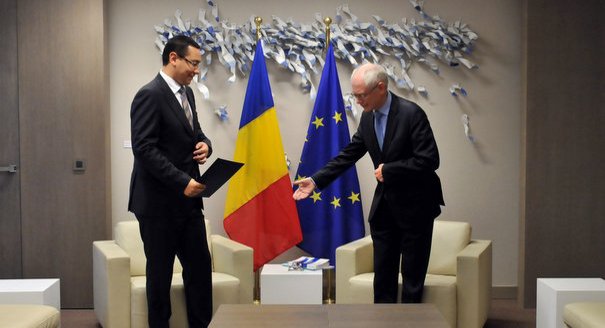
Source: Getty
The European Union has an opportunity to make a significant difference in their eastern borderlands, through a combination of social, economic, and political incentives.
Source: Financial Times

Troubling smoke-signals are quickly rising from the six European post-Soviet countries outside Russia: Belarus, Moldova, Ukraine, Armenia, Georgia and Azerbaijan. Twenty years after they became independent, with the end of the Soviet Union, they form an arc of disappointment.
Tiny Moldova is probably the brightest spot and has the most progressive government, but is also the poorest and its reformist agenda is mostly on paper. Belarus suffers under Europe’s most repressive leader, Alexander Lukashenka, and is close to bankruptcy. Ukraine has squandered the chance of transformation promised by the 2004 Orange Revolution and is wracked by permanent political strife.
Elsewhere, the current Georgian elite has made some impressive modernising reforms, but its democratic record is more patchy. Georgia is also currently a one-party state with few checks and balances. Armenia and Azerbaijan are still crippled by their perpetual and intractable conflict over the disputed territory of Nagorny Karabakh.
Today in Warsaw, the EU re-launches its worthy but faltering eastern partnership programme for these six countries. If ever there was a project to energise it, this should be it. In eastern Europe, far more than in the Arab world, the EU is a guiding star for millions of people, who feel European but are frustrated by inadequate governments and persistent poverty.
The issue is not a Russian imperial threat. With the exception of a few sensitive spots, such as Abkhazia and Crimea, Moscow is in long-term retreat from its former colonial space, and is mostly pre-occupied with domestic problems, such as the volatile North Caucasus. Russia had concerns about Nato expansion into Georgia and Ukraine, but that ill-conceived project has now run out of steam. The EU, by contrast, is just a fact of life to the west. Russia’s challenge is more of an economic one: a re-elected Mr Putin is likely to be more aggressive in pushing an agenda of cross-border crony capitalism via for example a customs union with Ukraine.
The EU can offer a brighter vision than that – if it tries. Currently the default policy is to withhold the big carrot, a membership perspective for these countries, while being softer on day-to-day issues, such as conditionality on reform and conduct of elections, in order to keep up a dialogue with governing elites.
In fact, it should be the other way round. The leaders of the EU should make a general commitment that in theory and in the future these six countries could eventually join the union, if – and it is a big if – they raise their standards to meet it. Offering the hope of eventual EU membership should not be a taboo. Turkey has been in the EU waiting-room since the 1960s, but, more by good luck than planning, the long wait has helped reform the Turkish state and now, arguably, outgrow its EU ambitions.
However, it would be a big mistake for the EU to cut corners on issues such as elections or trade agreements. Calling a bad election a bad election sends a clear signal that some governments are more legitimate than others. Negotiations on a deep and comprehensive free trade area with Georgia, Moldova and Ukraine promise eventual privileged access to the EU single market and Brussels should use all the leverage that it has on this issue. All of these countries have opaque and monopolistic corners in their economies that need more light shone into them. If they want better access to the EU, they should get it without bending the rules.
One principle should guide all others, in a new Ostpolitik: ordinary citizens are often more pro-European than their leaders. That means anything that can be done to lift visa restrictions and make travel easier for students or professionals could pay big dividends in the future. Leave aside the debt crisis for a moment. Presenting a vision of a bigger freer Europe is a project that even Germany and Greece should be able to get behind.

Senior Fellow, Carnegie Europe
Thomas de Waal is a senior fellow at Carnegie Europe, specializing in Eastern Europe and the Caucasus.
Recent Work
Thomas de Waal
Thomas de Waal
Carnegie does not take institutional positions on public policy issues; the views represented herein are those of the author(s) and do not necessarily reflect the views of Carnegie, its staff, or its trustees.

In supporting Europe’s far-right, MAGA and Russia both want the same thing: a weaker EU. Europe must defend itself without abandoning the openness these forces exploit.

Armida van Rij

As we close out another season of Strategic Europe, it is worth taking stock of the deep shifts underway.

Rym Momtaz
The hybrid warfare landscape is evolving rapidly, leaving policymakers without clear strategies. To better inform their work in addressing emerging challenges, governments must dig deeper into the underlying dynamics at play.


Raluca Csernatoni, Alicia Wanless
The EU had to compromise to adopt a twenty-first sanctions package against Russia, exposing growing cracks in the union’s resolve. Is this latest, weaker round worth it to keep pressure on Moscow?
Rym Momtaz, ed.

Trump is distracted and Ukraine wants Europe to step up. The continent’s leaders must find their voice and assert it in talks with Russia.

Alissa de Carbonnel