

Commentary
Judy Dempsey
{
  "authors": [
    "Judy Dempsey"
  ],
  "type": "legacyinthemedia",
  "centerAffiliationAll": "",
  "centers": [
    "Carnegie Endowment for International Peace",
    "Carnegie Europe"
  ],
  "collections": [
    "Transatlantic Cooperation",
    "Europe’s Southern Neighborhood"
  ],
  "englishNewsletterAll": "",
  "nonEnglishNewsletterAll": "",
  "primaryCenter": "Carnegie Europe",
  "programAffiliation": "",
  "programs": [],
  "projects": [],
  "regions": [
    "Asia",
    "Europe",
    "North America",
    "South Asia",
    "Afghanistan",
    "Western Europe"
  ],
  "topics": [
    "Security",
    "Political Reform",
    "Democracy",
    "Foreign Policy"
  ]
}
Source: Getty
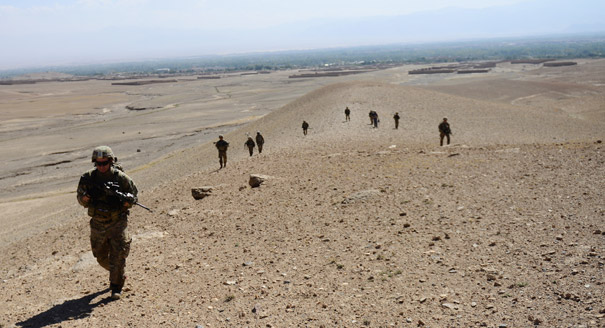
In 2001, both Americans and Europeans spoke of building democracy in Afghanistan. Now the priority has shifted toward making the country stable and making Afghans responsible for security.
Source: New York Times
Over the next 12 months, President Barack Obama will withdraw more than 34,000 U.S. troops from Afghanistan, halving the American contingent.
By the end of 2014, when NATO’s combat mission ends and its new training mission begins, diplomats say that the United States is planning to have no more than 10,000 troops available for Afghanistan.
About 5,000 will focus on counterterrorism operations. The remainder are expected to join the NATO training mission. The size of that mission, yet to be finalized, is expected to be between 8,000 and 12,000 troops.
“This is the planning assumption, but no decision has been taken,” said Oana Lungescu, a NATO spokeswoman.The number of U.S. troops that will be earmarked for Afghanistan after 2014 shows how much the United States needs to save money and how urgently it wishes to close this particular chapter.
Mr. Obama confirmed the U.S. intention to pull out, and soon, during his State of the Union address. “By the end of next year, our war in Afghanistan will be over,” he said. Victory was not mentioned, nor was an end to fighting in Afghanistan.
The Europeans, especially Germany, with 4,400 troops in Afghanistan, fear that they will be much more vulnerable to attacks by insurgents without a strong U.S. presence.
Until now, the United States has been providing its European allies with logistics and intelligence, air protection and evacuation for the wounded. Thomas de Maizière, the German defense minister, has repeatedly asked the United States what support would be available during the transition from the combat to the training mission.
“The administration’s game is to rush the transition,” said Anthony H. Cordesman, a security expert at the Center for Strategic and International Studies in Washington. “It is a reflection of the U.S.’s different priorities and different strategies. The Europeans should understand that.”
For the Europeans, the illusion that they and the United States would go into the Afghan combat mission together and leave together has been broken.
“The Americans are throwing down the gauntlet to the Europeans,” said Markus Kaim, defense expert at the German Institute for International and Security Affairs in Berlin.
As the United States rapidly draws down, another illusion is waiting to be shattered. It is the ability of the Afghan National Army, or A.N.A., to take over the security of the country by the end of 2014.
NATO continues to heap praise on the abilities of the Afghan forces because that would justify ending NATO’s combat role and because it believes that Afghanistan must be responsible for its own security.
“The Afghan security forces have reached their overall recruiting target,” a NATO official said, speaking on the condition of anonymity. “They are leading 80 percent of operations and are taking the lead for the security of 87 percent of the population.”
A recent report to Congress by the U.S. Defense Department paints a different picture. It stated that the rate of attrition in the A.N.A. was very high, the level of retention was very low, and the logistic capabilities were inadequate.
Between October 2011 and September 2012, the A.N.A. lost 27 percent of its fighting force, according to the report. The “attrition rate is higher than desirable for the Afghan Army,” the NATO official acknowledged.
The retention rate, which refers to those soldiers who have completed their three-year enlistment and who then choose to remain, is even lower. “On average, the A.N.A. is only retaining 7 percent of its forces,” according to the Afghanistan Analysts Network, an independent nonprofit policy research organization that monitors developments in the country.
Given the problems of attrition, retention and training, NATO defense ministers last month agreed to increase the A.N.A. to 352,000, up from 240,000, through 2018.
This is “an investment that would be worth making because it would allow us greater flexibility as we take down our troops,” Leon E. Panetta said last month in Brussels before stepping down as U.S. defense secretary. He did not say which countries would pay for the extra forces, given that most NATO countries are cutting their military budgets.
The A.N.A.’s difficulties have implications for human rights conditions and the rule of law.
Indeed, both Americans and Europeans in 2001 once spoke about building democracy in Afghanistan. Not anymore. That illusion has given way to trying to make the country stable. “The goals set for Afghanistan proved impossible,” Mr. Cordesman said. No European leader has disagreed.
This article was originally published in the New York Times.

Nonresident Senior Fellow, Carnegie Europe
Judy Dempsey is a nonresident senior fellow at Carnegie Europe
Recent Work
Judy Dempsey
Judy Dempsey
Carnegie does not take institutional positions on public policy issues; the views represented herein are those of the author(s) and do not necessarily reflect the views of Carnegie, its staff, or its trustees.
Europe’s industrial supply chains leave it vulnerable to global shocks. The EU needs a pragmatic green industrial strategy that balances durable partnerships and bolsters homegrown clean tech without sacrificing low-carbon ambition.


Milo McBride, Pauline Gerard
Defense tech innovations will be at the heart of Europe’s new security strategy. But so far, Brussels has been making moves without a broader plan, undermining readiness and credibility.

Raluca Csernatoni

When the U.S.-Iran memorandum of understanding was announced, the UK, France, Germany, and Italy declared their readiness to help demine the Strait of Hormuz and lift nuclear sanctions on Tehran. But does Europe need new tools to recover a diplomatic role?

Rym Momtaz, ed.
The Franco-German relationship is on the rocks again. But unlike previous moments of tension, the epochal changes on the world stage require that both step up investment in their bilateral ties.
Rym Momtaz

As geopolitical rivalry weaponizes global supply chains, the EU’s true vulnerability lies in emerging-risk imports. For these goods, suppliers are growing more concentrated, substitution more difficult, and political risk is looming.

Sinan Ülgen