

Commentary
Judy Dempsey
{
  "authors": [
    "Judy Dempsey"
  ],
  "type": "legacyinthemedia",
  "centerAffiliationAll": "dc",
  "centers": [
    "Carnegie Endowment for International Peace",
    "Carnegie Europe",
    "Malcolm H. Kerr Carnegie Middle East Center"
  ],
  "collections": [
    "Turkey’s Transformation",
    "Transatlantic Cooperation"
  ],
  "englishNewsletterAll": "menaTransitions",
  "nonEnglishNewsletterAll": "",
  "primaryCenter": "Carnegie Europe",
  "programAffiliation": "MEP",
  "programs": [
    "Middle East"
  ],
  "projects": [],
  "regions": [
    "Middle East",
    "Europe",
    "North America",
    "Türkiye",
    "United States",
    "Israel",
    "Western Europe"
  ],
  "topics": [
    "Foreign Policy",
    "Security"
  ]
}
Source: Getty
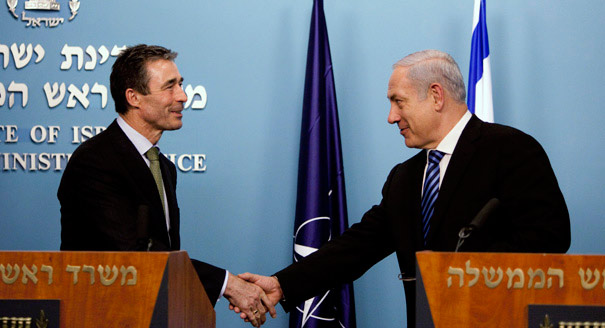
After President Obama’s visit to Jerusalem last month, there were high hopes in Washington and NATO for a turning point in relations between Israel and Turkey.
Source: New York Times
After President Barack Obama’s visit to Jerusalem last month, there were high hopes in Washington and NATO for a turning point in relations between Israel and Turkey.
Mr. Obama had persuaded Prime Minister Benjamin Netanyahu to apologize to Turkey for the episode aboard the Mavi Marmara in May 2010. The organizers of the aid ship had wanted to break Israel’s naval blockade of the Gaza Strip. Israeli marines boarded the ship while still in international waters, killing nine people — eight Turks and an American of Turkish descent.
The United States hoped that the apology would end the freeze in Israeli-Turkish relations, especially since both share a border with Syria and a stake in the outcome of the civil war there. Both are also important U.S. allies.To general disappointment in Washington and Brussels, Israel’s gesture has produced few positive results from Turkey.
“This is a headache Washington wanted cleared away,” said Hay Eytan Cohen Yanarocak, an expert on Turkey with the Moshe Dayan Center at Tel Aviv University. “Washington needs Israel and Turkey to cooperate, especially over security issues.”
NATO also believed the apology would give new life to the Mediterranean Dialogue, the attempt by NATO during the mid-1990s to facilitate security and political cooperation between several North African and Middle Eastern countries, including Israel.
Despite reluctance by some Middle Eastern countries to sit at the same table with Israel, NATO managed to host two meetings among foreign ministers of the Mediterranean Dialogue countries. The last was in 2008, shortly before Israel launched its assault on the Hamas leadership in the Gaza Strip. Since then, Turkey, to the annoyance of the United States, has prevented NATO from forging closer ties with Israel.
Recep Tayyip Erdogan, the Turkish prime minister, quashed alliance plans to host a gathering of Mediterranean Dialogue foreign ministers last week in Brussels, where NATO foreign ministers were meeting.
“While the atmospherics are somewhat better, we haven’t seen changes of substance,” one NATO diplomat said, speaking on the condition of anonymity because she was not authorized to discuss the issue.
Turkey also said it would not re-establish full diplomatic relations with Israel until the issue of compensating the victims’ families was settled and Israel lifted its blockade of the Gaza Strip.
“What we hear informally is that once the compensation issue is resolved, we can expect an improvement in the overall approach toward Israel,” the NATO diplomat added.
But will it?
Analysts cannot see a return to the 1990s, when Israel and Turkey shared intelligence and cooperated on military matters and Israel could use Turkish airspace for training and reconnaissance.
“There is no going back to the 1990s,” said Ozgur Unluhisarcikli, director of the Ankara office for the German Marshall Fund of the United States. “Too much has changed.”
During the 1990s, because of the Oslo peace accords between Israel and the Palestinians, Israel could use its good relations with the European Union to support Turkey’s ambitions to open accession talks with the bloc.
Similarly, as a leading NATO member, Turkey was prepared to support the U.S.-led military alliance forging closer ties to Israel.
Circumstances have since changed markedly. Israel is less useful to Turkey in the European Union. The paralysis over resolving the Palestinian conflict and Israel’s continuing settlement policy have hardened the bloc’s attitude toward Israel.
Turkey is also less useful to Israel in NATO because of Mr. Erdogan’s policies. Since his Justice and Development Party was elected in 2002, Mr. Erdogan has wanted Turkey to become a major regional player, competing with Egypt for regional pre-eminence.
To achieve this, Turkey, a non-Arab country, reached out to its Arab neighbors, especially the Palestinians. Previous Turkish governments, in contrast, had focused on building a strong relationship with Israel.
Yet regional experts say that even if there is no going back to the 1990s, it is in the interests of Israel and Turkey to reach a new understanding.
“The turmoil in the region surely means that Turkey needs relative stability on its borders and regional cooperation,” said Ian Lesser, an expert on Turkey and director of the Brussels office of the German Marshall Fund. That includes Israel.”
Israel needs Turkey for secure borders that will keep weapons from reaching Hamas or the Shiite militant group Hezbollah in Lebanon. No wonder, then, that the United States and NATO will keep pushing both countries to improve their relations.
“A modus vivendi between Israel and Turkey will have to be found,” said Mr. Cohen Yanarocak of Tel Aviv University. “But it will be no honeymoon. Those times are over.”
This article was originally published in the New York Times.

Nonresident Senior Fellow, Carnegie Europe
Judy Dempsey is a nonresident senior fellow at Carnegie Europe
Recent Work
Judy Dempsey
Judy Dempsey
Carnegie does not take institutional positions on public policy issues; the views represented herein are those of the author(s) and do not necessarily reflect the views of Carnegie, its staff, or its trustees.

Radical-right parties are expected to do well in upcoming elections in four of the EU's biggest member states. If successful, they could prevent the union from addressing key challenges ahead.

Stefan Lehne

The aftermath of the Ceuta crisis shows Europe has drawn the wrong lessons. Rather than doubling down on failed migration policies, the EU needs to address the underlying roots of such episodes.

Richard Youngs

An overwhelming victory by a far-right-wing party in a small state in eastern Germany will have major repercussions for Chancellor Friedrich Merz’s coalition.
Judy Dempsey

Canadian Prime Minister Mark Carney has twice inspired praise for standing up to U.S. President Donald Trump: at the 2026 World Economic Forum in Davos and on Canada-U.S. trade negotiations. Is Carney showing a third way better than the EU has in dealing with the Trump administration?

Rym Momtaz, ed.

The EU’s responses to two recent incidents expose the gulf between European perceptions and capabilities. Unless the union can bridge that gap, it will never become a real geostrategic power.
Rym Momtaz