

Commentary
- +1
Paul Haenle, Xue Gong, Ngeow Chow Bing, …
{
  "authors": [
    "Paul Haenle"
  ],
  "type": "legacyinthemedia",
  "centerAffiliationAll": "",
  "centers": [
    "Carnegie Endowment for International Peace",
    "Carnegie China"
  ],
  "collections": [
    "U.S.-China Relations",
    "China’s Foreign Relations"
  ],
  "englishNewsletterAll": "",
  "nonEnglishNewsletterAll": "",
  "primaryCenter": "Carnegie China",
  "programAffiliation": "",
  "programs": [],
  "projects": [],
  "regions": [
    "North America",
    "United States",
    "East Asia",
    "South Korea",
    "China",
    "North Korea"
  ],
  "topics": [
    "Security",
    "Arms Control",
    "Economy",
    "Nuclear Policy",
    "Foreign Policy"
  ]
}
Source: Getty
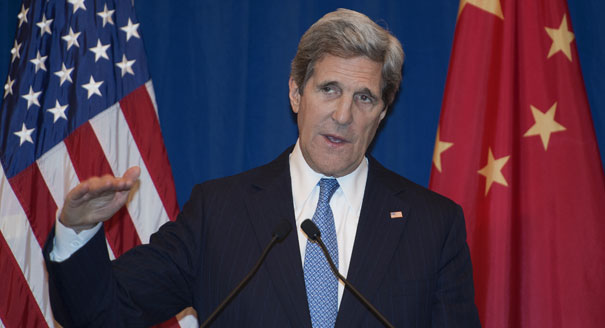
U.S. Secretary of State John Kerry’s first visit to China will likely see a focus on security on the Korean peninsula, the Trans-Pacific Partnership agreement, and cyber security.
Source: China Radio International
Speaking to China Radio International, Carnegie’s Paul Haenle detailed the strengths and agenda of the new U.S. Secretary of State, John Kerry. Haenle explained that throughout Kerry’s time on the Senate Committee on Foreign Relations, he showed a great commitment and interest in China. Now that he is Secretary of State, it is unlikely that the U.S. policy of rebalancing toward to Asia will change. Haenle stressed that this policy is not hostile or hardline and in fact is designed to facilitate cooperation and collaboration between both countries.
Haenle then turned to some of the individual issues likely to be raised during Kerry’s visit. Haenle stated that the United States is taking the threats coming from North Korea more seriously. He said that the “United States should be looking for opportunities, as the policy shifts in China, to find areas where China and the United States, South Korea, and Japan and the other members of the Six Party Talks can work together to bring stability to the region”. Haenle also clarified the nature of the Trans-Pacific Partnership and its origins and indicated that it would be beneficial for all if China would join. Cyber security is another area of tension between China and the United States, he added, but the nascent nature of this threat means there is greater scope for all major powers to work together to contain it.

Former Maurice R. Greenberg Director’s Chair, Carnegie China
Paul Haenle held the Maurice R. Greenberg Director’s Chair at the Carnegie Endowment for International Peace and is a visiting senior research fellow at the East Asian Institute, National University of Singapore. He served as the White House China director on the National Security Council staffs of former presidents George W. Bush and Barack Obama.
Recent Work


Paul Haenle, Xue Gong, Ngeow Chow Bing, …

Paul Haenle, Chong Ja Ian
Carnegie does not take institutional positions on public policy issues; the views represented herein are those of the author(s) and do not necessarily reflect the views of Carnegie, its staff, or its trustees.

European NATO countries are wrestling with the possibility of U.S. disengagement from the alliance. With the continent’s security increasingly uncertain, governments must restore the credibility of their collective defense.



Hans-Dieter Lucas, Adam Thomson, Pierre Vimont

The domestic impacts of how long it is taking to end the war in Ukraine have pushed the French electorate to the political extremes and compromised the country’s diplomatic capacity.

Rym Momtaz

The new U.S.–Denmark–Greenland agreement will help Washington exert political, economic, and financial dominance under the guise of security. Yet, it acknowledged Copenhagen’s and Nuuk’s sovereignty on the island.

Marc Pierini

A summer of escalation in the Black Sea has hurt Ukraine economically and is exacerbating world food security. A truce is needed—as is a broader reframing of Europe’s Ukraine strategy.

Thomas de Waal

Are Germany’s economic, industrial, and political struggles becoming a liability for the EU’s ability to rise to the geopolitical moment?
Rym Momtaz, ed.