

Commentary
Funding Ukraine remains a priority for European leaders. As Russia’s war of aggression heads into another winter, two feasible options to mobilize support for Kyiv should be fast-tracked.
Vladyslav Rashkovan, Gregory P. Wilson
{
  "authors": [
    "Pavel Koshkin",
    "Dmitri Trenin"
  ],
  "type": "legacyinthemedia",
  "centerAffiliationAll": "dc",
  "centers": [
    "Carnegie Endowment for International Peace",
    "Carnegie Russia Eurasia Center"
  ],
  "collections": [],
  "englishNewsletterAll": "ctw",
  "nonEnglishNewsletterAll": "",
  "primaryCenter": "Carnegie Russia Eurasia Center",
  "programAffiliation": "russia",
  "programs": [
    "Russia and Eurasia"
  ],
  "projects": [],
  "regions": [
    "Russia",
    "Eastern Europe",
    "Ukraine",
    "Western Europe"
  ],
  "topics": [
    "Political Reform",
    "Economy",
    "Foreign Policy"
  ]
}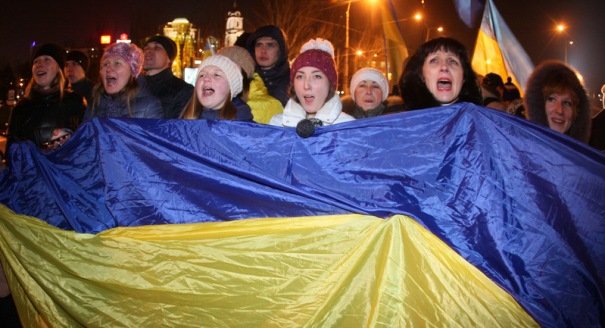
Source: Getty
If Europe decides to venture into Ukraine, then it should seriously invest in Ukraine, economically, financially, and politically. As for Russia, it would be better off to continue its policy of non-interference that it is officially maintaining now.
Source: Russia Direct
Amidst growing uncertainty about the future of Ukraine, Russia Direct sat down with Dmitri Trenin, Director of the Carnegie Moscow Center, to discuss the implications of the Ukrainian unrest for Russia’s relations with the EU and the U.S. Trenin offers a forecast for the future and suggests some general lessons that all sides should take into account while making decisions about Ukraine.
D.T.: Every side will put forward its own conditions. The protesters may submit specific conditions such as stopping [criminal] prosecution against some protesters and Maidan activists or rescheduling presidential elections for an earlier date. The government may seek some guarantees for the Ukrainian president and some close persons from his team in the case of victory of another candidate in the upcoming elections. Both sides, too, might consider new conditions in the case of [imprisoned] Yulia Timoshenko, Ukraine’s former prime minister.
D.T.: It’s very difficult and impossible to predict because the situation is rapidly changing and unpredictable in principle. For Russia, it’s very important to keep calm and not to meddle in Ukraine’s affairs in this situation, despite the fact that Europe is interfering and the U.S. has its [political] presence.
Russia’s interference would be very harmful to Russia itself. Probably, Moscow should do what it is asked to do by its high-level government leaders. In short, Moscow should see the events [in Kiev] as Ukraine’s domestic issue and accept the choice of the Ukrainian people. We shouldn’t satisfy ourselves with the idea that Maidan brought together only a portion of Ukraine’s 45 million people, we shouldn’t appease ourselves that Ukraine’s elite is being manipulated by the United States and Europe. We should sensibly take into account that the majority of the Ukrainian elite is not aiming at integration with Russia, that most Ukrainians are also oriented to the European Union, and only a minor part of the Ukrainian people seeks closer ties with Russia.
D.T.: I would say that Russia has shown clearly to Ukraine what the consequences of the formation of a free trade zone with Europe will bring about. But, at the same time, Moscow offered Ukraine such a package of [economic and political] aid that nobody else has been able to offer.
D.T.: There is some basis in this opinion. If the crisis in Ukraine will turn into a battle for Ukraine, it will result in a confrontation between Russia, the U.S. and EU, and determine the future of their relations.
D.T.: It’s not clear because it is not obvious how the major participants of [the crisis] will act. Currently, it is growing tensions, cutthroat competition, and mutual irritation. So, what will happen tomorrow is difficult to predict.
D.T.: I don’t agree with this opinion. One can believe in this opinion and it is very convenient to believe in it, yet at the same time, one should be mindful about grave mistakes that may result from such an approach. A mistake in assessing the situation will bring about mistakes in making decisions.
D.T.: The United States under Barack Obama’s administration is paying much less attention to Europe than any other U.S. administration dating back to the era of Franklin Delano Roosevelt. And Europeans, by the way, don’t like this. Washington thinks that the problem of Eastern Europe - including Ukraine - is a problem that should be addressed by the European Union.
Although this year the U.S. has already seen for itself this situation is complicated and may develop unfavorably, the U.S. allows the EU to play the leading role in this issue. And it is not for the first time. Leading from behind is typical for the Obama Administration, which means “We will keep track and supervise, but remain in the background.” And the “leading-from-behind” strategy in the case of Ukraine is just like in other regions where there is no threat for key American interests.
So, the opinion that the U.S. is orchestrating the unrest is fallacious and it may result in a wrong assessment of the situation. Historically, when the United States saw all actions against regimes and governments that were friendly toward them as actions orchestrated by Moscow, this thinking led the U.S. to the defeat in Vietnam and serious setbacks in Latin America. If Russian authorities would like to repeat this experience, they can do it easily.
D.T.: It can affect the relationship if the situation becomes deadlocked, or if there will be serious conflict between Russia and the EU. So far, we don’t see it, we see mutual irritation, direct criticism, but that’s all.
D.T.: Let’s assume that Ukraine is included in the Customs Union. In this case, there will be many more people in Ukraine who will stand against not only Yanukovich, but also against Moscow and Russia’s imperialism. Let’s assume that Ukraine will indeed be part of Russia’s economic, political and military zone. This will create a serious hotbed of anti-Russian sentiment within this zone which will seek national independence for Ukraine from Russia’s dominance and Moscow will have to deal with this.
D.T.: Europe should keep the promises which it gives to other countries. If it decides to venture into Ukraine, then it should seriously invest in Ukraine, economically, financially and politically. Even though it is very serious, long, difficult and very expensive, Europe should take responsibility. And this is the lesson. Russia would be better off to continue its policy of non-interference that it is officially maintaining now.
It should keep track of the events and stick to its statement that it will accept the choice of the Ukrainian people but that it will also act depending on the outcome. If it is necessary to support Russia’s economic partners that might lose something as a result of Ukraine’s accession to the EU free trade zone, then Russia should defend these interests within the framework of the WTO (World Trade Organization). At the same time, such a policy shouldn’t turn into the punishment of Ukraine. Russia should keep in mind that it is stronger without Ukraine. With Ukraine, it will be weaker.
Pavel Koshkin
Former Director, Carnegie Moscow Center
Trenin was director of the Carnegie Moscow Center from 2008 to early 2022.
Carnegie does not take institutional positions on public policy issues; the views represented herein are those of the author(s) and do not necessarily reflect the views of Carnegie, its staff, or its trustees.

Funding Ukraine remains a priority for European leaders. As Russia’s war of aggression heads into another winter, two feasible options to mobilize support for Kyiv should be fast-tracked.


Vladyslav Rashkovan, Gregory P. Wilson

While the EU and European governments are embracing the much-lauded middle-power moment, this entails three difficult conundrums.

Richard Youngs

Europe is facing rising populism internally as well as external pressures from Russia, China, Turkey, and the United States.

Dimitar Bechev

A notable degree of participative democracy has firmly arrived in Europe. But to have more far-reaching impact, democratic deliberation needs to move into a radically new phase.
Richard Youngs

Much has been said of the changes Brussels is trying to make to the EU enlargement process. Here’s why gradual integration might—or might not—be the answer.
Dimitar Bechev