

Commentary
Judy Dempsey
{
  "authors": [
    "Judy Dempsey"
  ],
  "type": "commentary",
  "blog": "Strategic Europe",
  "centerAffiliationAll": "",
  "centers": [
    "Carnegie Endowment for International Peace",
    "Carnegie Europe"
  ],
  "collections": [
    "Turkey’s Transformation"
  ],
  "englishNewsletterAll": "",
  "nonEnglishNewsletterAll": "",
  "primaryCenter": "Carnegie Europe",
  "programAffiliation": "",
  "programs": [],
  "projects": [],
  "regions": [
    "Middle East",
    "Europe",
    "Türkiye",
    "Syria"
  ],
  "topics": [
    "Security",
    "Foreign Policy"
  ]
}
Source: Getty
Every week leading experts answer a new question from Judy Dempsey on the foreign and security policy challenges shaping Europe’s role in the world.
Every week leading experts answer a new question from Judy Dempsey on the foreign and security policy challenges shaping Europe’s role in the world.
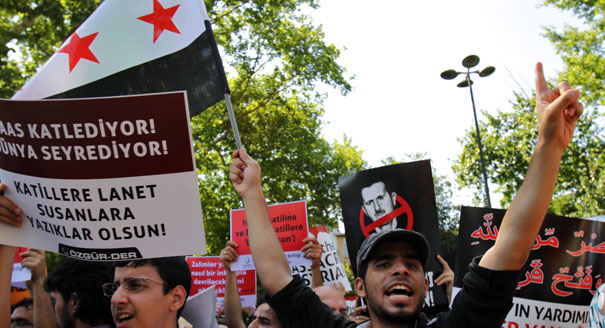
Last weekend’s car bombs in the Turkish town of Reyhanlı, near the Syrian border, were one of the country’s deadliest attacks in decades. Amid the increasing regional spillover from the Syrian conflict, our experts assess whether Turkey can survive the ongoing crisis.
The answer to this question hinges on whether the Syrian conflict remains Syrian, or whether it becomes part of a larger narrative linking the corrupt and ineffective regimes of the greater Arab nation to an illegitimate regional order. That order has its roots in the French and British mandates of the period following the First World War and the partitioning of the Ottoman Empire.
If, in the minds of Arabs across the region, the conflict remains largely an internal Syrian affair, Turkey is well positioned to ride out the storm and contend with any military eventualities. If, however, opposition to President Assad’s regime is cast as part of a wider effort to establish a new political order for the Arab nation, others are likely to raise similar demands. Once the sanctity of existing borders is no longer taken for granted, what reason is there to deny the Kurds their own state?
The greatest threat to Turkish integrity is thus the future ideological development of the crisis—rather than any military or humanitarian escalation.
The Syrian conflict is spilling over into Turkey, as shown by the recent Reyhanlı bombings. That much I know. For some more in-depth analysis, I asked my ECFR colleague and Turkey expert Dimitar Bechev for his take. This is what he told me:
The turmoil in Syria and the wider Middle East is forcing Turkey to recalibrate its foreign policy. Before the Arab awakening, Turkey was pursuing a distinctly unilateralist course in its ambition to be a power center, projecting influence over several distinct neighborhoods (primarily the Middle East, but also the Balkans, North Africa, the Southern Caucasus, and further afield).
But now Turkey is pivoting back to the Western alliance, as evidenced by the deployment of Patriot missiles along its 900 km (560 mile) long border with Syria. The key reason is the growing instability south of Turkey’s borders, especially in Syria, where the civil war has gone from bad to worse. Neither side has an immediate prospect of victory.
The conflict might spill over into neighboring Iraq, Lebanon, or Jordan, putting yet more pressure on Ankara. In his upcoming meeting with U.S. President Obama, Turkish Prime Minister Erdoğan will be compelled to put more pressure on the United States to act more forcefully, although Obama is unlikely to stray from the current withdrawn U.S. policy.
Turkey is also working to secure a lasting settlement of the Kurdish issue. That would bolster Turkey’s role in the region—in relation to both the energy-rich Kurdistan Regional Government in Northern Iraq and a possible Kurdish entity in post-Assad Syria.
Diplomatic sources are terribly worried about the current strains in Turkey. Dogged by terrorism, old and new tensions, and a lack of strategy, the country is a constant pendulum, not just between Asia and Europe, but also between openness and intolerance.
The EU made a blunder of historic proportions by giving Turkey the cold shoulder. U.S. political scientist Samuel Huntington was wrong in predicting the coming of a “clash of civilizations” between “us” and “them.” Since the Cold War we have been living in a world of “us” against “us” and “them” against “them.” Sunnis are Shias’ worse enemies, and vice versa. Liberal Muslims fight Salafists, and Muslim Brotherhood’s real adversary is not the West but the progressive computer whiz kid in Cairo.
Turkey faces a crucial dilemma: which side to take in the coming intercultural civil war. Europe should have engaged Turkey with vision and generosity. Instead, the West ignored Constantinople—again. That was a big mistake.
The short answer to this question is “no.”
Since a resolution to the ongoing civil war is not in sight, the priorities now are crisis management and damage control. The recent terror attacks in Reyhanlı are a sad reminder (not the first one, and most likely not the last) that the conflict cannot be confined to Syria.
All of Syria’s neighbors will have to deal with the political and the sectarian spillover of the Syrian crisis. First and foremost that means Jordan and Lebanon, which have to shoulder the heavy burden of hosting an increasing number of refugees.
But Turkey is deeply involved, too. Against the backdrop of the latest attack and Prime Minister Erdoğan’s need to send a message of reassurance to his own people, one can understand his statement that “Turkey would not be drawn into its southern neighbor’s civil war.”
But the truth is that Turkey has already been drawn into the Syrian quagmire, so how can Erdoğan make promises that he can’t keep? Since geography is destiny, Turkey is “doomed” to live with the repercussions of the Syrian conflict as long as it goes on, as well as with its messy outcome once it’s over.
In that light, Turkish Foreign Minister Ahmet Davutoğlu’s dream of “zero problems with our neighbors” and 100 percent stability along the Syrian border will remain unfulfilled.
Last Saturday’s car bombs in the Turkish town of Reyhanlı mark a new chapter in the Syrian conflict and illustrates its potential for regional contagion. The Turkish authorities have been quick to hold the Syrian regime responsible. But the attacks have also laid bare the risks for Turkey of its aggressive policy on Syria. It is no surprise that many Turks are now blaming the government for having entangled Turkey in this deadly conflict.
At the same time, public pressure is mounting for a retaliation against Syria. Last week’s strike against Damascus, allegedly by Israel, is increasingly cited by an angry Turkish public as an example of how Turkey needs to respond.
So far, despite its stalwart opposition to the Syrian regime, Ankara has refused to act unilaterally. Yet this time around, the Turkish government stated that it will exact revenge from the perpetrators of this terrorist act. Turkey’s reaction is likely to be a combination of tactical and political approaches.
At the tactical level, Ankara may give the green light to a special operation targeting those behind this attack. When a car bomb exploded at the Turkish-Syrian border a month ago, Turkish special forces went deep into Syria to bring the culprits back to Turkey. A similar operation could be staged, if for no other reason than to placate public opinion.
Ankara will also seek support for its demands for regime change in Syria. In Washington, Prime Minister Erdoğan will press President Obama for a more interventionist U.S. policy to combine the supply of arms to the opposition with the establishment and enforcement of a no-fly zone.
Of course Turkey can withstand the Syrian conflict.
Turkey is a strong NATO member with a robust military and a vibrant economy. It will be fine. The recent bomb blasts in Reyhanlı are tragic and—if indeed Syrian President Assad’s regime was behind them—an affront to Turkish sovereignty. But they do not alter the picture strategically. A more serious attack on Turkey would be met by an overwhelming response, and is therefore highly unlikely. Syrian refugees are an enormous burden on Turkey, but that will ease if Assad is deposed.
The real question is whether Syria can withstand the Syrian conflict. With Iran, Russia, Hezbollah, and others all working hard to prop up Assad—and the United States and Europe on the sidelines—the two most likely outcomes appear to be the two most catastrophic: the regime’s survival (with further killing and torture); or fragmentation of the country into warring groups.
The best outcome is a new government that is tolerant, inclusive, and capable of keeping Syria together. That can only come about if the international community makes a much more concerted effort. This means creating a no-fly zone and a safe zone inside Syria (using airpower and missile defenses as necessary), arming the most responsible opposition forces, pushing for political cohesion among the opposition, and encouraging outreach to post-Assad Shia communities.
Only by increasing pressure on Assad to depart can the international community help to save Syria and end the bloodshed.

Nonresident Senior Fellow, Carnegie Europe
Judy Dempsey is a nonresident senior fellow at Carnegie Europe
Recent Work
Judy Dempsey
Judy Dempsey
Carnegie does not take institutional positions on public policy issues; the views represented herein are those of the author(s) and do not necessarily reflect the views of Carnegie, its staff, or its trustees.
Defense tech innovations will be at the heart of Europe’s new security strategy. But so far, Brussels has been making moves without a broader plan, undermining readiness and credibility.

Raluca Csernatoni

When the U.S.-Iran memorandum of understanding was announced, the UK, France, Germany, and Italy declared their readiness to help demine the Strait of Hormuz and lift nuclear sanctions on Tehran. But does Europe need new tools to recover a diplomatic role?

Rym Momtaz, ed.
The Franco-German relationship is on the rocks again. But unlike previous moments of tension, the epochal changes on the world stage require that both step up investment in their bilateral ties.
Rym Momtaz
The EU is putting together a new security strategy to meet today’s myriad challenges. But for any proposal to be effective, the union needs to grapple with its identity and ambitions.

Pierre Vimont

The EU’s new migration policy is not suited to today’s realities. With climate change increasingly becoming a driver of displacement, Europe needs to rethink its deterrence-focused approach.

Shana Tabak