

Commentary
Judy Dempsey
{
  "authors": [
    "Judy Dempsey"
  ],
  "type": "commentary",
  "blog": "Strategic Europe",
  "centerAffiliationAll": "",
  "centers": [
    "Carnegie Endowment for International Peace",
    "Carnegie Europe"
  ],
  "collections": [],
  "englishNewsletterAll": "",
  "nonEnglishNewsletterAll": "",
  "primaryCenter": "Carnegie Europe",
  "programAffiliation": "",
  "programs": [],
  "projects": [],
  "regions": [
    "Eastern Europe",
    "South Asia",
    "Afghanistan",
    "Russia",
    "Ukraine",
    "Western Europe",
    "Europe"
  ],
  "topics": [
    "Security",
    "Military",
    "Foreign Policy",
    "EU"
  ]
}
Source: Getty
The ongoing turmoil in Ukraine is shifting European and American attitudes toward Moscow. The West is perceiving the Ukrainian crisis through the prism of Russia.
Since becoming NATO secretary general in 2009, Anders Fogh Rasmussen has spent much of his time dealing with two big issues: the alliance’s big mission in Afghanistan, and the question of how to persuade NATO countries that they share the same threats.
So it was expected that during a panel discussion at this year’s Munich Security Conference entitled “Global Power and Regional Security,” Rasmussen would dwell on NATO’s future after its combat mission in Afghanistan ends later this year.
Instead, Rasmussen, a former Danish prime minister, surprised the summit’s participants by focusing his short and pithy speech mostly on Russia. The fact that he was unusually critical of Russia showed how the ongoing crisis engulfing Ukraine is fundamentally changing EU and U.S. attitudes toward the Kremlin. The West is perceiving that crisis through the prism of Russia.
For Rasmussen, NATO and Russia faced a clear choice in their relationship. They could either “accept cold cooperation” or “aim for a constructive engagement [by] moving forward towards the strategic partnership which offers the common security we seek.”
While citing several positive aspects of NATO-Russian ties, Rasmussen pulled no punches about what Russia was doing in its neighborhood.
“I get concerned when I hear talk of [Russia] deploying offensive—not defensive, but offensive—weapons systems. Such as fighter detachments to Belarus, Iskander missiles to Kaliningrad, or more military forces to the Arctic,” Rasmussen said. “I get concerned when I hear our missile defence system consistently—and falsely—described as offensive by Russia. And I get concerned when I hear that Russia views NATO’s Open Door policy as a threat like international terrorism.”
Turning to Ukraine, Rasmussen spoke plainly. “Ukraine must have the freedom to choose its own path without external pressure.”
Speaking during the same debate, Herman Van Rompuy, the president of the European Council, said Ukraine’s choice was clear. “The future of Ukraine belongs in the European Union,” he told the audience.
The German foreign minister, Frank-Walter Steinmeier, was much more cautious about criticizing Russia. “It is up to Moscow to see and to define what [Russia] has in common with Europe and state this publicly,” Steinmeier said.
During his first stint as foreign minister between 2005 and 2009, Steinmeier rarely criticized the Kremlin’s violations of human rights and the widespread corruption. Since returning to the foreign ministry in late 2013, he has had to weigh up his support for the Ukrainian opposition, on the one hand, and his relations with Russia, on the other.
Many EU member states, especially in Eastern Europe and the Baltics, are wondering what kind of long-term policy German Chancellor Angela Merkel’s coalition of conservatives and Social Democrats will pursue with Russia—and indeed Ukraine. Her government’s policies will inevitably influence Europe’s overall strategy toward Russia.
However, Javier Solana, the EU’s former foreign policy chief, believes that time is on no one’s side. Speaking to Carnegie Europe, he said that the crisis in Ukraine had become so dangerous that some kind of transitional government was necessary before next year’s presidential elections.
Furthermore, he added, because Ukraine is such a geostrategic issue for Russia and, increasingly, for Europe, maybe the EU, the United States, and Russia should consider a mediating role in the Ukrainian crisis.
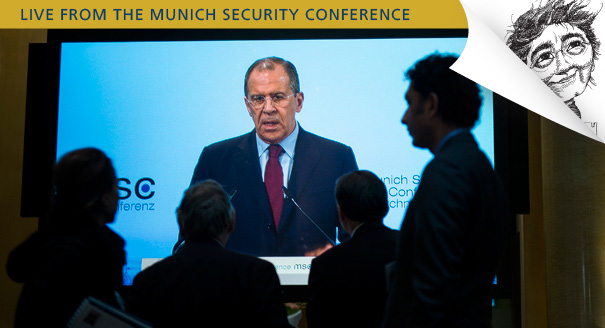
Back in the conference hall, during the speeches by Rasmussen, Van Rompuy, and Steinmeier, Russian Foreign Minister Sergei Lavrov sat stone-faced throughout. When he had his chance to address the participants, he gave a long and haranguing monologue. He said that the Europeans and the United States were “imposing a choice” on Ukraine. But when asked about Russia’s own policies toward Ukraine, he said he had forgotten the question.

Nonresident Senior Fellow, Carnegie Europe
Judy Dempsey is a nonresident senior fellow at Carnegie Europe
Recent Work
Judy Dempsey
Judy Dempsey
Carnegie does not take institutional positions on public policy issues; the views represented herein are those of the author(s) and do not necessarily reflect the views of Carnegie, its staff, or its trustees.

As we close out another season of Strategic Europe, it is worth taking stock of the deep shifts underway.

Rym Momtaz
The EU had to compromise to adopt a twenty-first sanctions package against Russia, exposing growing cracks in the union’s resolve. Is this latest, weaker round worth it to keep pressure on Moscow?
Rym Momtaz, ed.

Trump is distracted and Ukraine wants Europe to step up. The continent’s leaders must find their voice and assert it in talks with Russia.

Alissa de Carbonnel

Mounting economic strain and battlefield losses will not necessarily make the Kremlin less dangerous. They could instead push Moscow toward a more aggressive hybrid campaign designed to test NATO’s Eastern flank, exploit allied hesitation, and fracture European resolve.

Maksym Beznosiuk

Over the past ten years, NATO has held almost as many summits as it did during the entirety of the Cold War. Are they still useful, or is it time to stop holding annual meetings?
Rym Momtaz, ed.