

Commentary
Judy Dempsey
{
  "authors": [
    "Judy Dempsey"
  ],
  "type": "commentary",
  "blog": "Strategic Europe",
  "centerAffiliationAll": "",
  "centers": [
    "Carnegie Endowment for International Peace",
    "Carnegie Europe"
  ],
  "collections": [],
  "englishNewsletterAll": "",
  "nonEnglishNewsletterAll": "",
  "primaryCenter": "Carnegie Europe",
  "programAffiliation": "",
  "programs": [],
  "projects": [],
  "regions": [
    "Eastern Europe",
    "Central Asia",
    "Kazakhstan",
    "Caucasus",
    "Russia",
    "Georgia",
    "Ukraine",
    "Western Europe",
    "Moldova",
    "Europe",
    "Asia"
  ],
  "topics": [
    "Democracy",
    "Foreign Policy",
    "EU",
    "Civil Society"
  ]
}
Source: Getty
In the struggle between the EU and Russia over Eastern Europe, Brussels needs to clarify its long-term objectives. Is EU membership an option for its Eastern neighbors or not?
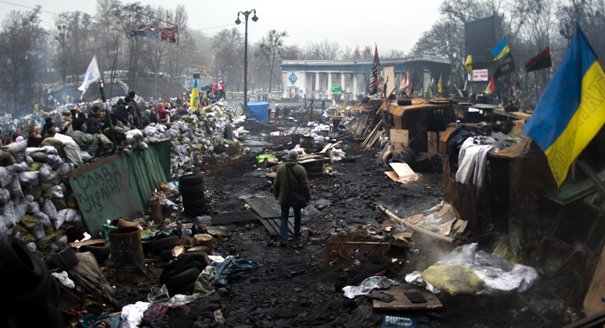
The continuing crisis in Ukraine means that the EU can no longer continue doing business as usual. The U.S. administration has criticized the EU for not giving more support to Ukraine’s antigovernment protests and for not retaliating against Russia’s bullying tactics in former Soviet countries.
Yet the tug-of-war between Ukrainian President Viktor Yanukovych and pro-Western demonstrators presents a great opportunity for the EU. Now is the time for the EU to start selling itself, not just in Ukraine but also in Georgia and Moldova, two other countries of the EU’s Eastern Partnership initiative. And the EU can no longer avoid the issue of Eastern enlargement.
At a summit last November in Vilnius, Georgia and Moldova initialed trade and association agreements with the EU, while other Eastern Partnership countries—Armenia, Azerbaijan, and Ukraine—rejected the offers. Georgia and Moldova are scheduled to sign the accords later this year.
But there is great concern that Russia may try to use this interim period to thwart the signing of the agreements. The EU could easily be caught napping, as it was during the run-up to the Vilnius summit. On that occasion, EU officials said they had no idea how damaging Moscow’s embargo on certain Ukrainian exports to Russia was for Ukraine’s economy. What on earth were EU diplomats doing in Kiev—or, indeed, in Brussels?
Now, Poland and Sweden, the two EU member states that spearheaded the Eastern Partnership, are attempting to force the EU’s hand over Georgia and Moldova. Swedish Foreign Minister Carl Bildt and his Polish counterpart, Radek Sikorski, have concluded that the EU’s policy toward the region needs a radical overhaul if the bloc wants to avoid the mistakes it made in Ukraine.
In early February, the two ministers presented papers on the Eastern neighborhood to their EU counterparts. Their message was clear: the EU must go on the offensive in Georgia and Moldova if it wants both countries to go through with signing the association agreements.
The Swedish document, entitled “20 Points on the Eastern Partnership Post-Vilnius,” proposes that the EU should embark on an intense public diplomacy campaign in Georgia, Moldova, and the other Eastern Partnership countries. The paper, already approved by a dozen other EU countries, pushes for a more open Europe that would allow student exchanges and greater opportunities for travel within the EU.
The text also explains how and why Brussels should “calibrate” its policies toward individual governments instead of pursuing a monolithic approach. The more each country reforms, the more access they would gain to EU programs and financial assistance.
The Polish paper looks at how EU funding should be increased and disbursed more quickly. It also argues that in the more repressive regimes, the EU should focus more on civil society. That is one of Poland’s main interests.
The two papers are important because they convey a sense of urgency. They call for the EU to act now, instead of spending months issuing tenders for communications experts to carry out public diplomacy, or shifting around funding for the EU’s Eastern neighbors.
On closer reading, the papers are also about countering possible Russian mischief. The two foreign ministers’ proposals—a combination of public diplomacy, more funds, a focus on concrete EU projects with a particular emphasis on civil society—are instruments aimed at opposing Moscow’s influence.
The Swedish document in particular suggests that the EU should not be afraid of comparing its own value-bound community with Russia’s customs union, which also includes Belarus and Kazakhstan.
As if to highlight the opportunities of such an approach, Kazakhstan’s president, Nursultan Nazarbayev (who by no stretch of the imagination can be considered a democrat), recently went on a big campaign in Europe. During talks with EU and World Trade Organization officials, Nazarbayev made it clear that he wanted his country to become more independent from Russia. He even complained about restrictions that Moscow has imposed on Kazakhstan’s export policy as a result of the Russian-dominated customs union.
Yet for all the talk of a big offensive in Eastern Europe, the EU still ducks the hard questions: What is the EU’s goal in its Eastern neighborhood? Is EU membership a realistic prospect for the countries in the East? Or is the EU offering a special partnership that confers extensive trade and other rights but falls short of membership?
Sooner rather than later, EU governments will have to decide on their long-term relationship with Eastern Europe. It is clear that the Eastern Partnership countries will not embrace big reforms unless they have the perspective of membership. That, unfortunately, is the reality.

Nonresident Senior Fellow, Carnegie Europe
Judy Dempsey is a nonresident senior fellow at Carnegie Europe
Recent Work
Judy Dempsey
Judy Dempsey
Carnegie does not take institutional positions on public policy issues; the views represented herein are those of the author(s) and do not necessarily reflect the views of Carnegie, its staff, or its trustees.

A summer of escalation in the Black Sea has hurt Ukraine economically and is exacerbating world food security. A truce is needed—as is a broader reframing of Europe’s Ukraine strategy.

Thomas de Waal

Are Germany’s economic, industrial, and political struggles becoming a liability for the EU’s ability to rise to the geopolitical moment?

Rym Momtaz, ed.

European Commission President Ursula von der Leyen is about to give her annual address on the state of the EU. Here’s what she won’t—but should—say.
Rym Momtaz

The aftermath of the Ceuta crisis shows Europe has drawn the wrong lessons. Rather than doubling down on failed migration policies, the EU needs to address the underlying roots of such episodes.

Richard Youngs
An overwhelming victory by a far-right-wing party in a small state in eastern Germany will have major repercussions for Chancellor Friedrich Merz’s coalition.
Judy Dempsey