

Commentary
Nathalie Tocci, Jan Techau
{
  "authors": [
    "Jan Techau"
  ],
  "type": "commentary",
  "blog": "Strategic Europe",
  "centerAffiliationAll": "",
  "centers": [
    "Carnegie Endowment for International Peace",
    "Carnegie Europe"
  ],
  "collections": [],
  "englishNewsletterAll": "",
  "nonEnglishNewsletterAll": "",
  "primaryCenter": "Carnegie Europe",
  "programAffiliation": "",
  "programs": [],
  "projects": [],
  "regions": [
    "Eastern Europe",
    "Russia",
    "Ukraine",
    "Western Europe",
    "Europe"
  ],
  "topics": [
    "Political Reform",
    "Democracy",
    "Foreign Policy",
    "EU",
    "Security",
    "Civil Society"
  ]
}
Source: Getty
The EU committed a series of strategic blunders in the way it dealt with Ukraine. Europe’s leaders need to learn from those mistakes and avoid repeating them in the future.
The unfolding political catastrophe in Ukraine has led not only to a vivid debate about appropriate crisis management but also to deep European soul-searching about the root causes of the disaster.
The situation is complex, and no one actor deserves all the blame. But it is now clear that the EU made almost every strategic mistake possible in its handling of the Ukraine file. Europe’s leaders should examine those mistakes carefully to avoid making them again in the future.
Initially, the EU’s Eastern Partnership appeared to be moving in the right direction. Until late 2013, the EU had an interesting offer for Ukraine: a series of association and free-trade agreements that would grant the country access to Western money and markets.
The EU institutions made the project a priority and created an impression of political unity around it. Even the European Neighborhood Policy’s conceptual flaws, analyzed lucidly in a recent paper by Carnegie Europe’s Stefan Lehne, did not derail the undertaking. Everyone expected the Ukrainian government to sign the EU accords at a summit in Vilnius in November 2013.
But then everything fell apart.In their first mistake, Europeans completely misread their interlocutors’ motivations and interests. The EU failed to see that then president Viktor Yanukovych was not interested in developing Ukraine’s economy and modernizing its politics and society. All he was concerned about was his political survival. The EU’s tools, with their assumption that Ukraine would be willing to reform, were bound to be useless.
Even more disastrous was the EU’s misreading of Russia. In recent years, Russian President Vladimir Putin has talked about the Kremlin’s fears of Western encirclement. He has declared that EU and NATO enlargement are part of a conspiracy to destroy Russia, that Ukraine is not really a sovereign nation, and that Western agents provocateurs were behind Ukraine’s 2004–2005 Orange Revolution.
Amid all that rhetoric, the West failed to recognize that Putin was deadly serious. Such talk was dismissed either as cheap propaganda or as the mild lunacy of a handful of overideologized true believers. Nobody imagined that Putin himself really believed his own bluster.
But for the Russian president, the fight over Ukraine is not an imperialistic adventure, it is a fight for survival against a mortal Western enemy. Just because observers in the West know that’s nonsense, that doesn’t mean that others think the same. Such Western projections were finally debunked when German Chancellor Angela Merkel remarked to U.S. President Barack Obama on March 2 that Putin was “in another world.”
Putin is indeed acting within an alternative reality. That the West failed to grasp this, despite enormous diplomatic efforts and an array of forums, summits, and consultations, was probably its biggest strategic mistake.
As a consequence, the EU made its second error: it realized too late that it was in the middle of a geopolitical game. The EU brought a low-politics toolbox to a high-politics construction site. It believed, almost until the day of Yanukovych’s ouster, that the Ukraine dossier was merely a technical one that could be dealt with by experienced bureaucrats instead of senior politicians. That was never going to work.
Equally important was mistake number three, the EU’s failure to coordinate its approach in Europe’s East with the United States. To be fair, Washington was not particularly interested in yet another boring technical EU project, and it also woke up rather late to the geopolitical eminence of the Ukraine crisis.
But in its dealings with what Russia considers its own legitimate sphere of influence, the EU should never take any major steps without its most important ally firmly aligned. That might hurt the pride of some Europeans, but that kind of pride has never been a particularly helpful adviser. The Ukraine disaster must also be considered a momentous failure of the transatlantic relationship.
Blunder number four was the EU’s inability to commit itself to the Eastern neighborhood with full force. Despite a show of political unity before the Vilnius summit, most EU member states did not have their whole heart in the matter.
Germany came on board as a supporter of the EU’s Eastern Partnership, but had to be lured into doing so. The UK had lost all interest in EU foreign policy long ago and was afraid of a worsening of already strained relations with Moscow. Southern countries were reluctant as they feared a shift of focus away from the EU’s Southern neighborhood. Other members were too absorbed with domestic affairs and economic woes, or were just too small to be bothered.
And so a cornerstone of the EU’s external relations was never infused with enough political energy from the member states, the only real source of power in the EU system.
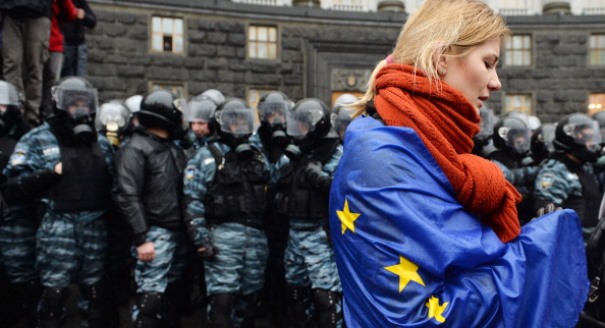
Finally, the EU’s fifth strategic shortcoming was to underestimate the attractiveness of its own model to millions of Ukrainians. So used to crisis talk, self-bashing, and Euroskepticism at home, Europeans could barely believe it when protesters in Kiev wrapped themselves in EU flags. Demonstrators were not only standing up to corruption and mismanagement but were also demanding a right to pursue their liberal, European dream.
It is certainly useful to be self-critical. But for the EU to be ignorant about its own core strengths and soft power was a grave strategic mistake.
None of these considerations will help the EU much in the immediate crisis management of the Crimean crisis and the standoff with Russia. But eventually, room for strategy will return to Europe’s Eastern neighborhood. The EU would do well to take a careful look at its own strategic mistakes to avoid repeating them when that moment comes.

Director, Europe Team, Eurasia Group
Techau is director with Eurasia Group's Europe team, covering Germany and European security from Berlin. Previously, he was director of Carnegie Europe.
Recent Work

Nathalie Tocci, Jan Techau
Jan Techau
Carnegie does not take institutional positions on public policy issues; the views represented herein are those of the author(s) and do not necessarily reflect the views of Carnegie, its staff, or its trustees.

Trump is distracted and Ukraine wants Europe to step up. The continent’s leaders must find their voice and assert it in talks with Russia.

Alissa de Carbonnel

Mounting economic strain and battlefield losses will not necessarily make the Kremlin less dangerous. They could instead push Moscow toward a more aggressive hybrid campaign designed to test NATO’s Eastern flank, exploit allied hesitation, and fracture European resolve.

Maksym Beznosiuk

Over the past ten years, NATO has held almost as many summits as it did during the entirety of the Cold War. Are they still useful, or is it time to stop holding annual meetings?

Rym Momtaz, ed.
Nearly a year and a half after Europeans leaned into sucking up to Trump, the strategy has produced some benefits when it comes to Ukraine.
Rym Momtaz
Far-right leader Marine Le Pen can—and will—run in France’s next presidential election. What does the outcome of her appeal against a 2025 embezzlement conviction mean for the country’s political future?

Catherine Fieschi