

Commentary
Judy Dempsey
{
  "authors": [
    "Judy Dempsey"
  ],
  "type": "commentary",
  "blog": "Strategic Europe",
  "centerAffiliationAll": "",
  "centers": [
    "Carnegie Endowment for International Peace",
    "Carnegie Europe"
  ],
  "collections": [],
  "englishNewsletterAll": "",
  "nonEnglishNewsletterAll": "",
  "primaryCenter": "Carnegie Europe",
  "programAffiliation": "",
  "programs": [],
  "projects": [],
  "regions": [
    "Eastern Europe",
    "Russia",
    "Ukraine",
    "Western Europe",
    "Europe"
  ],
  "topics": [
    "Democracy",
    "Security",
    "Military",
    "Foreign Policy",
    "EU"
  ]
}
Source: Getty
No matter how Ukraine’s interim government reacts to pro-Russian provocations and violence in the East of the country, Kiev’s actions will be exploited by the Kremlin.
Just days before U.S., EU, Ukrainian, and Russian diplomats meet in Geneva to discuss the crisis in Ukraine, pro-Russian militiamen are rushing to establish facts on the ground in Eastern parts of the country. Their actions are creating a hugely difficult dilemma for Kiev.
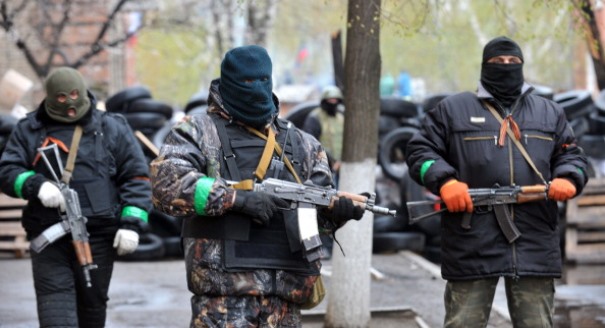
On April 12 in the towns of Sloviansk and Kramatorsk, close to the Russian border, well-armed pro-Russian gunmen seized government buildings and police stations. They also set up barricades in the towns, with little resistance from the local security forces.
The men then tore down the Ukrainian flag, hoisted the Russian one, and read out a declaration of independence, following the template of separatists in the Crimean peninsula. There is little doubt that the Kremlin is behind some of these militias as it tries to destabilize Ukraine before the country votes for a new president in May. “This instability was written and choreographed in and by Russia,” said Samantha Power, U.S. ambassador to the United Nations.
But by April 13, Ukrainian Interior Minister Arsen Avakov had clearly had enough. He deployed special forces under the command of the interior and defense ministries. The attacks in the country’s East were “a display of external aggression from Russia,” Avakov said.
Indeed, Russia has maneuvered its neighbor into a dangerous no-win situation. If the Ukrainian authorities had continued doing nothing, Russia would have accused them of failing to restore order and defend the Russian minority in Eastern Ukraine (as if Russians hadn’t provoked the violence in the first place). In that case, Russia might have engineered an “invitation” to enter Ukraine and protect the ethnic Russians.
Yet now that the Ukrainian government is trying to defend the country’s integrity and end the violence, Moscow will accuse Kiev of threatening or even attacking the ethnic Russians in Eastern Ukraine. Again, the next step could be for Russia to be “invited” to send help.
Russian Foreign Minister Sergei Lavrov is eager to exploit Kiev’s dilemma. “Ukraine was demonstrating its inability to take responsibility for the fate of the country,” he said. At the same time, Lavrov warned that any use of force against Russian speakers “would undermine the potential for cooperation,” including during the talks in Geneva, scheduled for April 17.
In parallel to its provocations on the ground, Russia has already mapped out its plans for Ukraine. It wants a federal model for the country. That would reduce the role of the central authorities and give the regions more autonomy in a way that Moscow could exploit at Kiev’s expense.
Russia also wants Ukraine to remain neutral, which would prevent the country from joining NATO. Russia, in short, is insisting on telling another country how it should be governed and what political direction it should take.
It is well known that several European countries, including Germany, do not want Ukraine to join NATO. Nevertheless, it is staggering and shameful to see how European countries are allowing Russia to set Ukraine’s security and political agenda.
NATO, for its part, has taken an unusually robust stance by openly criticizing the Kremlin. It has rushed to bolster the defenses of its Eastern European members, while also pledging to help train Ukraine’s armed forces.
Ukraine, NATO, and the EU do not want a military confrontation with Russia. But nor does Ukraine want to see further parts of its territory brought under Russian control. That is exactly what Ukraine’s acting President Oleksandr Turchynov said on April 13, when he stated that he would not allow a repetition of what happened in Crimea.
As it is, Ukraine and the West have ceded Crimea to Russia. That must surely have boosted Russian President Vladimir Putin’s confidence to try and grab further bits of Ukraine.
With Crimea signed away, the West has to find ways to defend the rest of Ukraine. As difficult as that may be and as much as European countries fear the cost of serious economic sanctions, there is no choice. Europe’s governments, already wobbly over Ukraine, cannot allow Russia to reshape borders as it wants. Ultimately, this is about Europe making a choice: defending democracy, security, and borders, or giving in to Putin’s brand of politics.

Nonresident Senior Fellow, Carnegie Europe
Judy Dempsey is a nonresident senior fellow at Carnegie Europe
Recent Work
Judy Dempsey
Judy Dempsey
Carnegie does not take institutional positions on public policy issues; the views represented herein are those of the author(s) and do not necessarily reflect the views of Carnegie, its staff, or its trustees.

Before the next wave of EU enlargement takes place, the union needs to grapple with thorny questions of how power is distributed among its members.


Emil Sondaj Hansen, Ditte Brasso Sørensen

A summer of escalation in the Black Sea has hurt Ukraine economically and is exacerbating world food security. A truce is needed—as is a broader reframing of Europe’s Ukraine strategy.

Thomas de Waal

Are Germany’s economic, industrial, and political struggles becoming a liability for the EU’s ability to rise to the geopolitical moment?

Rym Momtaz, ed.

European Commission President Ursula von der Leyen is about to give her annual address on the state of the EU. Here’s what she won’t—but should—say.
Rym Momtaz

The aftermath of the Ceuta crisis shows Europe has drawn the wrong lessons. Rather than doubling down on failed migration policies, the EU needs to address the underlying roots of such episodes.

Richard Youngs