

Commentary
Judy Dempsey
{
  "authors": [
    "Judy Dempsey"
  ],
  "type": "commentary",
  "blog": "Strategic Europe",
  "centerAffiliationAll": "",
  "centers": [
    "Carnegie Endowment for International Peace",
    "Carnegie Europe"
  ],
  "collections": [
    "Transatlantic Cooperation"
  ],
  "englishNewsletterAll": "",
  "nonEnglishNewsletterAll": "",
  "primaryCenter": "Carnegie Europe",
  "programAffiliation": "",
  "programs": [],
  "projects": [],
  "regions": [
    "Eastern Europe",
    "Western Europe",
    "Europe"
  ],
  "topics": [
    "Security",
    "Foreign Policy"
  ]
}
Source: Getty
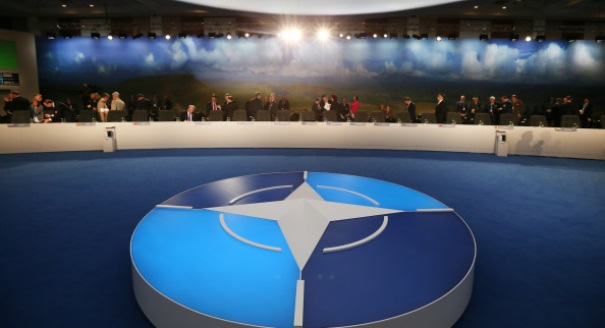
Last week’s NATO summit in Wales tried to be optimistic about the alliance’s future. But there is still no strategy for dealing with the Ukraine crisis or the Islamic State.
After international summits end, there is always a collective sigh of relief. So it was with the NATO meeting in Wales that ended on September 5.
All NATO leaders got something out of the Euro-Atlantic gathering, even if it wasn’t what they had wanted during the run-up to the summit. There were reassurances for NATO’s Eastern European members and promises of technical assistance to Ukraine and of closer cooperation with Georgia, Moldova, Montenegro, and Macedonia. And there were pledges from a group of allies to support Washington in dealing with the rapid advance of the Islamic State (IS).
Behind the headlines, the NATO summit established three fundamental trends that will shape the alliance’s future. That future is not a particularly rosy one, but it’s the reality that NATO has to deal with.
NATO members have had enough of putting boots on the ground. Publics on both sides of the Atlantic have had enough of war, even though recent opinion polls show that Europeans and Americans share concerns about the belligerence of both Russia and IS.
Yet if anyone believes that drones or air strikes will be sufficient to deal with the jihadists currently ravaging Iraq and Syria, they are mistaken. These conflicts require military action. Civilians are in dire need of protection.
For now, NATO has also ruled out any kind of collective military role in either Ukraine or Iraq and Syria. That’s not just because alliance members lack a shared perception of threats. It’s also because allies are divided over the use of force and what it would achieve.
Those divisions are a big problem for NATO. The alliance’s 2011 bombing campaign in Libya was, in hindsight, a disaster because allies could not agree on any follow-up to support the country after the end of the campaign. Britain and France, which led the military mission under a NATO flag, failed to take on board the lessons of the U.S.-led intervention in Iraq.
At the NATO summit in Wales, one high-ranking alliance diplomat, who understandably had to go off the record, said that the organization was in denial over Libya. Given the persistent unrest in Iraq and Afghanistan, it is no wonder that there are questions about the effectiveness of using force without putting in place any contingencies for the day after.
That aside, the Wales summit also showed how NATO is turning itself into coalitions of the willing. In practice, that means that clusters of allies and non-NATO countries will support the alliance’s Eastern European members. The same approach will go for dealing with the Islamic State. In short, the time when NATO thought and acted as one collective organization is over.
Given the alliance’s structures, values, and members, NATO should accept that it is a valuable toolbox into which coalitions of the willing can dip. If that is indeed how the organization sees itself, then NATO’s incoming secretary general could make a big attempt to increase its pool of common assets. In that way, those NATO countries that join coalitions of the willing will not always have to pick up the costs themselves.
That might square the circle of how to accommodate NATO’s 28 national defense policies. If some countries do not want to be part of a mission, then those that do should have access to more shared assets. That could lead to more burden sharing inside NATO and decrease the resentment from those countries involved in missions that believe that nonparticipants are getting a free ride.
As for the question of defense spending, NATO countries made a weak pledge at their summit to raise expenditure toward 2 percent of their GDP within a decade, but nothing close to the firm and immediate commitment that outgoing Secretary General Anders Fogh Rasmussen had asked for.
It is true that Europe’s economies are not in good shape. That makes it difficult for governments to justify spending more on defense, even though Europe is threatened by the crises in eastern Ukraine and the Middle East. The reluctance of European countries to boost their defense budgets shows once again that they still expect the United States to carry the can.

Nonresident Senior Fellow, Carnegie Europe
Judy Dempsey is a nonresident senior fellow at Carnegie Europe
Recent Work
Judy Dempsey
Judy Dempsey
Carnegie does not take institutional positions on public policy issues; the views represented herein are those of the author(s) and do not necessarily reflect the views of Carnegie, its staff, or its trustees.

Trump is distracted and Ukraine wants Europe to step up. The continent’s leaders must find their voice and assert it in talks with Russia.

Alissa de Carbonnel

Mounting economic strain and battlefield losses will not necessarily make the Kremlin less dangerous. They could instead push Moscow toward a more aggressive hybrid campaign designed to test NATO’s Eastern flank, exploit allied hesitation, and fracture European resolve.

Maksym Beznosiuk

Over the past ten years, NATO has held almost as many summits as it did during the entirety of the Cold War. Are they still useful, or is it time to stop holding annual meetings?

Rym Momtaz, ed.
Nearly a year and a half after Europeans leaned into sucking up to Trump, the strategy has produced some benefits when it comes to Ukraine.
Rym Momtaz
Far-right leader Marine Le Pen can—and will—run in France’s next presidential election. What does the outcome of her appeal against a 2025 embezzlement conviction mean for the country’s political future?
Catherine Fieschi