

Commentary
Judy Dempsey
{
  "authors": [
    "Judy Dempsey"
  ],
  "type": "commentary",
  "blog": "Strategic Europe",
  "centerAffiliationAll": "",
  "centers": [
    "Carnegie Endowment for International Peace",
    "Carnegie Europe"
  ],
  "collections": [
    "Europe’s Eastern Neighborhood"
  ],
  "englishNewsletterAll": "",
  "nonEnglishNewsletterAll": "",
  "primaryCenter": "Carnegie Europe",
  "programAffiliation": "",
  "programs": [],
  "projects": [],
  "regions": [
    "Europe",
    "Eastern Europe",
    "Ukraine"
  ],
  "topics": [
    "EU",
    "Economy",
    "Climate Change"
  ]
}
Source: Getty
Ukraine’s state-owned energy giant is a source of corruption that oligarchs and Russia can exploit. The EU should consider becoming a major stakeholder in the network.
On October 30, the EU, Ukraine, and Russia concluded seven months of negotiations that ended the latest gas dispute between Kiev and Moscow.
The EU’s engagement in the dispute has become so intense that Brussels should now go a step further in its attempts to modernize Ukraine’s economy.
The EU should no longer have to endure Russian threats over Moscow’s gas supplies to Ukraine and Kiev’s continuing mismanagement of its energy sector. Instead, the union should temporarily become a major stakeholder or lessee of Naftogaz, Ukraine’s state-owned energy company.
Of course, it would be a high-risk strategy for the EU to acquire a stake in the firm. But it could be the key to dismantling the corruption that has built up around Naftogaz over the past two decades.
The move could also put in train a long-overdue reform of a company that during the first six months of 2014 alone ran up debts of over $4.4 billion, according to Naftogaz itself. Under clean and transparent management, Naftogaz could become a highly competitive company.
According to the terms of the October 30 EU-brokered agreement, which lasts only from November 1, 2014, until March 31, 2015, Ukraine will settle its debts with Gazprom, Russia’s state-owned energy giant.
Briefly, Ukraine will pay Russia $1.45 billion up front and another $1.65 billion by the end of 2014. Those debts are based on a preliminary price of $268.50 per 1,000 cubic meters of gas. Russia, for its part, will deliver gas, again with Ukraine paying in advance. The price will be below $385 per 1,000 cubic meters.
According to the European Commission, Ukraine will be able draw on €760 million ($950 million) in EU loan facilities in addition to an existing International Monetary Fund (IMF) facility of $1.5 billion. In short, the West is paying Russia.
The EU should temporarily become a major stakeholder or lessee of #Naftogaz.Tweet This
Needless to say, the EU is patting itself on the back over the deal. “This breakthrough will not only make sure that Ukraine will have sufficient heating in the dead of the winter,” said Günther Oettinger, the EU energy commissioner, who chaired the talks. “It is also a contribution to the de-escalation between Russia and Ukraine.”
In reality, however, the deal resolves none of the fundamental gas-related issues between Ukraine and Russia. These obstacles have been one of the main sources of tension between the two countries ever since Ukraine’s independence from the Soviet Union nearly twenty-five years ago.
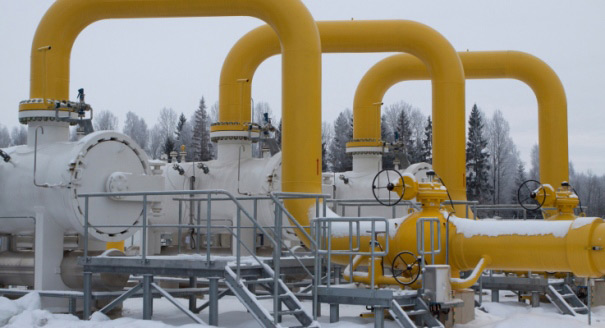
One issue is that Russia has never come to terms with Ukraine’s role as a major transit country for Russian gas exports to Europe. Ukraine imports half of the gas it consumes from Russia. Between 12 and 15 percent of the gas consumed by EU countries passes through the territory of Ukraine. Naftogaz is responsible for importing and distributing Russian gas in Ukraine. The company also holds a monopoly on sending Russian gas via Ukraine to Europe.
Since Russia has had to pay transit costs to Ukraine for the use of its gas pipelines, Gazprom has made repeated attempts, all in vain, to take over Naftogaz with the aim of weakening Moscow’s dependence on Ukraine as a transit country.
Another source of friction between Moscow and Kiev is that Ukraine’s governments have often used the transit pipeline as a bargaining chip to negotiate the price at which Ukraine would buy its gas from Russia.
As a result, both sides have constantly threatened each other: Russia by withholding its gas to Ukraine—and using it as a political weapon against Kiev—and Ukraine by holding back the transit of Russian gas to its lucrative European markets. No wonder parts of Europe faced serious energy shortages in 2005 and again in 2009.
During all these disputes, successive Ukrainian governments never used the opportunity to reform Naftogaz, which is the source of so much corruption.
Repeated reports by the IMF, the World Bank, and the International Energy Agency bring up the issue of corruption in the energy sector. Ukraine’s media are also increasingly writing about corruption inside Naftogaz and the country’s energy ministry.
In March 2014, Ukrainian police raided the homes of Ukraine’s former energy minister, Eduard Stavytsky, and interior minister, Arsen Avakov. The police found 42 kilograms (93 pounds) of gold. The police also detained the then chief executive of Naftogaz, Yevhen Bakulin.
Yet despite repeated proposals by the EU, the IMF, and other international financial institutions for Ukraine to reform its energy sector, such steps have yet to begin.
The result is that Ukraine has an energy sector that is one of the most energy-intensive in Europe. The country has one of the continent’s lowest gas and heating tariffs. And it has a sector that has been starved of investment while oligarchs and politicians have siphoned off profits.
The EU and IMF must adopt a hands-on approach to #Ukraine's energy sector.Tweet This
Because of cheap, highly subsidized gas and a lack of transparency, local distribution companies in Ukraine were able to inflate the amount of gas they bought to take advantage of the subsidies. In short, oligarchs, politicians, and local energy distributors had no incentive to overhaul Naftogaz.
That is why the latest gas deal will change nothing unless the EU and the IMF adopt a hands-on approach to Ukraine’s energy sector. Otherwise, there is no reason to believe that the EU won’t have to broker another deal next year. If that happens, the EU will once again have to pay Russia—which, after all, is the winner of this latest gas dispute.

Nonresident Senior Fellow, Carnegie Europe
Judy Dempsey is a nonresident senior fellow at Carnegie Europe
Recent Work
Judy Dempsey
Judy Dempsey
Carnegie does not take institutional positions on public policy issues; the views represented herein are those of the author(s) and do not necessarily reflect the views of Carnegie, its staff, or its trustees.

The EU can impose sanctions but struggles to enforce them without the United States. With Washington increasingly disinterested in backing European interests, the bloc must now fend for itself.


Nicu Popescu, Tiago Antunes

Russia is testing the waters of NATO’s mutual defense clause. What do strikes in Romanian territorial waters mean for the alliance’s posture toward Moscow?

Dimitar Bechev

With its public finances in shambles, the far right polling at 35 percent ahead of the 2027 presidential election, and a growing protest movement, is France’s crisis a threat to the EU’s geopolitical awakening?

Rym Momtaz, ed.

Ahead of a tough winter for Ukraine, Donald Trump’s swing back toward Russia bodes ill. But instead of panicking, Kyiv’s European allies are focusing on action.
Rym Momtaz

While the EU and European governments are embracing the much-lauded middle-power moment, this entails three difficult conundrums.

Richard Youngs