

Commentary
Judy Dempsey
{
  "authors": [
    "Judy Dempsey"
  ],
  "type": "commentary",
  "blog": "Strategic Europe",
  "centerAffiliationAll": "",
  "centers": [
    "Carnegie Endowment for International Peace",
    "Carnegie Europe"
  ],
  "collections": [
    "Europe’s Eastern Neighborhood"
  ],
  "englishNewsletterAll": "",
  "nonEnglishNewsletterAll": "",
  "primaryCenter": "Carnegie Europe",
  "programAffiliation": "",
  "programs": [],
  "projects": [],
  "regions": [
    "Europe",
    "Eastern Europe",
    "Ukraine",
    "Western Europe"
  ],
  "topics": [
    "Foreign Policy",
    "EU",
    "Climate Change",
    "Security"
  ]
}
Source: Getty
Greece’s economic crisis and the war in Ukraine pose similar threats to Europe’s security—threats that most European leaders prefer to ignore.
The future of Europe’s security is being played out in Greece and Ukraine. The crises engulfing these two countries are not only economic, stemming from the failures over the years of Athens and Kiev to deal with the fundamental structural weaknesses of their state institutions.
The two crises are also about Europe’s inability to recognize that if Greece quit the eurozone and if Europe backed away from giving Ukraine maximum political and financial support, Europe’s security would be at stake.
Aside from all the pros and cons of Greece quitting the eurozone, a Grexit would wreak havoc in this part of southern Europe.
For a start, a Greek exit would harm the Western Balkans, which are not in good shape. The region’s will to push ahead with further economic, social, and political reforms has all but dissipated. Links between local oligarchs and political elites have weakened transparency and accountability. Good governance is at a premium.
The influence of the European Union, which once provided the motivation for reforms in the region, has waned. Somehow, the prospect of joining the EU is no longer the driving force it used to be.
A Grexit would do untold damage to this part of Europe. Over the years, Greek companies had invested in the Western Balkans. That investment is already drying up because of Greece’s economic crisis. A Grexit would make foreign investors steer clear of Greece and its neighbors. The remaining reformers in the region would be further isolated.
As for the security dimension, recent instability in Macedonia, Greece’s neighbor, exposed the fragility of that state. The EU had been slow to react to Macedonia’s brittle security situation.
Once the Yugoslav Wars ended in 1999 with NATO’s bombing of Serbia to stop the ethnic cleansing of Kosovo, it was hoped that the EU would assume political and economic responsibility for this part of Europe. The union has done a bad job at that, whether in Bosnia and Herzegovina or in Kosovo. Without the presence of NATO, Kosovo would be in far worse shape than it is today.
The future of Europe's security is being played out in #Greece and #Ukraine.Tweet This
A Grexit would pose even bigger challenges for Europe’s refugee crisis, for which the EU and the member states still have no long-term strategy. Greece is unable to cope with the daily influx of refugees. A Greek exit from the eurozone could fuel the country’s ultranationalist and anti-immigration parties. Europe has neither the security instruments nor the strategic means to cope with the potential instability of a bigger refugee crisis. It would have to depend on NATO.
And then there is the fate of the Cyprus talks on how to end the island’s division. The failure or success of the talks depends as much on Greece and Turkey as on Cyprus itself. A weakened Greece would not bode well for the negotiations. In short, a Grexit poses serious security threats to Europe. Without NATO, the Europeans will not be able to deal with those threats.
It’s the same with Ukraine. The Europeans are barely coping with the security situation presented by Russia’s continuing interference in eastern Ukraine. And the longer the crisis continues in Ukraine, the more likely it is that Germany could wobble.
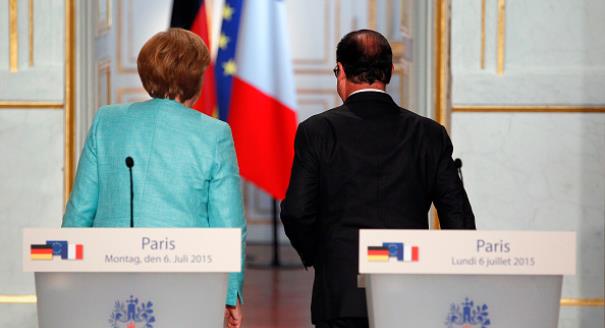
German Chancellor Angela Merkel has managed to keep all 28 EU countries united over the sanctions against Russia. But that is not the same thing as Berlin supporting U.S. efforts to boost the security of the Baltic states or providing training and nonlethal weapons for the Ukrainian army.
There is a longing among some of Germany’s elites to go back to the old days of Ostpolitik, when Germany drove a rapprochement with Russia while Moscow used that relationship to weaken Europe and undermine the transatlantic alliance. Implicit in that Eastern policy was a suspicion—if not criticism—of the United States, despite Washington being Europe’s security guarantor.
This criticism filtered through a speech given by German Foreign Minister Frank-Walter Steinmeier on June 30, 2015, to mark sixty years since Germany joined NATO. Steinmeier said that the Cold War was over but that “old reflexes from that era are still in place, and they appear to be gaining vitality these days.”
While he criticized plans by Russian President Vladimir Putin to modernize Russia’s strategic missile arsenal, he implicitly criticized the U.S. for “ratcheting up rhetoric [that] can lead to escalation on the ground. It is in our interest to keep our responses lighter on the reflexes and heavier on the nuance and the far-sighted strategic thinking.”
When it comes to #Ukraine, Europe's strategy should be unambiguous.Tweet This
But nuance is no substitute for strategy. When it comes to Ukraine, Europe’s strategy should be unambiguous. Europe must commit itself to helping make Ukraine stable and supporting Kiev’s reforms. Without reforms of its state institutions, Ukraine will not be rid of corruption, clientelism, and the influence of the oligarchs, who oppose reforms and a vibrant democracy. Russia would be the beneficiary of an unreformed Ukraine.
It’s the same for Greece, where successive governments—as if the EU didn’t realize it—have failed to build strong and transparent institutions based on good governance. The Europeans are now paying a high price for ignoring Greece’s dysfunctional economy and state structures.
A Grexit and Europe’s unwillingness to commit itself to Ukraine would put a brake on reforms and put both countries on a path to becoming failing states. If only Europe would wake up to the security implications of these two crises.

Nonresident Senior Fellow, Carnegie Europe
Judy Dempsey is a nonresident senior fellow at Carnegie Europe
Recent Work
Judy Dempsey
Judy Dempsey
Carnegie does not take institutional positions on public policy issues; the views represented herein are those of the author(s) and do not necessarily reflect the views of Carnegie, its staff, or its trustees.

As we close out another season of Strategic Europe, it is worth taking stock of the deep shifts underway.

Rym Momtaz
The EU had to compromise to adopt a twenty-first sanctions package against Russia, exposing growing cracks in the union’s resolve. Is this latest, weaker round worth it to keep pressure on Moscow?
Rym Momtaz, ed.

Trump is distracted and Ukraine wants Europe to step up. The continent’s leaders must find their voice and assert it in talks with Russia.

Alissa de Carbonnel

Mounting economic strain and battlefield losses will not necessarily make the Kremlin less dangerous. They could instead push Moscow toward a more aggressive hybrid campaign designed to test NATO’s Eastern flank, exploit allied hesitation, and fracture European resolve.

Maksym Beznosiuk
Over the past ten years, NATO has held almost as many summits as it did during the entirety of the Cold War. Are they still useful, or is it time to stop holding annual meetings?
Rym Momtaz, ed.