

Commentary
Stefan Lehne
{
  "authors": [
    "Stefan Lehne"
  ],
  "type": "commentary",
  "blog": "Strategic Europe",
  "centerAffiliationAll": "",
  "centers": [
    "Carnegie Endowment for International Peace",
    "Carnegie Europe"
  ],
  "collections": [
    "Europe’s Eastern Neighborhood"
  ],
  "englishNewsletterAll": "",
  "nonEnglishNewsletterAll": "",
  "primaryCenter": "Carnegie Europe",
  "programAffiliation": "",
  "programs": [],
  "projects": [],
  "regions": [
    "Europe",
    "Eastern Europe",
    "Ukraine"
  ],
  "topics": [
    "Security"
  ]
}
Source: Getty
In crisis situations between the West and Russia, the OSCE offers a useful safety net to preserve a minimum level of stability. No other body could replace it.
From its beginnings in the early 1970s, the Conference for Security and Cooperation in Europe (CSCE) was conceived as an instrument to manage a difficult relationship between Russia and the West.
While Moscow celebrated the conference’s Helsinki Final Act—signed forty years ago, on August 1, 1975—as a recognition of the territorial status quo in Europe, the West used it as a tool to promote systemic change, highlighting the contradictions between the human rights commitments contained in the document and the harsh reality in Eastern Europe. Right up to the end of the Cold War, the conference played a dual role, as a forum of dialogue and cooperation and as an ideological battleground.
However, the community of values announced by the OSCE’s documents clashed with the authoritarianism and poor governance that prevailed in much of Eastern Europe. And as the years went by, Russia and some of the other countries emerging from the former Soviet Union reverted to a more traditional notion of sovereignty and began to resist the OSCE’s meddling in their internal affairs.
The early years of the twenty-first century marked further decline. One of the organization’s strongest assets—its elaborate regime for conventional arms control—eroded in the post-Soviet territorial configuration. Disputes about frozen conflicts crippled the OSCE’s decisionmaking capacity. Debates on human rights assumed the old confrontational tone, and the organization’s purported role in promoting economic cooperation never got off the ground.
The OSCE had thus become a backwater of international diplomacy when the Ukraine crisis struck in spring 2014 like a tsunami. The crisis turned into the worst setback to the relationship between Russia and the West since the end of the Cold War. Russia’s annexation of Crimea and involvement in asymmetric warfare in eastern Ukraine violated some of the central principles of the OSCE documents and challenged everything the organization stood for.
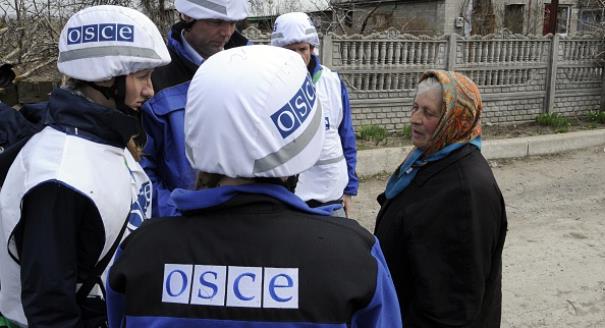
Yet, paradoxically, the Ukraine crisis led to a sudden revival of the OSCE’s political relevance. As an inclusive forum operating on the basis of consensus, the organization offered the only crisis management tool kit acceptable to Russia. The OSCE’s monitoring mission quickly became an important source of objective information.
The #OSCE was a backwater of diplomacy when the #Ukraine crisis struck.Tweet This
Inadequate cooperation from the parties to the conflict and, in particular, incomplete access to the conflict areas, impede the work of the mission, but the operation is widely recognized as an essential factor of stability. And while the key decision of political crisis management—the so-called Minsk agreement containing a road map for a political settlement—was negotiated among certain powerful countries and the parties to the conflict, the OSCE was also charged with leading the talks on implementing the deal.
The Ukraine crisis therefore constitutes a key test of the OSCE’s capacity as a crisis management institution. The top priorities now must be to enhance the monitoring mission’s capabilities in stabilizing the situation and to move forward with the stagnating negotiations on implementing the Minsk package. Whether this will happen depends on the parties to the conflict and, in particular, on Moscow. Ending the violence and moving toward a genuine political solution will require a significant shift of Russia’s approach to the crisis.
Unless such a change takes place, relations between Russia and the West could remain difficult for a long time—with implications for Russia’s entire western and southern neighborhood from the Baltics to Central Asia. The existing protracted conflicts in the region have the potential to flare up again, and new hot spots could appear in several places. Sanctions and countersanctions and the remilitarization of East-West relations all contribute to a tense and risky environment.
The instruments that the OSCE has deployed in Ukraine might be needed elsewhere. There is a strong case for developing the OSCE’s capacities to address the different phases of the conflict cycle, ranging from early warning, crisis management, and conflict resolution to postconflict rehabilitation and reconciliation. Enhancing the organization’s ability to run civilian as well as military operations deserves particular attention.
It is also high time to revise the Vienna Document on Confidence- and Security-Building Measures and to adjust the document to today’s changed circumstances. In view of the overall heightened level of military activities, the OSCE should place particular emphasis on the prevention of military incidents.
Relations between Russia and the West remain key for the future of the #OSCE.Tweet This
Just as forty years ago, the quality of the relationship between Russia and the West remains the key factor for the future of the OSCE. The organization’s capacity to influence these relations is limited, as the really important decisions are made elsewhere.
However, the Ukraine crisis has demonstrated the OSCE’s comparative advantages in situations in which Russia and the West are antagonists or back different sides in a conflict but have a shared interest in containing risks. In such situations, the OSCE offers a useful safety net to preserve a minimum level of stability. No other body could replace it.
A Carnegie Europe paper on the OSCE and the Ukraine crisis by the same author will be published in September 2015.

Senior Fellow, Carnegie Europe
Stefan Lehne is a senior fellow at Carnegie Europe in Brussels, where his research focuses on the post–Lisbon Treaty development of the European Union’s foreign policy, with a specific focus on relations between the EU and member states.
Recent Work
Stefan Lehne
Stefan Lehne
Carnegie does not take institutional positions on public policy issues; the views represented herein are those of the author(s) and do not necessarily reflect the views of Carnegie, its staff, or its trustees.

As we close out another season of Strategic Europe, it is worth taking stock of the deep shifts underway.

Rym Momtaz
The EU had to compromise to adopt a twenty-first sanctions package against Russia, exposing growing cracks in the union’s resolve. Is this latest, weaker round worth it to keep pressure on Moscow?
Rym Momtaz, ed.
Trump is distracted and Ukraine wants Europe to step up. The continent’s leaders must find their voice and assert it in talks with Russia.

Alissa de Carbonnel

Mounting economic strain and battlefield losses will not necessarily make the Kremlin less dangerous. They could instead push Moscow toward a more aggressive hybrid campaign designed to test NATO’s Eastern flank, exploit allied hesitation, and fracture European resolve.

Maksym Beznosiuk

Over the past ten years, NATO has held almost as many summits as it did during the entirety of the Cold War. Are they still useful, or is it time to stop holding annual meetings?
Rym Momtaz, ed.