

Commentary
Cornelius Adebahr
{
  "authors": [
    "Cornelius Adebahr"
  ],
  "type": "commentary",
  "blog": "Strategic Europe",
  "centerAffiliationAll": "",
  "centers": [
    "Carnegie Endowment for International Peace",
    "Carnegie Europe"
  ],
  "collections": [
    "Europe’s Southern Neighborhood",
    "Iranian Proliferation"
  ],
  "englishNewsletterAll": "",
  "nonEnglishNewsletterAll": "",
  "primaryCenter": "Carnegie Europe",
  "programAffiliation": "",
  "programs": [],
  "projects": [],
  "regions": [
    "Middle East",
    "Europe",
    "Iran",
    "Western Europe"
  ],
  "topics": [
    "Foreign Policy",
    "Climate Change",
    "Nuclear Policy",
    "EU",
    "Security"
  ]
}
Source: Getty
The agreement achieved on July 14 on Iran’s nuclear program is a major achievement. But the hard work continues, especially for the EU and its member states.
Twelve years after France, Germany, and the United Kingdom began talks with Iran on limiting Tehran’s nuclear activities, the deal reached in Vienna on July 14 is balm for Europe’s soul, which has been battered by the Greek debt crisis.
Hardly noticed in EU capitals in the aftermath of the eurozone’s own marathon negotiations on July 12–13, the agreement between Iran and those three European countries, the United States, Russia, and China as well as the EU vindicates the approach of diplomacy over military confrontation that was promoted by the Europeans and eventually adopted by the United States. Given that the nuclear negotiations were also prompted by the 2003 U.S.-led intervention in Iraq, this alone is no small feat.
The conditions imposed on Iran in return for the lifting of international sanctions represent the “good enough” deal that the EU demanded. The immediate task is not only to shepherd the deal through rough domestic waters in both Tehran and Washington but also to formalize it through a UN Security Council resolution. Then, the hard part of seeing through the implementation of the agreement can begin.
In terms of security, the major gain is that the deal takes an Iranian nuclear bomb off the table as much as it precludes a Western military strike against Tehran’s nuclear facilities. This not only makes Europe and the world safer but should also soothe the concerns of those countries that feel most threatened by the Islamic Republic. However, in the Arab countries and in Israel, governments will fear that the deal emboldens Iran in conventional terms.
Already, arms expenditures have risen dramatically around the Persian Gulf, both in reaction to Iran’s increased activities in Iraq, Syria, and Yemen and in anticipation of an eventual agreement. In addition, some might claim that Iran will try to cheat on the deal or else dash for the bomb when much of the agreement expires a decade from now. That would allow Tehran not only to enrich its coffers through sanctions relief and unfrozen assets but also to prepare for the day after the deal terminates.
That’s why the transatlantic partners will have to build on their joint achievement and focus on the regional power play, weighing in on Iran as well as on Israel and the Gulf sheikhdoms to play more constructive roles.
The nuclear deal does not offer any solution to regional sectarian and political rivalries, nor does it do away with the fundamentally anti-U.S. and anti-Israeli tenets of Iranian foreign policy. However, now that the agreement has established lines of contact between Iran and the United States, facilitated by the European Union, it could at least provide channels to discuss the other hot spots in the Middle East.
In a world of disorder, reaffirming the possibility and value of a diplomatic compromise is another asset.
The Europeans in particular will be pleased that their slogan of effective multilateralism has now been filled with life. That mantra was coined as a central element of the EU’s 2003 Security Strategy, which is currently under review. The interplay between six world powers—the five permanent members of the UN Security Council plus Germany—and the International Atomic Energy Agency and the European Union is truly a multilateral effort. If these institutions jointly manage the deal’s implementation, their work will rightly be seen as effective.
This should give the EU a double boost to both promote a multilateral approach and equip itself with the hard tools to back it up.
One obvious point of departure is the Nuclear Non-Proliferation Treaty, which the EU aims to strengthen with the deal. Brussels should ensure that the treaty’s inspection standards serve as an example for broader nonproliferation efforts, while being careful to stress that indigenous enrichment should not be the new norm.
On the inspection standards, the EU will have to make a concerted effort to get all of the treaty’s signatories—in particular, holdouts like Brazil, Argentina, Egypt, and Saudi Arabia—to sign the Additional Protocol, which provides for tougher monitoring.
In economic terms, European companies will be well positioned to reenter the Iranian market, provided that there are no residual U.S. sanctions that (if only theoretically or psychologically) prevent the private sector from such an engagement.
While some individual oil and gas companies are likely to secure a number of lucrative contracts, the broader shifts for Europe are likely to be less pronounced. Most of the additional Iranian gas will be absorbed by the domestic market, and both the building of gas pipelines to Europe and the construction of liquefied natural gas infrastructure to ship it will take some time.
Iran’s oil wells, in contrast, have been seriously damaged by being offline for so long and thus require a lot of investment. This will be hard to come by at a moment when the mere expectation of future Iranian oil exports after the deal leads to another drop in already low global oil prices.
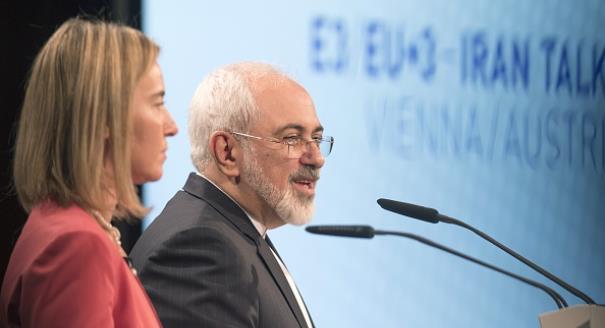
In their statement after the negotiations’ conclusion, EU foreign policy chief Federica Mogherini and Iranian Foreign Minister Mohammad Javad Zarif were right in pointing out that July 14—Bastille Day, for those who care to remember—was not the end of their common efforts.
Indeed, while all those who participated in the talks can take a well-deserved break, it had better be short. The hard work continues, and Europe—the EU and its member states in particular—should not merely benefit from the deal but should own it by filling it with life.

Former Nonresident Fellow, Carnegie Europe
Cornelius Adebahr was a nonresident fellow at Carnegie Europe. His research focuses on foreign and security policy, in particular regarding Iran and the Persian Gulf, on European and transatlantic affairs, and on citizens’ engagement.
Recent Work
Cornelius Adebahr

Cornelius Adebahr, Barbara Mittelhammer
Carnegie does not take institutional positions on public policy issues; the views represented herein are those of the author(s) and do not necessarily reflect the views of Carnegie, its staff, or its trustees.

With its public finances in shambles, the far right polling at 35 percent ahead of the 2027 presidential election, and a growing protest movement, is France’s crisis a threat to the EU’s geopolitical awakening?

Rym Momtaz, ed.

Ahead of a tough winter for Ukraine, Donald Trump’s swing back toward Russia bodes ill. But instead of panicking, Kyiv’s European allies are focusing on action.
Rym Momtaz

While the EU and European governments are embracing the much-lauded middle-power moment, this entails three difficult conundrums.

Richard Youngs

Much has been said of the changes Brussels is trying to make to the EU enlargement process. Here’s why gradual integration might—or might not—be the answer.

Dimitar Bechev

The European Commissioner for Trade is headed to China. But after President Xi’s bridge-building visit to Washington, can a more isolated EU overcome Beijing’s stranglehold on critical raw materials? Who will blink first?
Rym Momtaz, ed.