

Commentary
Marc Pierini
{
  "authors": [
    "Marc Pierini"
  ],
  "type": "commentary",
  "blog": "Strategic Europe",
  "centerAffiliationAll": "",
  "centers": [
    "Carnegie Endowment for International Peace",
    "Carnegie Europe",
    "Carnegie Russia Eurasia Center"
  ],
  "collections": [
    "Turkey’s Transformation"
  ],
  "englishNewsletterAll": "",
  "nonEnglishNewsletterAll": "",
  "primaryCenter": "Carnegie Europe",
  "programAffiliation": "",
  "programs": [],
  "projects": [],
  "regions": [
    "Middle East",
    "Europe",
    "Türkiye"
  ],
  "topics": [
    "Democracy",
    "Security",
    "EU",
    "Foreign Policy"
  ]
}
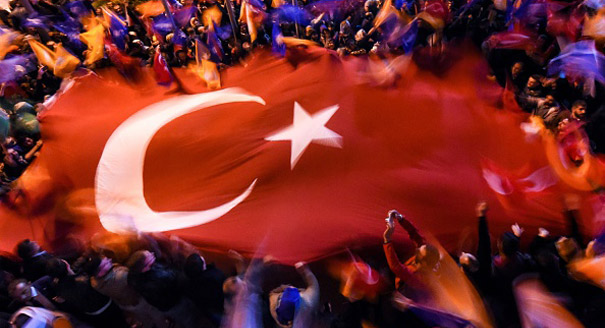
Source: Getty
Turkey’s future will depend to a large extent on President Recep Tayyip Erdogan, who remains the towering figure of the country’s politics.
Turkey’s legislative election on November 1 took place in an extremely tense atmosphere.
On the one hand, this was due to internal factors: the country’s rule of law architecture was being dismantled, political narratives were extremely polarized, a spiral of violence and repression had engulfed Turkey’s southeast, the ruling Justice and Development Party (AKP) was fighting for continued supremacy, and parties had uneven access to the media.
On the other hand, Turkey also faced external difficulties: the AKP’s Middle East policy was challenged on all fronts, the Syrian Kurds were on the rise politically and militarily, Russia’s intervention was continuing in Syria, and the refugee crisis was showing no signs of abating.
For the AKP, the good news is that its victory was clear-cut: having secured 4.5 million more votes than in the previous election on June 7, the party won an overall majority of seats in the Turkish parliament and will form a government on its own. A preference for governmental stability has prevailed. In the short term, this will spare the country several weeks of coalition haggling.
For the president, the less good news is that the AKP remains short of the three-fifths majority of 330 seats that would allow it to submit to a referendum a constitutional amendment introducing an executive presidential regime. The country is split in two on this subject. And it is not clear that the AKP itself is as one on the president’s project.
For Turkey’s democracy, the worse news is that the election results were obtained at a very high price: an endless, harsh clampdown on the media (including after the polls), an extremely polarizing narrative, and an all-out demonization of the pro-Kurdish Peoples’ Democratic Party (HDP), which is now the third party in the parliament. These are wounds that will be long in healing. The next prime minister will have the daunting task of piecing together a deeply divided country.
Restoring domestic peace and harmony would require drastic changes to Turkey’s political narratives, a rapid return to the rule of law, and a willingness to genuinely accept the country’s social and political diversity.
Is this within reach? Or will the election results be considered a blank check for AKP policies across the board, including majority rule? The November 1 vote is widely seen as a personal victory for a president who had based his campaign precisely on an “us and them” discourse and on shutting down critical voices. Although this was a legislative election, the answers to these questions depend to a large extent on President Recep Tayyip Erdoğan, who remains the towering figure of Turkish politics.
The EU refugee plan with #Turkey is unlikely to work as originally conceived.Tweet This
On the foreign policy front, the badly dented rule-of-law architecture is likely to draw more criticism from the EU. (But does this really matter for the president?). Postelection messages from Brussels, Berlin, and Washington all stressed their deep worries on the subject.
On the refugee crisis, the ill-footed EU approach of a refugee action plan with Turkey is unlikely to work as originally conceived. Turkey seems poised to benefit from the panicky attitude of EU politicians, who have offered to speed up the country’s accession negotiations in return for Ankara’s help in the refugee crisis, among other potential concessions. But the plain reality is that Turkey shares with the EU very similar problems: new waves of refugees about to arrive; no returns in the foreseeable future; a need to combine humanitarian care with education and job creation; and a €2 billion ($2.2 billion) human trafficking business in 2015 alone.
This mass exodus carries the potential for major social, economic, and political destabilization in all the countries concerned, Turkey included. This calls for a joint, responsible management of this international crisis, not for bargaining diplomacy. Both the EU and Turkey need to change their approaches.
Similarly, Turkey’s policy in the Middle East has been seriously challenged on all fronts, in particular in Syria. There, Turkish policy is now confronted with a set of U.S. and Russian options that run counter to Ankara’s own preferences for removing Syrian President Bashar al-Assad, fighting the Syrian Kurds, and establishing a safe zone in northern Syria.
#Turkey urgently needs to return to a more serene relationship with its allies.Tweet This
Seen from Brussels, what Turkey needs is a return to normal governmental operations after five months of political vacuum. Long considered a rare case of Muslim democracy and an example of successful economic transformation, Turkey has lost a huge part of its international prestige during the past two years. With its neighborhood on fire and its economy in a sharp slowdown, and on the eve of the G20 summit it will host on November 15–16, Turkey urgently needs to go back to a more serene relationship with its European and U.S. allies.
The EU has saluted the AKP’s victory with prudence. The EU is now waiting to see if, under a confident leadership and with no more elections for nearly four years, Turkey will make a constructive contribution to the international arena and restore harmony and freedoms on the domestic scene. These could be the benefits of the AKP’s spectacular November 1 victory. But at this stage, that remains a wide open question.

Senior Fellow, Carnegie Europe
Marc Pierini is a senior fellow at Carnegie Europe, where his research focuses on developments in the Middle East and Turkey from a European perspective.
Recent Work
Marc Pierini
Marc Pierini
Carnegie does not take institutional positions on public policy issues; the views represented herein are those of the author(s) and do not necessarily reflect the views of Carnegie, its staff, or its trustees.

The European Commissioner for Trade is headed to China. But after President Xi’s bridge-building visit to Washington, can a more isolated EU overcome Beijing’s stranglehold on critical raw materials? Who will blink first?

Rym Momtaz, ed.

The domestic impacts of how long it is taking to end the war in Ukraine have pushed the French electorate to the political extremes and compromised the country’s diplomatic capacity.
Rym Momtaz

Before the next wave of EU enlargement takes place, the union needs to grapple with thorny questions of how power is distributed among its members.


Emil Sondaj Hansen, Ditte Brasso Sørensen

A summer of escalation in the Black Sea has hurt Ukraine economically and is exacerbating world food security. A truce is needed—as is a broader reframing of Europe’s Ukraine strategy.

Thomas de Waal

Are Germany’s economic, industrial, and political struggles becoming a liability for the EU’s ability to rise to the geopolitical moment?
Rym Momtaz, ed.