

Commentary
Marc Pierini
{
  "authors": [
    "Marc Pierini"
  ],
  "type": "commentary",
  "blog": "Strategic Europe",
  "centerAffiliationAll": "",
  "centers": [
    "Carnegie Endowment for International Peace",
    "Carnegie Europe"
  ],
  "collections": [
    "Turkey’s Transformation"
  ],
  "englishNewsletterAll": "",
  "nonEnglishNewsletterAll": "",
  "primaryCenter": "Carnegie Europe",
  "programAffiliation": "",
  "programs": [],
  "projects": [],
  "regions": [
    "Middle East",
    "Europe",
    "Türkiye",
    "Western Europe"
  ],
  "topics": [
    "Foreign Policy",
    "EU",
    "Migration",
    "Security"
  ]
}
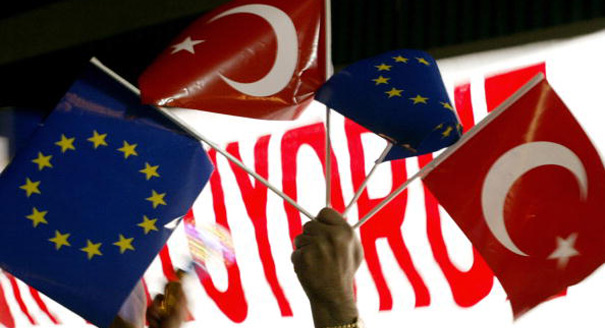
Source: Getty
From fighting the Islamic State to coping with Europe’s refugee crisis, the EU and Turkey now have even more daunting issues to deal with than in recent years.
Since Turkey started accession negotiations with the EU in 2005, a relatively predictable dialogue has unfolded about chapters, which are either opened or blocked, and political criteria, which are fulfilled either sufficiently or less so. Recently, discussions also took place on modernizing the EU-Turkey Customs Union, implementing visa liberalization, and readmitting irregular migrants. As slow or frustrating as it was at times, this comfortable routine remained immune from hard politics.
EU-Turkey relations are now in a different era. The “new Turkey”—the term used by the country’s president after successive presidential and legislative elections—finds itself in a multipronged conflictual situation of prime importance to the EU over the war in Syria, the self-proclaimed Islamic State, and the refugee crisis. At the same time, Ankara is caught in rather tense interactions with the United States over U.S. support for Syrian Kurdish forces and with Russia following Turkey’s downing of a Russian military aircraft on November 24.
On top of their old routine, the EU and Turkey now have much more daunting issues on their plates: Do they work together against the Islamic State, and do they see the refugee crisis as a joint challenge?
While the refugee action plan might just look like money for concessions, the underlying issue is the free hand enjoyed by traffickers operating in broad daylight on the Aegean coast. This is an enormous business of some €1 billion ($1.1 billion) a year: by the end of 2015, over 700,000 asylum seekers, mostly Syrians, Afghans, and Pakistanis, will have crossed from Turkey to Greece, each paying an average of €1,000–1,500 (a very conservative estimate) to traffickers on Turkey’s coastline. Getting this shameful and deadly racket under control is now the key issue.
Meanwhile, the focus of EU politics—and therefore of discussions with Turkey—has shifted dramatically toward Islamic State terrorism. Despite an optimistic Western narrative, the Islamist group is resilient and expanding in Sinai and Libya. It was recently able to cause some 500 deaths in thirty-five days in Turkey, the Middle East, and Western Europe. Islamic State operatives have challenged the police in France and Belgium, and inquiries have revealed connections between the perpetrators of recent killings and jihadists moving to and from Syria via Turkey.
From a counterterrorism standpoint, the recent spate of coordinated terrorist attacks is a quantum leap. From a European political standpoint, it is an earthquake.
Although many observers see an emerging anti–Islamic State coalition involving Russia, the United States, and France, this will translate into little more than minimal military cooperation to avoid accidental mishaps. This is not overly surprising because Russia’s objectives—first rescuing Syrian President Bashar al-Assad from the brink of deposal, then going after the Islamic State—differ substantially from the aims of the U.S.-led coalition.
The November 15–16 G20 meeting in Antalya showed that the United States, Europe, and Russia now have a common objective: stopping the well-documented flow of smuggled oil from Islamic State–controlled territory into Turkey. Russia claims that it has destroyed 500 oil tankers in Islamic State–held territory, while the United States said it had wiped out some 280. The West and Russia see severing one of the Islamic State’s main financial resources as a critical issue. Despite Ankara’s denials, Turkey is now openly criticized for its lack of action on the issue. Also, the transit of jihadists via Turkey, despite some improvements, remains a major source of concern, especially for France and Belgium.
Turkey’s priority objectives in Syria—the fall of the Assad regime, the establishment of a safe zone or no-fly zone, and the containment of the Syrian Kurds—have long been out of reach. The fate of Assad has become a secondary priority for the West, at least in the short term. U.S. President Barack Obama has publicly rejected the idea of a safe zone. And the Syrian Kurds have become essential partners for the United States, which has provided them with close air support and special forces on the ground, and won the political endorsement of Russian President Vladimir Putin in his speech to the UN General Assembly on September 28.
The November 13 Paris attacks and the refugee crisis are true game changers. Despite the oddity of the Syrian chessboard, the Islamic State has now become a common target for the United States, Europe, and Russia. As a result, Turkey’s ambivalent narrative on the Islamist group and its benign neglect on refugee traffickers are under close scrutiny.
Seen from Paris or Washington, there is a need for a thorough clarification of Turkey’s policy on Syria. Pro-Western political narratives from the Turkish leadership will not suffice at a time when smothering the Islamic State has become an overwhelming political priority for Western powers.
The despicable carnage in the heart of Turkey’s capital on October 10, when two bombs killed over 100 people, should be seen as a turning point—just as the downing of a Russian airliner over the Sinai on October 31 or the Paris massacres, events that led policies to be readjusted accordingly. Despite Ankara’s right to protect its sovereignty, the tragic incident between the Russian and Turkish air forces on November 24 is a serious complicating factor.
As the Islamic State wages a brutal war in Europe, with command centers in Syria, and the refugee crisis takes on a critical societal dimension, Turkey’s strategic foreign policy choices are more pivotal than ever. On November 29 in Brussels, the words and unequivocal commitments of Turkey—a NATO member and an EU candidate country—will be closely scrutinized.

Senior Fellow, Carnegie Europe
Marc Pierini is a senior fellow at Carnegie Europe, where his research focuses on developments in the Middle East and Turkey from a European perspective.
Recent Work
Marc Pierini
Marc Pierini
Carnegie does not take institutional positions on public policy issues; the views represented herein are those of the author(s) and do not necessarily reflect the views of Carnegie, its staff, or its trustees.

As we close out another season of Strategic Europe, it is worth taking stock of the deep shifts underway.

Rym Momtaz
The EU had to compromise to adopt a twenty-first sanctions package against Russia, exposing growing cracks in the union’s resolve. Is this latest, weaker round worth it to keep pressure on Moscow?
Rym Momtaz, ed.

Trump is distracted and Ukraine wants Europe to step up. The continent’s leaders must find their voice and assert it in talks with Russia.

Alissa de Carbonnel

Mounting economic strain and battlefield losses will not necessarily make the Kremlin less dangerous. They could instead push Moscow toward a more aggressive hybrid campaign designed to test NATO’s Eastern flank, exploit allied hesitation, and fracture European resolve.

Maksym Beznosiuk

Over the past ten years, NATO has held almost as many summits as it did during the entirety of the Cold War. Are they still useful, or is it time to stop holding annual meetings?
Rym Momtaz, ed.