

Commentary
Judy Dempsey
{
  "authors": [
    "Judy Dempsey"
  ],
  "type": "commentary",
  "blog": "Strategic Europe",
  "centerAffiliationAll": "",
  "centers": [
    "Carnegie Endowment for International Peace",
    "Carnegie Europe"
  ],
  "collections": [
    "Europe’s Eastern Neighborhood"
  ],
  "englishNewsletterAll": "",
  "nonEnglishNewsletterAll": "",
  "primaryCenter": "Carnegie Europe",
  "programAffiliation": "",
  "programs": [],
  "projects": [],
  "regions": [
    "Europe",
    "Eastern Europe",
    "Ukraine",
    "Western Europe"
  ],
  "topics": [
    "Foreign Policy",
    "EU"
  ]
}
Source: Getty
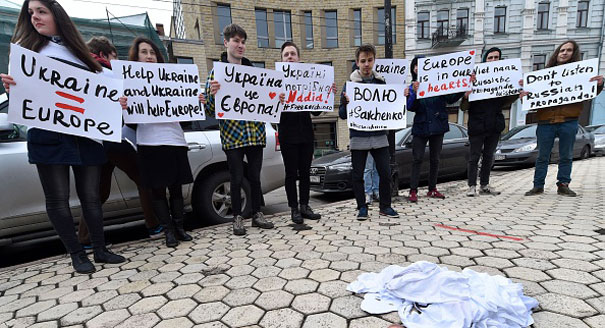
European leaders have stood by as the Dutch prepare to vote on an EU-Ukraine trade agreement. The ballot could make Vladimir Putin the winner and Europe the loser.
On April 6, the Dutch people will go to the polls in a referendum that could shift the mood in Europe against Ukraine. Voters will be asked whether they approve of the EU-Ukraine Association Agreement, a far-reaching political, economic, and trade accord.
The referendum is being organized after GeenPeil, a Euroskeptic social media movement, managed to gather enough signatures to request such a poll after a new law came into force in July 2015. This law allows Dutch citizens to call for a nonbinding referendum on any legislation passed by the parliament provided they collect 300,000 signatures. This GeenPeil did, and easily. The group now has over 470,000 signatures. Over the past few months, it has been on a roll.
Indeed, unless there is a major shift in public opinion, which currently shows the no supporters in the majority, the referendum will spell big problems: for the Dutch government, which will have to react to the vote; for the EU, because all EU member states need to ratify the Association Agreement; and for Ukraine, because reformers desperately need this accord as their ally for change.
Moreover, if the no campaign prevails, it will be a big success for Russian President Vladimir Putin and his propaganda machine, which has made big inroads into the EU member states, with most EU leaders looking on helplessly.
This Dutch referendum could have been an ideal opportunity for EU leaders to get out and campaign for an issue that is about European security, European stability, European interests, and Europe’s neighborhood. The outcome of Ukraine’s reforms—not to mention Russia’s continuing meddling in eastern Ukraine and its 2014 annexation of Crimea—has an impact on these four aspects.
Yet none of these issues has played a role in the referendum campaign. And with the exception of European Commission President Jean-Claude Juncker, who warned of the consequences of a no vote, EU leaders have been silent at worst, halfhearted at best.
Dutch Prime Minister Mark Rutte, whose country currently holds the rotating presidency of the EU’s Council of Ministers, ducked out from campaigning hard for a yes vote. “He fears that he has little to gain from leading [the yes campaign]. He faces general elections in Spring 2017, and his party is neck-and-neck with Geert Wilders’ right-wing populist Freedom Party in the race to become the country’s largest [in the Dutch parliament],” argued Rem Korteweg of the Centre for European Reform.
Rutte’s People’s Party for Freedom and Democracy is also divided over the issue. “If [Rutte] is too pro-European, he will alienate more Eurosceptic voters. If he is too critical of the EU and the agreement with Ukraine, it will complicate his relations with the rest of Europe,” Korteweg added.
The unwillingness to be drawn into a referendum that is about an EU not a national issue is a big mistake. It confirms how too often, EU leaders have pandered to Euroskeptic and populist movements by either adopting some of their policies or, in the case of the Dutch referendum, staying on the sidelines. Neither amounts to a policy or a strategy. Rather, such pandering amounts to a lack of conviction verging on cowardice.
If the EU believes the EU-Ukraine Association Agreement is a good thing—and already, 27 of the 28 member states have ratified it—then EU leaders should have campaigned for it ahead of the Dutch vote. The argument that this would be interfering in the internal affairs of another country is disingenuous. This is a European issue.
Not only that. Over the past few months, the no campaign has mutated from focusing on the democratic deficit in the EU to criticizing Ukraine’s endemic corruption and spreading (unfounded) fears that the accord would give Ukrainians the right to work in the EU.
Russian propaganda and conspiracy theories are also at work. GeenPeil supporters say the Association Agreement sparked the current conflict with Russia, forgetting that the conflict started when former Ukrainian president Viktor Yanukovych backed away from signing the accord at the last minute in November 2013 under pressure from Putin.
Even the downing of flight MH17 over eastern Ukraine in July 2014, when 193 Dutch passengers were killed, has played into the no campaign. The crash spurred the Dutch to fully support the sanctions against Russia that had been imposed in early 2014. But nearly two years later, GeenPeil is peddling all kinds of conspiracy theories about the crash—about the Dutch government’s investigations and what caused the incident—which suits Putin. Again, Rutte has been not been assertive enough, and neither have his EU colleagues.
And so, if the no camp wins on April 6, even though the vote is nonbinding, Euroskeptic and populist leaders can take heart at the ease with which they challenge the EU.

Nonresident Senior Fellow, Carnegie Europe
Judy Dempsey is a nonresident senior fellow at Carnegie Europe
Recent Work
Judy Dempsey
Judy Dempsey
Carnegie does not take institutional positions on public policy issues; the views represented herein are those of the author(s) and do not necessarily reflect the views of Carnegie, its staff, or its trustees.

Trump is distracted and Ukraine wants Europe to step up. The continent’s leaders must find their voice and assert it in talks with Russia.

Alissa de Carbonnel

Mounting economic strain and battlefield losses will not necessarily make the Kremlin less dangerous. They could instead push Moscow toward a more aggressive hybrid campaign designed to test NATO’s Eastern flank, exploit allied hesitation, and fracture European resolve.

Maksym Beznosiuk

Over the past ten years, NATO has held almost as many summits as it did during the entirety of the Cold War. Are they still useful, or is it time to stop holding annual meetings?

Rym Momtaz, ed.
Nearly a year and a half after Europeans leaned into sucking up to Trump, the strategy has produced some benefits when it comes to Ukraine.
Rym Momtaz
Far-right leader Marine Le Pen can—and will—run in France’s next presidential election. What does the outcome of her appeal against a 2025 embezzlement conviction mean for the country’s political future?

Catherine Fieschi