

Commentary
Judy Dempsey
{
  "authors": [
    "Judy Dempsey"
  ],
  "type": "commentary",
  "blog": "Strategic Europe",
  "centerAffiliationAll": "",
  "centers": [
    "Carnegie Endowment for International Peace",
    "Carnegie Europe"
  ],
  "collections": [
    "Transatlantic Cooperation"
  ],
  "englishNewsletterAll": "",
  "nonEnglishNewsletterAll": "",
  "primaryCenter": "Carnegie Europe",
  "programAffiliation": "",
  "programs": [],
  "projects": [],
  "regions": [
    "Europe",
    "North America",
    "United States",
    "Western Europe"
  ],
  "topics": [
    "EU",
    "Economy",
    "Climate Change",
    "Trade"
  ]
}
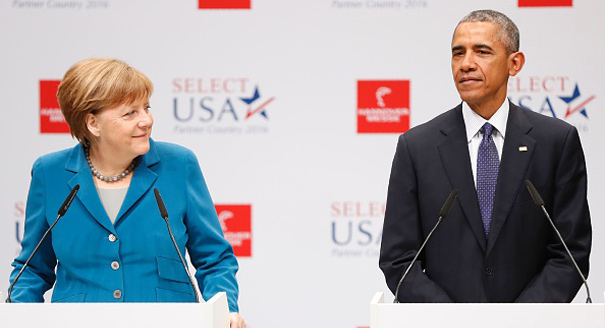
Source: Getty
A wide-ranging trade deal between the United States and Europe is needed to revive, if not rescue, the West’s liberal order.
U.S. President Barack Obama has only nine months left in office. He now seems a man in a hurry. During his visit to Europe on April 21–25, he made a big pitch for the proposed Transatlantic Trade and Investment Partnership (TTIP), which would radically change the functioning of trade between European and U.S. companies.
Speaking in the German city of Hannover, where he opened one of the world’s biggest trade fairs, he told German Chancellor Angela Merkel and scores of leading company executives how time was slipping by to clinch this trade deal. “If we don’t complete negotiations this year, then upcoming political transitions in the United States and Europe would mean this agreement won’t be finished for quite some time,” he said.
Obama’s pitch is long overdue. TTIP is not only about establishing a trade deal that would set crucial standards for how business is conducted. It is also about underpinning if not reviving the West’s liberal economic order, which is coming under massive pressure from Russia and particularly China.
After annexing Crimea in 2014 and later invading parts of eastern Ukraine, Russia is now meddling in Europe through a sophisticated propaganda campaign that does everything to publicize populist and Euroskeptic movements and anti-U.S. sentiments.
Russia is doing everything possible to rattle NATO weeks before the alliance holds a summit in Warsaw, where it will discuss how to improve the security of its Eastern members in the face of increasing Russian intimidation.
Europe’s divisions over refugees and TTIP also play into the hands of Russian President Vladimir Putin. A weakened Europe and a weakened transatlantic relationship are to Russia’s benefit. And to China’s.
Second only to the United States in terms of economic power, China is making a big bid to set new trading standards through its sheer size and political ambitions. Beijing’s huge investments in Africa and Latin America are about seeking allies to assert its authority and influence on the global stage.
That is why TTIP matters. If the deal does not go ahead, the West will have lost a major chance to regain its influence and set trading standards for the coming decades. Above all, Europe and the United States will have lost the opportunity to build a new transatlantic relationship, as the old one, built from the carnage of World War II, increasingly lacks the strategic importance and direction that it once had.
Despite the political and strategic significance of TTIP, European leaders have shied away from speaking out in favor of the deal. Merkel has rarely weighed in on an issue that has so far been successfully hijacked by a highly organized anti-TTIP campaign, not just in Germany but across Europe. Hours before Obama’s arrival in Hannover, tens of thousands of people demonstrated against TTIP.
Critics of TTIP insist that only big corporations will be the winners, that the United States will reap most of the benefits, and that consumers across Europe will be affected by lower standards when it comes to food protection and social issues.
Tell that to Germany’s Mittelstand, the medium-sized companies that are the backbone of the country’s economy. The German mechanical engineering industry, for example, ships more than €16 billion ($18 billion) of goods each year to the United States.
But don’t think a gadget made in Germany can be sold in its original form to a U.S. retailer. “We have to replace our EU plugs with US plugs, even though they essentially look the same, have the same safety characteristics and perform the same function,” said Carl Martin Welcker, vice president of the German Mechanical Engineering Industry and managing partner of Alfred H. Schütte, a machine tool factory.
“We are not just talking about plugs. We use the metric system to standardise our threads, whereas the USA measures in inches – so we have to change the threads in certain safety pipes,” he added. “The EU and the USA even have different requirements when it comes to the content of operating instructions. We end up producing the same machine twice, only differently. We have to buy materials twice, store materials twice. Machines have to be tested twice and approved twice.”
Just imagine the extra costs if a European company wants to enter and compete in the U.S. market. TTIP would do away with these different standards, in turn creating more jobs for European companies—and cutting production costs. These benefits are rarely articulated, just as the long-term strategic implications of TTIP are almost never discussed.
Instead, TTIP has become associated with populist, Euroskeptic, and antiglobalization movements. And there is more than a tinge of anti-Americanism, as Obama surely sensed during his visit to London on April 22–24. Indeed, his public support for Britain to remain in the EU and his pleading for European leaders to support TTIP were really about the United States wanting a stronger Europe and a revitalized transatlantic relationship.
Unless there is a major shift across Europe in the coming months, Obama’s bid to clinch what would be a historic trade deal will elude him. Russia and China will no doubt be relieved.

Nonresident Senior Fellow, Carnegie Europe
Judy Dempsey is a nonresident senior fellow at Carnegie Europe
Recent Work
Judy Dempsey
Judy Dempsey
Carnegie does not take institutional positions on public policy issues; the views represented herein are those of the author(s) and do not necessarily reflect the views of Carnegie, its staff, or its trustees.
Trump is distracted and Ukraine wants Europe to step up. The continent’s leaders must find their voice and assert it in talks with Russia.

Alissa de Carbonnel
Mounting economic strain and battlefield losses will not necessarily make the Kremlin less dangerous. They could instead push Moscow toward a more aggressive hybrid campaign designed to test NATO’s Eastern flank, exploit allied hesitation, and fracture European resolve.

Maksym Beznosiuk
Over the past ten years, NATO has held almost as many summits as it did during the entirety of the Cold War. Are they still useful, or is it time to stop holding annual meetings?

Rym Momtaz, ed.
Nearly a year and a half after Europeans leaned into sucking up to Trump, the strategy has produced some benefits when it comes to Ukraine.
Rym Momtaz
Far-right leader Marine Le Pen can—and will—run in France’s next presidential election. What does the outcome of her appeal against a 2025 embezzlement conviction mean for the country’s political future?

Catherine Fieschi