

Commentary
Judy Dempsey
{
  "authors": [
    "Judy Dempsey"
  ],
  "type": "commentary",
  "blog": "Strategic Europe",
  "centerAffiliationAll": "",
  "centers": [
    "Carnegie Endowment for International Peace",
    "Carnegie Europe"
  ],
  "collections": [
    "Transatlantic Cooperation"
  ],
  "englishNewsletterAll": "",
  "nonEnglishNewsletterAll": "",
  "primaryCenter": "Carnegie Europe",
  "programAffiliation": "",
  "programs": [],
  "projects": [],
  "regions": [
    "Europe",
    "North America",
    "Eastern Europe",
    "Western Europe"
  ],
  "topics": [
    "Foreign Policy",
    "EU",
    "Security"
  ]
}
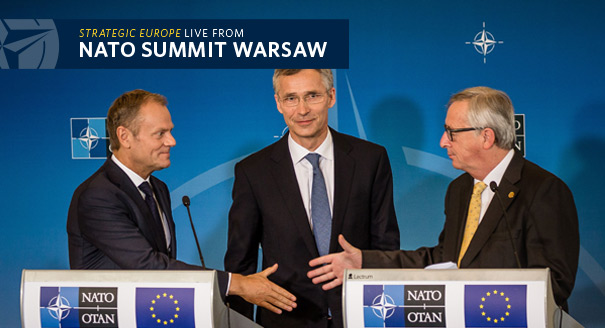
Source: Getty
A long and unnecessary turf war between NATO and the EU is finally coming to an end.
Carnegie Europe was on the ground at the NATO summit in Warsaw, offering readers exclusive access to the high-level discussions as they unfolded. See our live coverage here.
*
It has taken five major crises to convince the EU and NATO that it was time to set aside their differences and cooperate. This is what they announced just before NATO leaders began their summit on July 8–9 in the Polish capital of Warsaw.
NATO Secretary General Jens Stoltenberg said the EU and NATO had agreed on a timetable for coordinating exercises, including hybrid operations, that should begin in 2017. The two organizations will also try to promote stronger defense industries and greater defense research and industrial cooperation in Europe and across the Atlantic.
The two Brussels-based organizations have an overlap in membership. But their different cultures, rivalries, and sufficient doses of thickheadedness from EU member Cyprus and NATO member Turkey prevented them from agreeing to work together in a sustained and systematic way.
It took the Russian invasion of parts of Ukraine, the war in Syria, the migration crisis, the terrorist attacks in Paris and Brussels, and now Britain’s exit from the EU to jolt the union and the alliance out of their respective fiefdoms. They now need each other to protect their citizens and their values.
Donald Tusk, president of the European Council, which represents the EU member states, said as much in clear words after the signing ceremony of the joint EU-NATO declaration in a hotel in downtown Warsaw.
“Today, the EU and NATO face the same threats,” he said, “whether they come from the East or the South, or indeed from within, in the form of challenges to . . . liberal democratic values.” Tusk added that in this new reality, “our citizens are demanding greater security, no matter whether they live in countries that belong to the EU, to NATO or to both. It is our democratic responsibility as leaders to deliver.”
Jean-Claude Juncker, president of the European Commission, the EU’s executive, and Stoltenberg couldn’t agree more. Tellingly, Federica Mogherini, the EU’s foreign policy chief, didn’t sign the declaration. The heads of the EU institutions have their own turf wars too.
This agreement is important for three reasons. First, the EU and NATO cannot afford to go their own ways in dealing with the multitude of challenges they face. They both have expertise that complements the other’s. NATO has hard power, the EU has soft power. But they cannot both continue to shell out billions of euros on defense, training, and capabilities to deal with hybrid warfare. This is useless duplication. And it does little to enhance the security of Europe’s citizens.
Second, from a geostrategic point of view, EU-NATO cooperation could make it more difficult for Russia to divide Europe and weaken the transatlantic relationship. This has been Moscow’s long-intended goal. But Russia’s 2014 annexation of Crimea and invasion of Donbas in eastern Ukraine have backfired in several ways.
Russian adventurism galvanized NATO into taking steps to defend its Eastern members. It brought Finland and Sweden, which are neutral but in the EU, much closer to NATO. Both countries have no illusions about the impact of Russia’s hybrid war methods. The EU and the United States imposed sanctions on Russia for its actions despite opposition from several EU member states. And both the EU and NATO began understanding the implications of Russia’s information warfare and cyberwar.
Third, if the EU-NATO accord is implemented, it could be a boost for the Atlanticist wing in the EU. Britain’s exit from the EU will inevitably weaken Atlanticism. This new relationship between the EU and NATO could prevent that from happening. “Brexit gave extra energy to the process that led to the agreement,” a senior NATO official said, speaking on the condition of anonymity.
It was clear from the joint declaration that the leaders of the EU institutions and of NATO do not have the luxury of time. “Speedy implementation is essential,” it stated.
There are many details to be worked out—from sharing intelligence to communicating with each other. As Tusk said, “sometimes it seems as if the EU and NATO were on two different planets, and not headquartered in the same city.” Let’s see whether the planets have moved closer by the time NATO hosts its next summit in 2018.

Nonresident Senior Fellow, Carnegie Europe
Judy Dempsey is a nonresident senior fellow at Carnegie Europe
Recent Work
Judy Dempsey
Judy Dempsey
Carnegie does not take institutional positions on public policy issues; the views represented herein are those of the author(s) and do not necessarily reflect the views of Carnegie, its staff, or its trustees.
The EU is putting together a new security strategy to meet today’s myriad challenges. But for any proposal to be effective, the union needs to grapple with its identity and ambitions.

Pierre Vimont

The EU’s new migration policy is not suited to today’s realities. With climate change increasingly becoming a driver of displacement, Europe needs to rethink its deterrence-focused approach.

Shana Tabak
The battle over free speech has taken center stage since U.S. Vice President JD Vance accused Europe of censorship. From travel bans to social media regulation, especially around the Israel-Palestine conflict, are liberal democratic governments weaponizing free speech?

Rym Momtaz, ed.
Europe seems to have accepted its sidelining in the Middle East. The EU must reassert its support for the international rules-based order and step up engagement.
Rym Momtaz

Amid uncertainty caused by the Iran war, the global drive for nonproliferation has stalled. With Europe diplomatically marginalized and countries reassessing their nuclear options, efforts to curb the spread of nuclear weapons risk becoming irrelevant.

Jane Darby Menton