

Commentary
Judy Dempsey
{
  "authors": [
    "Judy Dempsey"
  ],
  "type": "commentary",
  "blog": "Strategic Europe",
  "centerAffiliationAll": "",
  "centers": [
    "Carnegie Endowment for International Peace",
    "Carnegie Europe"
  ],
  "collections": [
    "Europe’s Eastern Neighborhood"
  ],
  "englishNewsletterAll": "",
  "nonEnglishNewsletterAll": "",
  "primaryCenter": "Carnegie Europe",
  "programAffiliation": "",
  "programs": [],
  "projects": [],
  "regions": [
    "Russia",
    "Europe",
    "Eastern Europe",
    "Ukraine"
  ],
  "topics": [
    "Security",
    "Military",
    "Foreign Policy"
  ]
}
Source: Getty
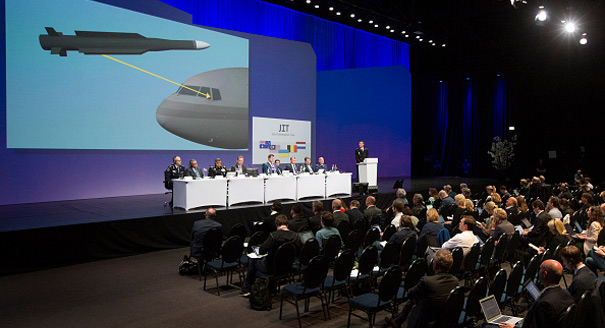
There will be no closure to the shooting down of Malaysian Airlines Flight 17 until those who gave the order to down it are identified.
A Joint Investigative Team (JIT) now has sufficient evidence to prove that on July 17, 2014, Malaysia Airlines Flight 17 (MH17) was shot down by a Buk missile that was transported from Russia to pro-Russian separatists in eastern Ukraine. All 298 people on board the plane were killed.
After lengthy investigations, which are not yet over, the team of representatives from Australia, Belgium, Malaysia, the Netherlands, and Ukraine gave a detailed account of the arrival into and departure out of Ukraine of the Buk transporter erector launcher and radar (TELAR) missile.
Briefly, the system was transported on a white Volvo truck with a lowboy trailer to eastern Ukraine. The trailer was escorted by several other vehicles and by armed men in uniform. The final destination of the Buk system was on farmland near the eastern Ukrainian city of Pervomaiskyi. After the missile was fired, the Buk TELAR was reloaded onto the Volvo truck and transported back to the Russian border. During the night of July 17, the convoy crossed into the Russian Federation.
These are the facts. What is not yet known is who gave the order to fire the missile and who is ultimately responsible for the downing of the civilian aircraft. Following on from that, it is not known why the plane was shot down.
The JIT findings put the spotlight on three issues: the victims, the victimized, and the ever-simmering and dangerous conflict in eastern Ukraine.
The relatives of the victims want closure. “We will continue to stand side by side with the victims’ families,” Mark Rutte, the Dutch prime minister, said on September 28 when the JIT released its report. “We will continue striving to ensure that those responsible for the MH17 disaster do not escape justice,” he added.
Russia believes the issue is being politicized; that Moscow is being victimized. “Russia invited Dutch experts to Moscow many times, but Amsterdam refused each offer and are now trying to make a scandal out of it,” said Maria Zakharova, a Russian foreign ministry spokeswoman. She insisted that the ministry “will stop all the attempts to politicize” the MH17 crash.
It is more than a scandal that those who gave the order will not take responsibility for the deaths and for the consequences for Russia. After all, it was the downing of MH17 that persuaded EU countries to impose sanctions on Russia, while the United States and Germany had been looking at ways to put pressure on Russia after its March 2014 annexation of Crimea. Those who gave the order carry responsibility for the sanctions. That, if anything, is self-imposed victimhood.
The third aspect of the investigation is that it shows there is no end to this debilitating conflict in eastern Ukraine. It’s not only about the political stalemate and the way Russia uses it to distract the Ukrainian government from political reforms. It’s also about the sheer scale of the continuing suffering.
By the last count, since Russia annexed Crimea and then went on to invade parts of eastern Ukraine, over 9,500 people have been killed—not to mention the more than 1.4 million internally displaced people. In addition, in the rebel-held areas, there is intimidation and abuse of human rights. The Ukrainian security forces too have been implicated in such violations.
There have also been repeated infringements of the Minsk II accord, forged by German Chancellor Angela Merkel and her Russian and Ukrainian counterparts in February 2015 with the aim of ending the conflict. Monitoring of the ceasefire by the Organization for Security and Cooperation in Europe is hampered by all kinds of restrictions. One can hardly talk even of an uneasy peace in the so-called Donetsk and Luhansk People’s Republics controlled by pro-Russian separatists.
Instead, the conflict is frozen. Attempts by the Normandy format, which consists of France, Germany, Russia, and Ukraine, to ensure full implementation of Minsk II have yielded few results, except one major outcome: the systematic fighting and killing has all but ended.
If he wanted, Russian President Vladimir Putin could end the conflict in Ukraine, just as much as he could help reduce the shocking bloodshed in Syria by stopping the indiscriminate bombing of civilians. But Ukraine is too important for him as a pawn as he tries to prevent the country from integrating with the EU. In the same way, Moscow’s involvement in Syria is about Russia wanting to be a global player and the dubious respect that goes with that longed-for status.
Actually, Russia’s status and reputation could take a turn for the better if the Kremlin admitted responsibility for the downing of MH17. There will be no closure for the victims until the sense of Russia being victimized is punctured.

Nonresident Senior Fellow, Carnegie Europe
Judy Dempsey is a nonresident senior fellow at Carnegie Europe
Recent Work
Judy Dempsey
Judy Dempsey
Carnegie does not take institutional positions on public policy issues; the views represented herein are those of the author(s) and do not necessarily reflect the views of Carnegie, its staff, or its trustees.
Defense tech innovations will be at the heart of Europe’s new security strategy. But so far, Brussels has been making moves without a broader plan, undermining readiness and credibility.

Raluca Csernatoni

When the U.S.-Iran memorandum of understanding was announced, the UK, France, Germany, and Italy declared their readiness to help demine the Strait of Hormuz and lift nuclear sanctions on Tehran. But does Europe need new tools to recover a diplomatic role?

Rym Momtaz, ed.
The Franco-German relationship is on the rocks again. But unlike previous moments of tension, the epochal changes on the world stage require that both step up investment in their bilateral ties.
Rym Momtaz
The EU is putting together a new security strategy to meet today’s myriad challenges. But for any proposal to be effective, the union needs to grapple with its identity and ambitions.

Pierre Vimont

The EU’s new migration policy is not suited to today’s realities. With climate change increasingly becoming a driver of displacement, Europe needs to rethink its deterrence-focused approach.

Shana Tabak