

Commentary
Before the next wave of EU enlargement takes place, the union needs to grapple with thorny questions of how power is distributed among its members.
Emil Sondaj Hansen, Ditte Brasso Sørensen
{
  "authors": [
    "Claudia Major",
    "Christian Mölling"
  ],
  "type": "commentary",
  "blog": "Strategic Europe",
  "centerAffiliationAll": "",
  "centers": [
    "Carnegie Endowment for International Peace",
    "Carnegie Europe"
  ],
  "collections": [],
  "englishNewsletterAll": "",
  "nonEnglishNewsletterAll": "",
  "primaryCenter": "Carnegie Endowment for International Peace",
  "programAffiliation": "",
  "programs": [],
  "projects": [],
  "regions": [
    "Western Europe",
    "Germany",
    "Europe"
  ],
  "topics": [
    "Security",
    "Military",
    "Foreign Policy",
    "EU"
  ]
}
Source: Getty
The defense industry is a taboo in Germany. The new government should make it a strategic element of Berlin’s security policy.
Germany is giving itself the luxury of spending several weeks to form a government.
Never before have Liberals, Greens, and Conservatives tried to set up a coalition to run the country. What has surfaced so far from the negotiations in the defense field reflects traditional dividing lines, such as those between (nuclear) deterrence and pacifist approaches. But a major agreement has also emerged: that a strong European defense policy is desirable.
Yet there is silence about a crucial element needed to make European defense a success: the defense industry. It is a topic that German politicians tend to fear like the devil to holy water.
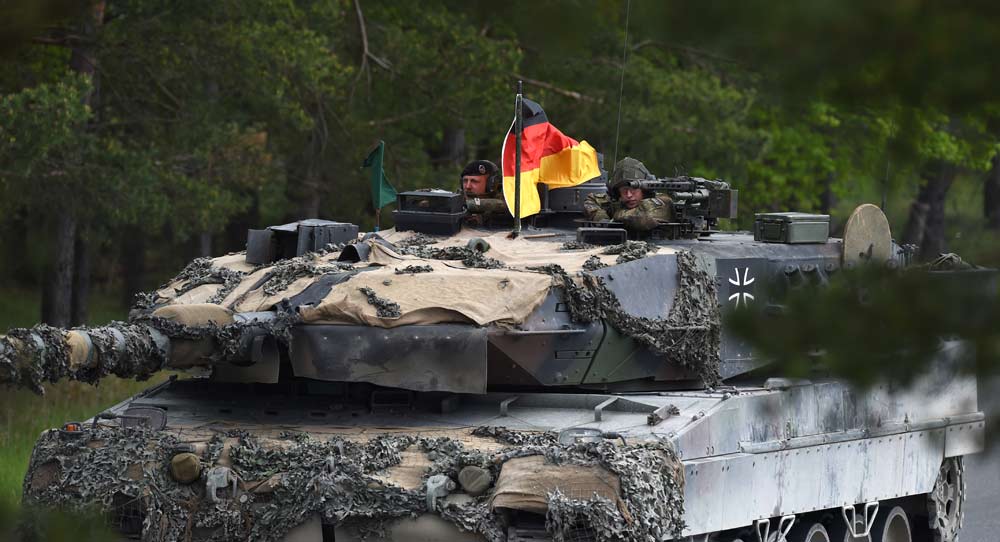
Germany has a large defense industry. It delivers world-class products, including the Leopard tank. But politicians have been reluctant to see the defense industry as an asset or a policy tool. Indeed, it seems that the current coalition would prefer not to touch it.
Rather than shying away from it to avoid controversies, the new government should seek to find a self-confident approach to deal with the German defense industry and make it a strategic element of Berlin’s security policy. It is a precondition for building a credible European defense.
Defense industry issues are difficult in Germany. In the best case, the industry is a non-issue; in the worst case, it’s a dirty business.
Government decisions to authorize arms exports, such as selling tanks to Saudi Arabia, usually create huge controversies in which ethic and human rights arguments clash with vaguely defined German security interests and employment arguments to save domestic manufacturers. In addition, procurement decisions reliably overrun cost and timelines.
Overall, the government does not seem to have a clear line on how the defense industry fits into Germany’s defense policy or, for that matter, Germany’s industrial policy. Berlin also prefers to avoid the issue out of fear of sparking yet another heated public debate. Attempts by Chancellor Angela Merkel’s last government to agree on a common approach toward the defense industry have largely stalled. As a result, industrial issues in their various forms, from procurements to exports, are something between the enfant terrible and the bastard of German security policy.
Yet, not addressing this issue has serious consequences for those goals on which all four German coalition parties agree: more Europe in defense, more cooperation, and more security. The defense industry, procurement, and armaments exports are central to these objectives.
The fact is that any sustainable and credible defense policy needs to be backed by an armament policy. Defense policy is materiel heavy: you can only use and offer to partners what you have currently in terms of capabilities, be it tanks or ships, but also in the next twenty years. Not having equipment available limits your political influence and your options to act and cooperate, thus impacting your partners. Germany likes to offer contributions to the EU, NATO, and the UN. But excluding armaments from defense policy risks affecting the access of German troops to equipment and, therefore, their operational readiness.
This exclusion also undermines the rhetoric of Germany’s defense policy—which usually features Germany as the reference framework nation for long-term military cooperation with partners. This matters for European security.
Any of the many defense cooperation agreements that Germany envisages—be it bilaterally with France, within the EU’s Permanent Structured Cooperation, or the Framework Nations Concept (FNC) within NATO—involves industry. Germany can lead only with reliable commitments in terms of defense industrial contributions and joint procurement. Otherwise, the coherence of the framework is undermined.
Eventually, armament cooperation and exports can be an instrument to shape security relations with others. Joint armament projects can tighten bilateral links, like the KANT project—a merger between French and German land warfare equipment producers. They can also support political goals, such as European strategic autonomy when maintaining, via cooperation, an innovative and independent defense industry, as embodied in the Franco-German initiative to develop a new fighter jet.
Yet all those projects are under pressure to find export solutions that all countries can accept. Their success depends on what regulations are adopted for the export of joint products, such as the next-generation main battle tanks that are manufactured partly in Germany or under German licenses. Not finding a solution, or a potential German export ban, affects German credibility and its reliability as a partner.
Hence the dilemma: Germany wants a stronger European defense. But it avoids addressing a crucial element of it: the industry. What is needed is a German armament strategy that delivers on two levels.
First, the strategy should establish a narrative by linking defense industrial cooperation and exports to German responsibilities in national, European, and global security. What Germany does is defined by its consequences for Berlin, as well as for its current and future partners and adversaries. The armaments dimension should be linked to regional strategies.
Second, security, defense, and industry can only be considered as a cooperative effort. Germany should define itself as a defense industrial framework nation, linked to the concept that exists already for the capability dimension. Germany should take responsibility to maintain the needed capabilities for these partners through industrial infrastructure and cooperation.
If Berlin really wants progress toward a European Defense Union and a strong EU pillar in NATO, it needs to bring defense exports and industrial cooperation in line with security, and explain to its partners how it aims to handle these issues in the future.
Claudia Major is a senior associate for international security at the German Institute for International and Security Affairs (SWP) and a member of Women in International Security (WIIS) Berlin. Christian Mölling is the research director at the German Council on Foreign Relations (DGAP).
Claudia Major
Christian Mölling
Carnegie does not take institutional positions on public policy issues; the views represented herein are those of the author(s) and do not necessarily reflect the views of Carnegie, its staff, or its trustees.

Before the next wave of EU enlargement takes place, the union needs to grapple with thorny questions of how power is distributed among its members.


Emil Sondaj Hansen, Ditte Brasso Sørensen

A summer of escalation in the Black Sea has hurt Ukraine economically and is exacerbating world food security. A truce is needed—as is a broader reframing of Europe’s Ukraine strategy.

Thomas de Waal

Are Germany’s economic, industrial, and political struggles becoming a liability for the EU’s ability to rise to the geopolitical moment?

Rym Momtaz, ed.

European Commission President Ursula von der Leyen is about to give her annual address on the state of the EU. Here’s what she won’t—but should—say.
Rym Momtaz

The aftermath of the Ceuta crisis shows Europe has drawn the wrong lessons. Rather than doubling down on failed migration policies, the EU needs to address the underlying roots of such episodes.

Richard Youngs