

Commentary
Judy Dempsey
{
  "authors": [
    "Judy Dempsey"
  ],
  "type": "commentary",
  "blog": "Strategic Europe",
  "centerAffiliationAll": "",
  "centers": [
    "Carnegie Endowment for International Peace",
    "Carnegie Europe"
  ],
  "collections": [
    "Turkey’s Transformation"
  ],
  "englishNewsletterAll": "",
  "nonEnglishNewsletterAll": "",
  "primaryCenter": "Carnegie Europe",
  "programAffiliation": "",
  "programs": [],
  "projects": [],
  "regions": [
    "Europe",
    "Türkiye",
    "Middle East",
    "Western Europe",
    "Germany"
  ],
  "topics": [
    "Foreign Policy",
    "EU"
  ]
}
Source: Getty
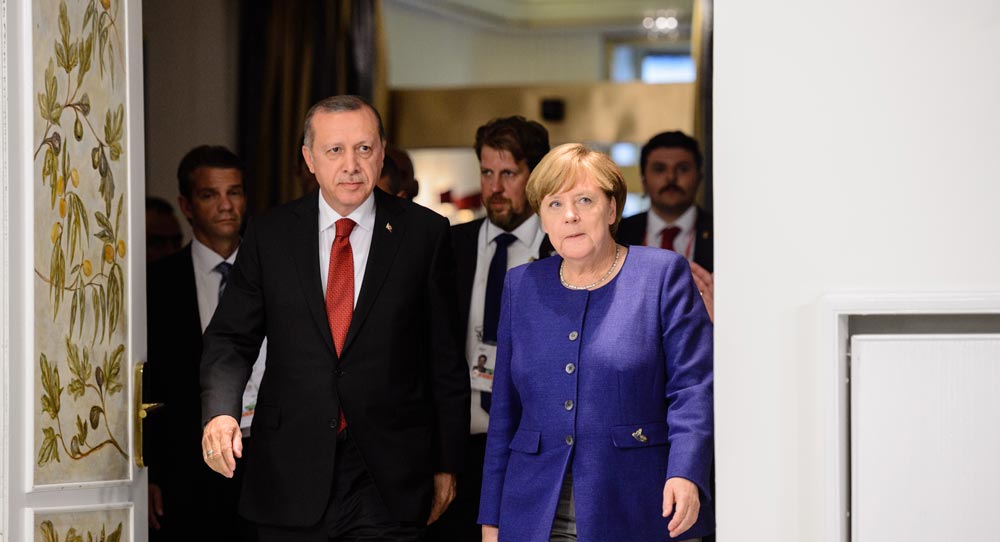
The Trump administration’s sanctions on Turkey just might be the catalyst to shift Europe’s relations with Ankara.
Diplomacy is not one of U.S. President Donald Trump’s strong suits. Rather, it is his use of sanctions, believing that they can change a leader’s behavior.
Trump slapped sanctions on Iran after his administration walked away from the nuclear deal the United States forged with the Europeans. He imposed more sanctions on Russia. Then there is the battery of U.S. sanctions in the form of a dangerous trade war with China.Now the latest casualty of this policy is Turkey, with the introduction of stiff U.S. tariffs on Turkish exports. The reason is that President Recep Tayyip Erdoğan has placed an American pastor, Andrew Brunson, under house arrest on charges of espionage and has flatly refused requests by Trump to release him and send him back to the United States. Washington has also placed sanctions on two Turkish ministers, accusing them of human rights abuses.
So far, Trump’s measures have emboldened Erdoğan. True to form, Erdoğan told a recent rally that the country was being threatened “through the economy, through sanctions, foreign exchange, interest rates, and inflation.” What was taking place was an “attempted economic coup… We tell them that we see their game and we challenge them,” he added.
Maybe Trump can feel vindicated by what is happening in Turkey. The economy is contracting. Investor and markets sentiment is weakening, the public is beginning to grumble, and the currency is rapidly losing value.
But for Europe, especially for Germany, the sanctions are not only the worst possible way to deal with a leading NATO ally—and one is that heavily embroiled in Syria. The sanctions could actually plunge Turkey into instability, moving it closer to Russia and Iran. This is something that Berlin dreads for several reasons.
First, Chancellor Angela Merkel needs Turkey to stick to the deal it reached with the EU to stop refugees reaching Europe. Turkey, with financial assistance from Brussels, has kept its side of the bargain. It’s hard to predict what would happen if there was a backlash against Erdoğan. The last thing Germany needs right now is an influx of refugees from Turkey. This is about interests.
Second, while Merkel has walked a fine line with Erdoğan—because she needs his cooperation over the refugee and migration issues—Germany’s political leaders have been consistent in criticizing Erdoğan’s persistent crackdown on the media, on the judiciary, on civil society, and on human rights activists.
But instead of imposing sanctions, Germany has applied the maximum of diplomatic and political pressure on Erdoğan. Erdoğan, in turn, has repeatedly railed against Germany, accusing it of “fascist actions” reminiscent of Nazi times when Berlin, citing security reasons, cancelled political rallies last year that were aimed at drumming up support for Erdoğan’s Justice and Development Party among the 1.5 million Turkish citizens in Germany.
Such comments caused an outcry in Germany, but the government has kept all diplomatic channels open and maintained the political pressure. It has paid off. Meşale Tolu, a German citizen and journalist was released. So was Taner Kılıç, a human rights defender for Amnesty International.
And third, despite Turkey’s role in Syria and its growing ties with Russia, it is an important NATO ally. It’s not just because NATO has a strategically important military airbase in İncirlik and relies on Turkey to help fight against the so-called Islamic state in Syria and Iraq. It’s because of the country’s geostrategic location. Erdoğan can certainly exploit this relationship. And despite all the private grumbling in NATO headquarters in Brussels about how Erdoğan is eroding the rule of law and is also sacking very experienced army officers and personnel, both sides need each other.
Reacting to the rapid deterioration of the Turkish economy and the stand-off between Washington and Ankara, German politicians (not Merkel) said both Berlin and the European Union must not isolate Turkey. “Turkey is a NATO partner who we cannot ignore. It is in everyone’s interest that Turkey remains economically stable and that the current turbulence involving its currency can be stemmed,” said Andrea Nahles, leader of the Social Democrats that is in coalition with Merkel’s conservative bloc. Berlin, too, is urging Ankara to accept an International Monetary Fund aid program. That would surely wound Erdoğan’s pride.
In short, Erdoğan, who is due to visit Germany in September, may be forced to take a hard look at his political, social, and economic policies. As it is, the economy is so dependent on Europe—and on Germany in particular. Perhaps the American sanctions could provide the Europeans with a chance, over time, to get Turkey back on the European track based on the rule of law, an independent judiciary, and a free and flourishing media. But Erdoğan has to make the first move and weigh up the cost.

Nonresident Senior Fellow, Carnegie Europe
Judy Dempsey is a nonresident senior fellow at Carnegie Europe
Recent Work
Judy Dempsey
Judy Dempsey
Carnegie does not take institutional positions on public policy issues; the views represented herein are those of the author(s) and do not necessarily reflect the views of Carnegie, its staff, or its trustees.
The EU had to compromise to adopt a twenty-first sanctions package against Russia, exposing growing cracks in the union’s resolve. Is this latest, weaker round worth it to keep pressure on Moscow?

Rym Momtaz, ed.

Trump is distracted and Ukraine wants Europe to step up. The continent’s leaders must find their voice and assert it in talks with Russia.

Alissa de Carbonnel

Mounting economic strain and battlefield losses will not necessarily make the Kremlin less dangerous. They could instead push Moscow toward a more aggressive hybrid campaign designed to test NATO’s Eastern flank, exploit allied hesitation, and fracture European resolve.

Maksym Beznosiuk

Over the past ten years, NATO has held almost as many summits as it did during the entirety of the Cold War. Are they still useful, or is it time to stop holding annual meetings?
Rym Momtaz, ed.
Nearly a year and a half after Europeans leaned into sucking up to Trump, the strategy has produced some benefits when it comes to Ukraine.
Rym Momtaz