

Commentary
Marc Pierini
{
  "authors": [
    "Marc Pierini"
  ],
  "type": "commentary",
  "blog": "Strategic Europe",
  "centerAffiliationAll": "",
  "centers": [
    "Carnegie Endowment for International Peace",
    "Carnegie Europe"
  ],
  "collections": [
    "Turkey’s Transformation"
  ],
  "englishNewsletterAll": "",
  "nonEnglishNewsletterAll": "",
  "primaryCenter": "Carnegie Europe",
  "programAffiliation": "",
  "programs": [],
  "projects": [],
  "regions": [
    "Russia",
    "Europe",
    "Türkiye",
    "Middle East"
  ],
  "topics": [
    "EU",
    "Economy",
    "Climate Change"
  ]
}
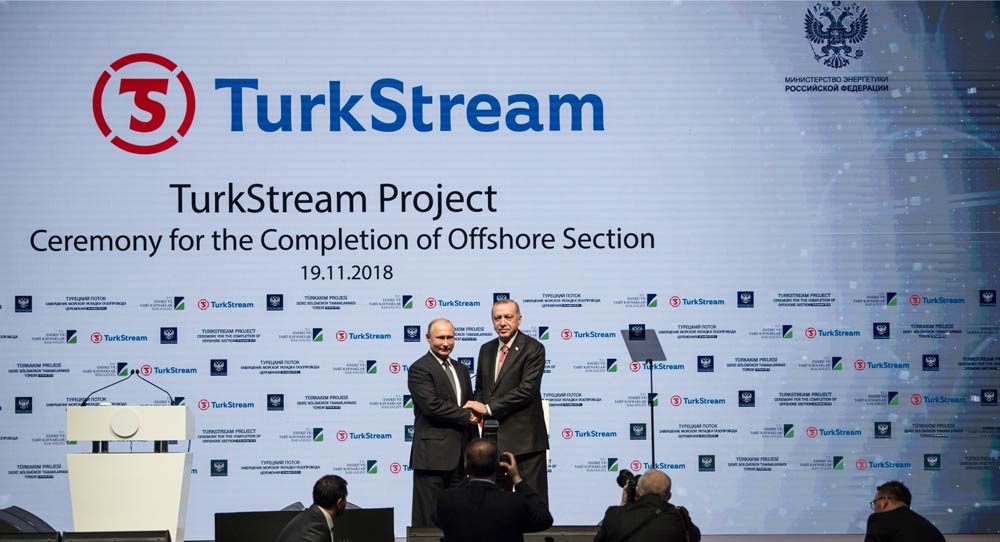
Source: Getty
The Turkish Stream pipeline will make Ankara more energy dependent on Moscow. It will also give Russia a bigger energy foothold in Europe.
It was November 19 in Istanbul.
There, Russian President Vladimir Putin and Turkish President Recep Tayyip Erdoğan held a ceremony marking the completion of the first underwater segment of the Turkish Stream gas pipeline, linking Russia to Turkey’s European shores. The project is a vivid illustration of Moscow’s strategy to strengthen its position in supplying gas to Europe while reducing its reliance on the Ukrainian transit corridor.
For Ankara, the project is a symbol of Turkey’s independent decisionmaking and of the country’s significance in the wider region. Seen from Ankara, Turkish Stream serves a political purpose. It celebrates the blossoming friendship between Turkey and Russia and confirms Ankara’s ambition to be part of the solution to major international issues—in this case, securing the gas needs for a large part of the EU.
However, Turkish Stream will also increase Ankara’s dependence on Moscow for its energy needs.The project’s second meaning is that Turkey is contributing to an essential element of Russia’s multi-pronged, long-term strategy of remaining Europe’s major gas supplier, while creating a “third gas corridor” in addition to the Ukrainian and Baltic Sea supply routes. This strategy is unfolding on several fronts: in Ukraine; in the Baltic Sea; and through future extensions of Turkish Stream to southern and central Europe (toward Bulgaria, Serbia, Hungary, Slovakia, and to Greece and Italy.)
This Russian strategy has raised continuous opposition from the United States.
It is worth noting that Turkish Stream is not part of the EU’s Energy Union plans since it does not contribute to diversification of supplies. In fact, it will rather reinforce Russia’s market predominance in both Turkey and the EU.
In Ukraine, the multi-pipeline network channeling Russian gas to Western Europe will remain a vital link. But reducing its use could inflict massive losses in terms of transit costs for authorities in Kiev, which is part of Russia’s strategy in Ukraine.
Much will depend on negotiations for the extension of the Russia-Ukraine commercial agreement, which will end in 2019. To help alleviate Kiev’s concerns, Germany has made the continuation of transit via Ukraine an ingredient of a final agreement on Nord Stream 2, the latter being the subject of controversies within the EU.
The Russian strategy is in no way limited to selling Russian gas on the European continent. It extends much further afield in the wider Eastern Mediterranean region.
Egypt is a case in point.
Following the massive discoveries in the so-called Zohr field to the north and east of the Nile River delta, Russia bought a 30 percent stake from the Italian energy group ENI in 2016 with the consent of the Italian government, which Moscow has had a long and close relationship with. The official reason for the sale was the need for ENI to spread the risk of its Egyptian operation.
Similarly, offshore gas discoveries in Lebanese waters have attracted Russian interest— although drilling off Lebanon is largely dominated by France’s TOTAL and Italy’s ENI, who have a 40 percent share each. Russia’s NOVATEK has bought a 20 percent stake.
Russia has also made moves to control both the oil and gas sector in Syria, despite the ongoing war. The actual effect of these recent maneuvers will very much depend on the final political arrangement expected to end the almost eight-year-old civil war. Many of Syria’s oil and gas fields are located north and east of the Euphrates River, currently outside the control of regime forces. In addition, for reasons linked to the ongoing naval military activities, no offshore exploration has yet taken place in Syrian waters.
In Iraq, Russia is involved in pipeline deals in the Kurdistan region through a number of oil and gas companies, although the actual exports would have to take place through Turkish territory or possibly even through Syria in the distant future.
Such an ambitious Russia strategy is justified by Europe’s gas market fundamentals.
A stronger demand for gas in Europe is good for Russia. According to Oxford Energy, gas demand in Europe (Turkey and non-EU Eastern Europe included, except Serbia) has started rising again for three consecutive years—in 2015, 2016, and 2017—to reach a level of 548 billion cubic meters (bcm), due to continued economic recovery, the impacts of climate change, and the increased use of gas by the power sector. The trend seems to be continuing in 2018.
According to the Finnish Institute for International Affairs, Russia took advantage of several factors: economic recovery and decreasing gas production in the EU, lower Russian selling prices, and the current limited availability of non-Russian liquefied natural gas (LNG) on the European market.
In addition, preexisting disputes between the EU and Russia (including an antitrust investigation against Gazprom, and a Russian complaint at the WTO) have been resolved, signaling that commercial interests on both sides have prevailed, despite a less-than-optimal political climate.
In such an environment, Russia is in a strong position to keep dominating gas supplies to the EU, which amounted to 40 percent of extra-EU imports in 2016—although new developments could upset the current situation, such as a rapid development of LNG exports to Europe from other sources. LNG imports amounted to only 14 percent of total extra-EU gas imports in 2017, with the main supplies coming from Qatar (41 percent), Nigeria (19 percent), and Algeria (17 percent).
In this wider context, and seen from Brussels, Turkish Stream—with a final projected capacity to deliver 31.5 bcm/y, of which 15.75 bcm/y would go to Europe —is a relatively small component of the wider gas supply chain to the EU. In fact, it would represent just over 6 percent of the EU’s imports at 2017 levels.
Yet, seen from Moscow, the pipeline is potentially a significant addition to Russia’s capabilities to export gas to Europe (Turkey included). Assuming that Turkish Stream’s second phase will be completed and operational, it would represent between 16 and 19 percent of Russian sales to the EU and Turkey (at 2017 levels and all other factors remaining unchanged).
In that sense, the ceremony on November 19 in Istanbul was more than just another photo opportunity. It was a symbol of the success of Russia’s objectives in the wider Western European area, with Turkey’s help. Together with Russia’s S-400 missile deal with Turkey, it was a symbol of how efficiently Moscow has been using Ankara’s relative diplomatic isolation to its advantage. For Ankara, this was another way of telling the world: Turkey matters.

Senior Fellow, Carnegie Europe
Marc Pierini is a senior fellow at Carnegie Europe, where his research focuses on developments in the Middle East and Turkey from a European perspective.
Recent Work
Marc Pierini
Marc Pierini
Carnegie does not take institutional positions on public policy issues; the views represented herein are those of the author(s) and do not necessarily reflect the views of Carnegie, its staff, or its trustees.

As we close out another season of Strategic Europe, it is worth taking stock of the deep shifts underway.

Rym Momtaz
The EU had to compromise to adopt a twenty-first sanctions package against Russia, exposing growing cracks in the union’s resolve. Is this latest, weaker round worth it to keep pressure on Moscow?
Rym Momtaz, ed.

Trump is distracted and Ukraine wants Europe to step up. The continent’s leaders must find their voice and assert it in talks with Russia.

Alissa de Carbonnel

Mounting economic strain and battlefield losses will not necessarily make the Kremlin less dangerous. They could instead push Moscow toward a more aggressive hybrid campaign designed to test NATO’s Eastern flank, exploit allied hesitation, and fracture European resolve.

Maksym Beznosiuk

Over the past ten years, NATO has held almost as many summits as it did during the entirety of the Cold War. Are they still useful, or is it time to stop holding annual meetings?
Rym Momtaz, ed.