

Commentary
Judy Dempsey
{
  "authors": [
    "Judy Dempsey"
  ],
  "type": "commentary",
  "blog": "Strategic Europe",
  "centerAffiliationAll": "",
  "centers": [
    "Carnegie Endowment for International Peace",
    "Carnegie Europe"
  ],
  "collections": [
    "Transatlantic Cooperation"
  ],
  "englishNewsletterAll": "",
  "nonEnglishNewsletterAll": "",
  "primaryCenter": "Carnegie Europe",
  "programAffiliation": "",
  "programs": [],
  "projects": [],
  "regions": [
    "Asia",
    "Europe",
    "North America",
    "Western Europe"
  ],
  "topics": [
    "Foreign Policy",
    "Security",
    "EU"
  ]
}
Source: Getty
The Europeans should stop writing off the West and instead worry about China, Russia, and other illiberal regimes.
Carnegie Europe is on the ground at the 2020 Munich Security Conference, offering readers exclusive access to the debates as they unfold and providing insights on today’s threats to international peace and stability.
***
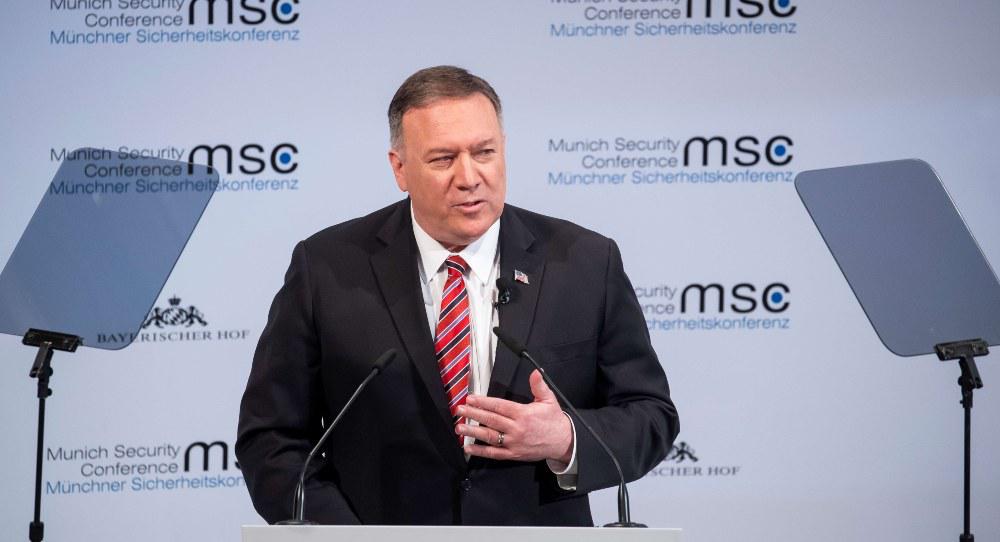
First, the good news if you are Mike Pompeo but not Wolfgang Ischinger.
As the U.S. secretary of state took to the podium at the start of day two of the Munich Security Conference (MSC), he slammed the idea of “Westlessness.” This was the theme Ischinger, the MSC chairman, had chosen for the conference. So it was a bit of an insult to the organizers but a relief to those who believe that the West is alive and well. For Pompeo, the West is in good shape.
“I’m happy to report that the death of the transatlantic alliance is grossly overexaggerated. The West is winning, and we’re collectively winning, we are doing it together,” he said.
The West’s health is thanks to the United States. It is right behind NATO. It is allocating more funds for the defense of Central and Eastern Europe. And under pressure from the Americans, NATO’s European allies are spending more on their own security, Pompeo said, with a word of appreciation to NATO Secretary General Jens Stoltenberg.Stoltenberg, who spoke before Pompeo, has the ability each year to duck any criticism of the alliance’s decisions or missions—despite its failure to stop the rise of the Taliban in Afghanistan or its lack of a plan for the day after NATO’s military attack in Libya in 2011.
Anyway, back to Pompeo, who stated that the United States was also supporting multilateralism and arms control. The audience found that hard to swallow.
The “America First” philosophy of the administration of U.S. President Donald Trump, while blunt and clear about its interests, runs counter to the idea of multilateralism.
The United States is walking away from the Paris Agreement on climate change, even though Pompeo also said the United States “was leading on the environment.” It is tearing up a multilateral accord to ban and destroy land mines. And while Pompeo waxed lyrical about the administration’s diplomatic overtures to North Korea, in the belief that the regime will discard its nuclear missile weapons program, everything suggests the opposite.
And don’t forget how the United States has walked away from the agreement, led by the major powers, to rein in Iran’s nuclear program. Maybe that agreement—the Joint Comprehensive Plan of Action—does need modification. But discarding it leaves America’s allies weaker in their ability to persuade Iran to stick to the deal.
All that aside, the West is doing fine. And the Europeans should recognize that. “The free West has a far brighter future than illiberal alternatives. . . . Don’t be fooled by those who say otherwise,” Pompeo said.
Another bout of slamming was taken up by Mark Esper, the U.S. secretary of defense. In his speech, Europe was a sideshow, to say the least. His focus was China, China, China. For him, China was conducting a “nefarious strategy” through its telecommunications company, Huawei.
“It is essential that we as an international community wake up to the challenges presented by Chinese manipulation of the long-standing international rules-based order,” Esper said.
Apart from the Huawei controversy, he also referred to the discussions that took place before China was admitted to the WTO in 2001. Back then, the idea was that with membership, China would become a market-oriented trading partner, which would then eventually lead to political opening.
But others warned that China would use the benefits of membership “to grow its economy and access technology required to build a strong military and security state capable of expanding the reach of its authoritarian rule,” Esper said.
“We know which one is winning right now. It’s not the former,” he concluded.
Both Pompeo and Esper were confident about the West’s future and confident about their views on China. It was up to the West to defend its values instead of whining—and to recognize that China’s values and interests makes it the West’s competitor.
Photo credit: MSC/Hennemuth

Nonresident Senior Fellow, Carnegie Europe
Judy Dempsey is a nonresident senior fellow at Carnegie Europe
Recent Work
Judy Dempsey
Judy Dempsey
Carnegie does not take institutional positions on public policy issues; the views represented herein are those of the author(s) and do not necessarily reflect the views of Carnegie, its staff, or its trustees.

Ahead of a tough winter for Ukraine, Donald Trump’s swing back toward Russia bodes ill. But instead of panicking, Kyiv’s European allies are focusing on action.

Rym Momtaz

While the EU and European governments are embracing the much-lauded middle-power moment, this entails three difficult conundrums.

Richard Youngs

Much has been said of the changes Brussels is trying to make to the EU enlargement process. Here’s why gradual integration might—or might not—be the answer.

Dimitar Bechev

The European Commissioner for Trade is headed to China. But after President Xi’s bridge-building visit to Washington, can a more isolated EU overcome Beijing’s stranglehold on critical raw materials? Who will blink first?
Rym Momtaz, ed.

The domestic impacts of how long it is taking to end the war in Ukraine have pushed the French electorate to the political extremes and compromised the country’s diplomatic capacity.
Rym Momtaz