

Article
Marc Pierini
{
  "authors": [
    "Marc Pierini"
  ],
  "type": "commentary",
  "blog": "Strategic Europe",
  "centerAffiliationAll": "",
  "centers": [
    "Carnegie Endowment for International Peace",
    "Carnegie Europe"
  ],
  "collections": [
    "Turkey’s Transformation",
    "Transatlantic Cooperation"
  ],
  "englishNewsletterAll": "",
  "nonEnglishNewsletterAll": "",
  "primaryCenter": "Carnegie Europe",
  "programAffiliation": "",
  "programs": [],
  "projects": [],
  "regions": [
    "Europe",
    "Türkiye",
    "Middle East",
    "Western Europe"
  ],
  "topics": [
    "Foreign Policy",
    "Security",
    "Democracy",
    "EU"
  ]
}
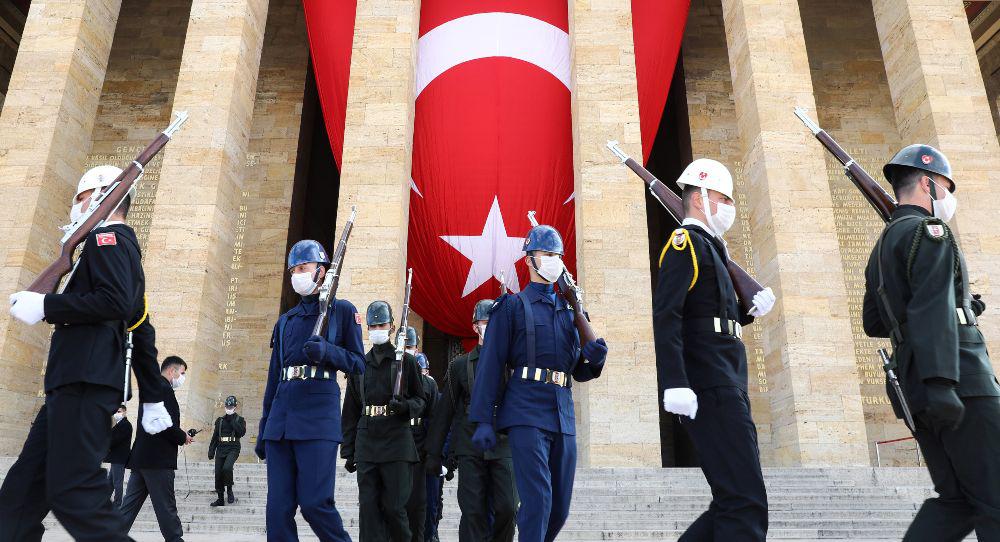
Source: Getty
The era of European benevolence and benign neglect with Ankara is over; Turkey is now openly adversarial toward the entire European Union and NATO. It’s time for the EU to clarify its response.
When dealing with Turkey in recent years, puzzled European governments have often oscillated between countering Ankara’s animosity and showing openness to dialogue.
It is now beyond doubt that the trajectory chosen by Turkey’s leaders is going against the interests and values of the EU in a host of different ways.Rule of law is being systematically destroyed. An absurd economic policy is weakening a large partner country and jeopardizing the stock of European investment. Turkey’s relations with its neighbors have sharply deteriorated, and the EU’s calls for dialogue remain unheeded.
The path to a comprehensive agreement on Cyprus has been closed by the Turkish president, who has said he favors a two-state solution for the island, which has been divided since 1974.
Ankara’s defense choices have played in favor of Russia, not NATO. Foreign policy has been militarized and become unpredictable. The intervention in Libya has created risks for European interests and could destabilize countries in the Sahel. Refugees have been weaponized, as seen in February 2020 at the land border with Greece.
In addition, the permanent narrative against a supposedly Islamophobic Europe is utterly ambiguous and seen more as a political instrument than anything akin to religious concerns. For example, Turkey long waged a massive campaign against Beijing’s repression of Uighurs, a Muslim minority in Western China, only to cancel it entirely when a few billion dollars of Chinese help was at stake.
European leaders have now woken up. Multiple attempts to assuage the Turkish president have failed—he has met all openings with silence or provocation, especially the European Council’s offer on October 1.
Many in Europe’s political circles now consider that a permanently adverse posture is likely in the run-up to the 2023 Turkish presidential and legislative elections (if they take place) and possibly beyond that pivotal year. Part of the animosity toward Europe can be explained by domestic political and economic hurdles and by the ruling alliance between the Justice and Development Party and the Nationalist Movement Party.
But another strong motive is Turkey’s willingness to distance itself from the West when its national interests are felt to be at stake.
This has recently resulted in multiple serious contradictions: deploying and testing Russian S-400 missiles; challenging maritime boundaries with Greece; blocking NATO’s policy to protect Poland and the Baltic states; hampering NATO’s Operation Sea Guardian, which enforces the arms embargo against all warring parties in Libya.
In practice—and despite Turkey’s vocal claims to the contrary—this means selectively shedding the commitment to the North Atlantic alliance.
Against its structural proclivity toward dialogue, the European Council cannot use procrastination and benevolence with Ankara anymore. A thorough clarification of the European Union’s policy with Turkey is necessary on several fronts—military, foreign affairs, economy, refugees, rule of law—based on an assessment of threats to EU interests and values.
Charting a course of action is no easy matter, not just because of different preferences between European governments, but primarily because of Ankara’s choice to fuel permanent tension.
There is little doubt that some EU governments will continue to pursue or support a benevolent approach toward Turkey, be it for reasons of principle, sheer economic interest, or autocratic affinity.
Others will prefer a more muscular approach. Ankara has so far exerted its best efforts to divide European governments and used an extraordinarily aggressive tone with France, Germany, and the Netherlands.
Notwithstanding the difficulty, an EU menu of action should aim to cover at least the following seven domains:
Turkey is free to chart an entirely new course for itself, but EU leaders have a duty to defend their values and interests.
Turning a blind eye or playing down what Turkey’s leadership is doing to its country and to its policies toward the EU and NATO creates a strategic risk for European governments. Leniency is not an option anymore.

Senior Fellow, Carnegie Europe
Marc Pierini is a senior fellow at Carnegie Europe, where his research focuses on developments in the Middle East and Turkey from a European perspective.
Recent Work
Marc Pierini
Marc Pierini
Carnegie does not take institutional positions on public policy issues; the views represented herein are those of the author(s) and do not necessarily reflect the views of Carnegie, its staff, or its trustees.

An overwhelming victory by a far-right-wing party in a small state in eastern Germany will have major repercussions for Chancellor Friedrich Merz’s coalition.

Judy Dempsey

Canadian Prime Minister Mark Carney has twice inspired praise for standing up to U.S. President Donald Trump: at the 2026 World Economic Forum in Davos and on Canada-U.S. trade negotiations. Is Carney showing a third way better than the EU has in dealing with the Trump administration?

Rym Momtaz, ed.

The EU’s responses to two recent incidents expose the gulf between European perceptions and capabilities. Unless the union can bridge that gap, it will never become a real geostrategic power.
Rym Momtaz

In supporting Europe’s far-right, MAGA and Russia both want the same thing: a weaker EU. Europe must defend itself without abandoning the openness these forces exploit.

Armida van Rij

As we close out another season of Strategic Europe, it is worth taking stock of the deep shifts underway.
Rym Momtaz