

Commentary
Judy Dempsey
{
  "authors": [
    "Judy Dempsey"
  ],
  "type": "commentary",
  "blog": "Strategic Europe",
  "centerAffiliationAll": "",
  "centers": [
    "Carnegie Endowment for International Peace",
    "Carnegie Europe"
  ],
  "collections": [
    "EU Integration and Enlargement"
  ],
  "englishNewsletterAll": "",
  "nonEnglishNewsletterAll": "",
  "primaryCenter": "Carnegie Europe",
  "programAffiliation": "",
  "programs": [],
  "projects": [],
  "regions": [
    "Russia",
    "Europe",
    "Western Europe"
  ],
  "topics": [
    "Foreign Policy",
    "EU",
    "Democracy"
  ]
}
Source: Getty
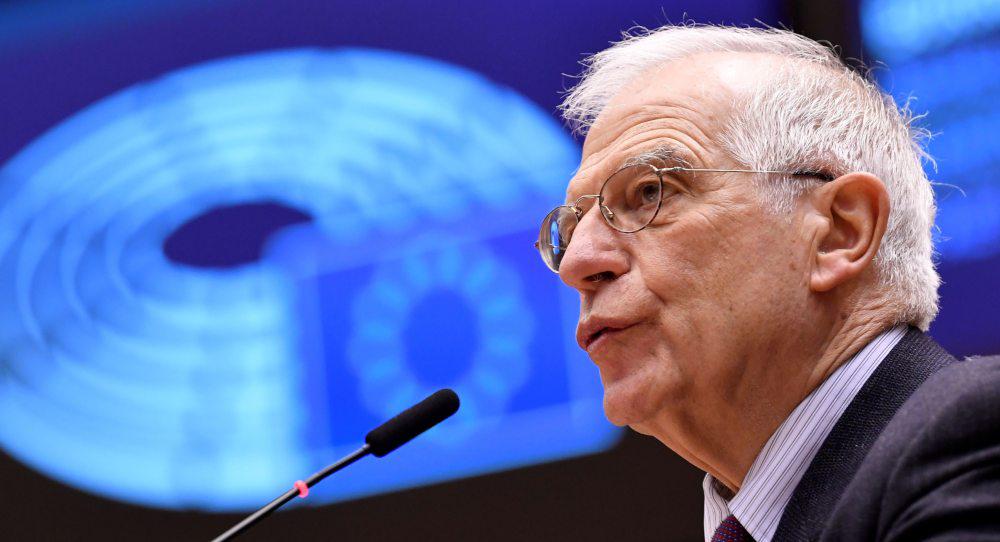
Josep Borrell’s trip to Moscow confirmed the miserable state of European foreign policy, which lacks strategy and direction. Starting with Germany, member states need to think beyond their own national interests.
During the last four years, the European Union had a rare chance to begin to act strategically. Then U.S. president Donald Trump, who was dismantling American global leadership, had only scorn for the EU, NATO, transatlantic relations, and multilateral institutions.
This could have been such an opportunity for the Europeans to try and fill the international gap created by the Trump administration. Instead, they wasted it. They seemed to prefer criticizing, if not mocking, the U.S. administration—rather than mobilizing European public support behind constructing a more strategic EU foreign policy. This is what French President Emmanuel Macron has tried but failed to do.The visit by the EU’s top diplomat, Josep Borrell, to Moscow on February 4–6 confirmed this miserable state of European foreign policy. Miserable because it lacks strategy and direction. Most of the member states, particularly Germany, see little interest in giving Borrell the authority he needs to forge a strong foreign policy. His predecessors endured the same weakness of a position that is beholden to Europe’s capitals.
No wonder then that Borrell’s blog, written upon his return from Moscow, was defensive. He went out of his way to justify a visit which had already been opposed by a few member states. Comparing his blog to the self-confident, partly condescending statement by Russian Foreign Minister Sergei Lavrov showed how Europe’s top diplomat travelled to Moscow with an empty suitcase.
After the visit, which included an “aggressively-staged” joint press conference that was followed by Russia’s expulsion of three EU diplomats, Borrell wrote that “the Russian authorities did not want to seize this opportunity to have a more constructive dialogue with the EU. While not fully unexpected, this is regrettable . . . [and] we will have to draw the consequences.”
But it’s the reverse situation. Moscow knows what it wants from the EU: a relationship that is based on dealing separately with each member state—which is exactly how it conducts its foreign, economic, and trade policy toward Germany, for example.
In contrast, the EU and the member states—collectively—don’t know what kind of dialogue or relationship they want with Russia. Germany’s stance is particularly puzzling.
As leader of the EU’s most important country, German Chancellor Angela Merkel has the authority to give Europe the foreign policy that it sorely needs. But Merkel is no strategist. If she were, she could have used Nord Stream 2, the gas pipeline being built between Russia and Germany, as leverage over Moscow.
This lack of a strategic thinking will not change under the administration of U.S. President Joe Biden, which is already moving fast on the foreign policy front. Instead, and this refers to Germany again, it will only change once Berlin makes the leap from defending national interests to defending European interests and giving the union the authority it needs to project a strong, common foreign policy. And one that combines interests with values.
As it is, even inside the EU, Germany is doing the opposite. Merkel could have exerted her considerable influence in the European People’s Party (EPP), the political bloc in the European Parliament that represents conservative parties, to expel Hungary’s governing Fidesz party.
Yes, Fidesz has been suspended. But it still sits in the EPP. Yet the damage that its leader, Hungarian Prime Minister Viktor Orbán, has inflicted on Hungary’s democracy, checks and balances, media, academic freedom, and civil society since 2010—while getting away with it all—erodes the values and interests of the EU as a whole. Countries such as Poland and Bulgaria now know they too can get away with undermining the rule of law and perpetuating state corruption.
This inability to collectively defend interests and values inside the EU has repercussions for foreign policy. It plays into the hands of China, Egypt, and Russia—to name just a few—whose leaders recognize the EU’s weaknesses as a foreign policy non-actor. That allows them to pursue their own interests with individual European governments.
Despite all the “deep concern” about Russian opposition leader Alexei Navalny’s prison sentence, or the attempt to murder him with a poisonous chemical substance, or Russia’s cyberattacks on the German parliament, or China’s threats to impose embargoes on EU countries that openly criticize its crackdown on democracy in Hong Kong, or the repression in Belarus, Europe’s responses have not been even half baked.
The fact that leaders of the EU institutions have not managed to counter the 17+1 forum, in which Beijing meets regularly with a group of Central and Eastern European and Balkan countries to promote its political and economic interests, is a perfect example of China’s successful divide-and-rule policy in Europe.
It is also a perfect example of how the twelve EU member states involved in this format have thrown EU values to the wind. When it comes to defending basic values, it makes it even more difficult for Brussels to deal with Beijing—as the recent EU-China investment accord shows. Values don’t get a look in.
None of the above makes Borrell’s role any easier.
Toward the end of his blog, he writes: “Locking ourselves up behind walls and calling on others from the safety of that position will not bring greater security to the EU,” adding that “we have to face challenges, including meeting others in their home turf, just when negative events are unfolding. . .”
He has a point. But surely that means traveling equipped with a strategy that combines values, common interests, and goals. Until now, national interests in Europe have prevented that from happening. It’s hard to see that changing.

Nonresident Senior Fellow, Carnegie Europe
Judy Dempsey is a nonresident senior fellow at Carnegie Europe
Recent Work
Judy Dempsey
Judy Dempsey
Carnegie does not take institutional positions on public policy issues; the views represented herein are those of the author(s) and do not necessarily reflect the views of Carnegie, its staff, or its trustees.

With its public finances in shambles, the far right polling at 35 percent ahead of the 2027 presidential election, and a growing protest movement, is France’s crisis a threat to the EU’s geopolitical awakening?

Rym Momtaz, ed.

Ahead of a tough winter for Ukraine, Donald Trump’s swing back toward Russia bodes ill. But instead of panicking, Kyiv’s European allies are focusing on action.
Rym Momtaz

While the EU and European governments are embracing the much-lauded middle-power moment, this entails three difficult conundrums.

Richard Youngs

Much has been said of the changes Brussels is trying to make to the EU enlargement process. Here’s why gradual integration might—or might not—be the answer.

Dimitar Bechev

The European Commissioner for Trade is headed to China. But after President Xi’s bridge-building visit to Washington, can a more isolated EU overcome Beijing’s stranglehold on critical raw materials? Who will blink first?
Rym Momtaz, ed.