

Q&A
- +1
Amr Hamzawy, Andrew Leber, Eric Lob, …
{
  "authors": [
    "Marwan Muasher"
  ],
  "type": "commentary",
  "blog": "Strategic Europe",
  "centerAffiliationAll": "",
  "centers": [
    "Carnegie Endowment for International Peace",
    "Carnegie Europe"
  ],
  "collections": [],
  "englishNewsletterAll": "",
  "nonEnglishNewsletterAll": "",
  "primaryCenter": "Carnegie Endowment for International Peace",
  "programAffiliation": "",
  "programs": [],
  "projects": [],
  "regions": [
    "Middle East",
    "Israel",
    "Palestine",
    "Western Europe",
    "Europe"
  ],
  "topics": [
    "Democracy",
    "Security",
    "Foreign Policy",
    "EU"
  ]
}
Source: Getty
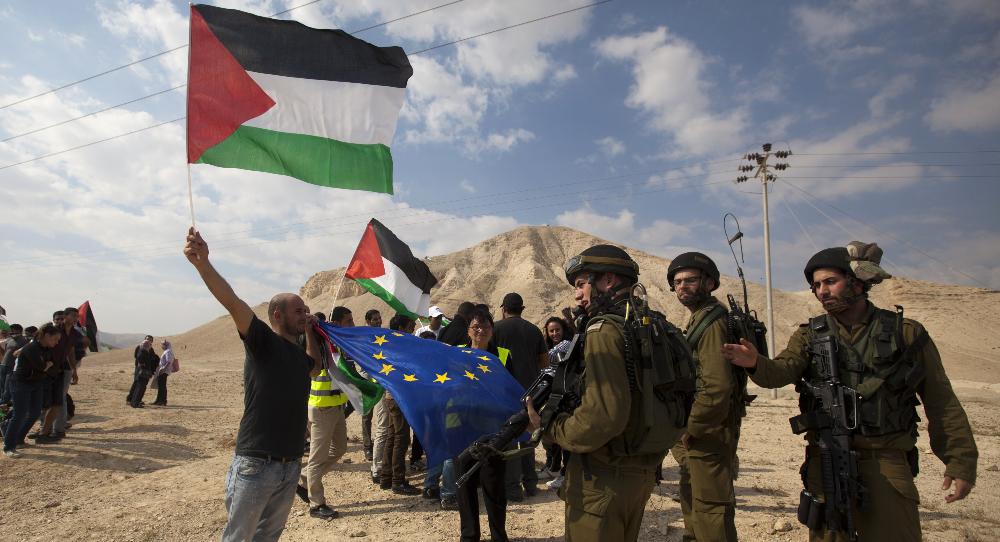
The Europeans have paid lip service to a two-state solution based on an independent Palestine alongside Israel. But without a clear plan to make it happen, such a solution will remain unattainable.
In 2002, shortly after I became Jordan’s foreign minister, a senior EU official shared an observation that I have not forgotten since. “The EU will never get ahead of the Americans on the peace process,” he said. He was right.
The EU has taken positions on the Palestinian-Israeli conflict that have gone further than different U.S. administrations have.
Nine EU member states have already recognized Palestine as a state. The EU has been, for years, the largest donor to the Palestinian Authority (PA). In addition, the EU’s position—supporting a two-state solution to the conflict—has been steady even when the United States wavered in such support under President Donald Trump.
In sticking to its position, the EU has consistently insisted that it will not recognize any changes to the 1967 borders unless agreed to by the two parties.
But the EU’s support for a two-state solution has, not unlike that of much of the international community, become rather passive, particularly in the absence of a negotiating process between Israel and Palestine.
When in January 2020 the Trump administration unveiled its “Peace to Prosperity” plan, which allowed for the annexation of 30 percent of the West Bank and practically an end to a viable two-state solution, a few EU members tried not to reject it out of hand on the basis that it might lead to something positive.
One reason for considering Trump’s proposal was that the EU hardly has a strong and unified position on the conflict. France and Sweden have more advanced positions in support of the Palestinians than countries like Hungary and Poland. And there are some states that have criticized such support, in particular bilateral financial assistance to Palestinians.
On the one hand, many EU governments have said, publicly or privately, that Palestinians, instead of focusing on building a sustainable economy, strong democratic institutions, and combatting corruption, have grown more dependent on foreign aid.
On the other hand, they consider such assistance as helping finance the Israeli occupation, by allowing Israel not to spend much money on development in the occupied territories.
Either way, the Europeans have opted for the status quo by perpetuating a PA that appears to be doing Israel’s bidding and is seen by many Palestinians as either corrupt or out of touch with its citizens.
The PA has consistently cracked down on any genuinely independent civil society movement that campaigns for real political reform and on a non-violent peace movement. Neither is in the interests of the PA or Israel. The EU should have long ago moved out of its status quo box.
That aside, the main flaw in the EU’s position toward the conflict is that the continued passive support for a two-state solution—while acquiescing to Israeli actions—has helped kill that solution. Yet it remains the EU’s preferred outcome to the conflict.
The EU’s reluctance to challenge Washington’s views on the peace process or even to try to influence them when the two sides’ views diverge, such as in the Trump administration era, has practically meant that Europe—even if unintentionally—is contributing to the demise of the very objective it seeks: a two-state solution.
Paying lip service to the two-state solution without accompanying it with a clear plan to make it happen has essentially given Israel a green light to continue building settlements and creating new facts on the ground that will make such a solution unattainable. The situation is comparable to two people arguing over a slice of pizza while one of them is eating it.
As for a clear plan: reviving the road map would be toothless without introducing a monitoring mechanism to ensure there is accountability when one of the parties does not adhere to their commitments.
The EU, as others in the international community have done, has chosen what it sees as the easiest path—push the problem ahead and hope for better times, when a more forthcoming constellation of Israeli, Palestinian, and U.S. leaders might improve the chances of a breakthrough.
Such wishful thinking cannot be substituted for policy, especially when the main assumption behind such thinking—that the status quo can be preserved—is a deeply flawed one with the continued expansion of settlements.
For almost thirty years since the Oslo agreements were signed, the issue of rights for people under occupation—that is, the Palestinians—has been relegated to the sidelines in the hope that a two-state solution to the conflict might make it moot. No more.
As the possibility of a viable Palestinian state living side by side with Israel is becoming less likely, the international community cannot ignore the issue of rights for much longer.
The decline of the possibility of statehood for Palestinians is increasingly going to be coupled with their call for equal rights within the territories they live in.
What will the international community do then? Will the EU be able to deny Palestinians a state and also equal rights? How will it accommodate a situation where Israel maintains two separate and unequal legal systems within the territories they occupy—a textbook definition of apartheid?
This is the situation that the EU will increasingly find itself in, should it continue to watch passively as Israel solidifies its control over what is already a one-state reality—with unequal rights.
The prospects for solving the conflict may be slim now, but the alternative of dealing with an apartheid system in Israel might push the international community to do the right thing: help end the longest occupation in modern history.

Vice President for Studies
Marwan Muasher is vice president for studies at Carnegie, where he oversees research in Washington and Beirut on the Middle East. Muasher served as foreign minister (2002–2004) and deputy prime minister (2004–2005) of Jordan, and his career has spanned the areas of diplomacy, development, civil society, and communications.
Recent Work



Amr Hamzawy, Andrew Leber, Eric Lob, …
Marwan Muasher
Carnegie does not take institutional positions on public policy issues; the views represented herein are those of the author(s) and do not necessarily reflect the views of Carnegie, its staff, or its trustees.

While the EU and European governments are embracing the much-lauded middle-power moment, this entails three difficult conundrums.

Richard Youngs

Much has been said of the changes Brussels is trying to make to the EU enlargement process. Here’s why gradual integration might—or might not—be the answer.

Dimitar Bechev

The European Commissioner for Trade is headed to China. But after President Xi’s bridge-building visit to Washington, can a more isolated EU overcome Beijing’s stranglehold on critical raw materials? Who will blink first?

Rym Momtaz, ed.

The domestic impacts of how long it is taking to end the war in Ukraine have pushed the French electorate to the political extremes and compromised the country’s diplomatic capacity.
Rym Momtaz

Before the next wave of EU enlargement takes place, the union needs to grapple with thorny questions of how power is distributed among its members.


Emil Sondaj Hansen, Ditte Brasso Sørensen