

Commentary
Judy Dempsey
{
  "authors": [
    "Judy Dempsey"
  ],
  "type": "commentary",
  "blog": "Strategic Europe",
  "centerAffiliationAll": "",
  "centers": [
    "Carnegie Endowment for International Peace",
    "Carnegie Europe"
  ],
  "collections": [],
  "englishNewsletterAll": "",
  "nonEnglishNewsletterAll": "",
  "primaryCenter": "Carnegie Europe",
  "programAffiliation": "",
  "programs": [],
  "projects": [],
  "regions": [
    "Europe",
    "North America",
    "South Asia",
    "Afghanistan",
    "Western Europe",
    "Asia"
  ],
  "topics": [
    "Foreign Policy",
    "Security",
    "EU"
  ]
}
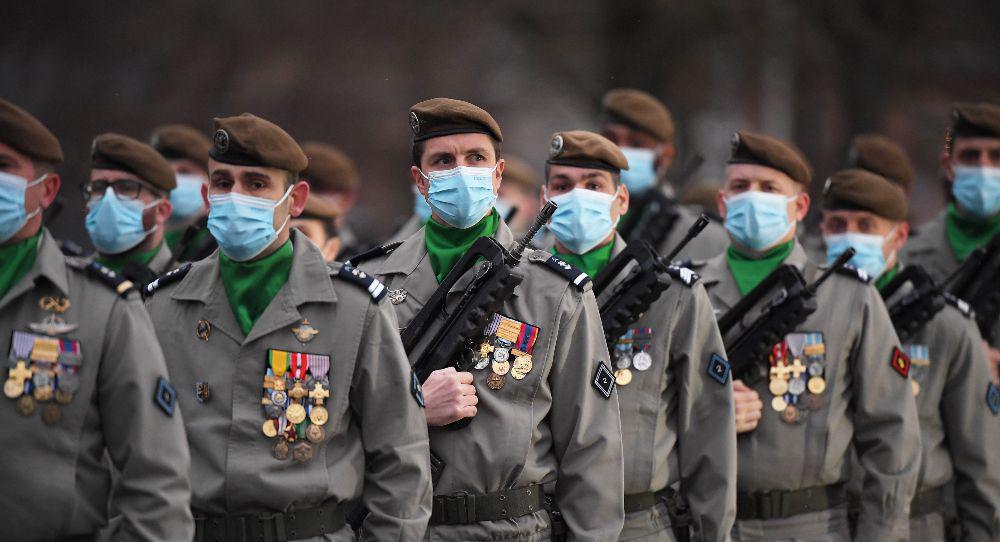
Source: Getty
Blaming NATO and the United States for the West’s failure in Afghanistan won’t help Europe establish a credible security and defense policy. Its continued absence leaves the EU’s citizens and neighborhoods vulnerable.
The European Union thrives in every crisis.
That’s what European leaders want to believe. Crises, they say, galvanize the bloc. They give a push for more integration. They help the EU develop what it has long lacked: a credible defense and security policy. That, supposedly, is now the lesson of Afghanistan for the Europeans, judging by the meeting of EU foreign ministers in Slovenia on September 2-3.
Josep Borrell, the EU’s foreign policy chief, said Afghanistan had “shown in a striking way that deficiencies in EU capacity to act autonomously comes with a price.”
As if those deficiencies were not well-known: weak capabilities, duplication, the lobbying power of defense industries, and the overriding lack of trust and divisions among member states when it comes to defining security ambitions and threats.
Borrell said the only way forward was “to combine our forces and strengthen not only our capabilities, but also our will to act.”
This means—and here we go with the same refrain—“enhancing our capacity to respond to hybrid challenges, covering key capability gaps, including logistic transport, raising the level of readiness through joint military training and developing new tools like the 5,000 people Initial Entry Force that we are discussing actually.”
Borrell added that such an entry force “would have helped us to provide a security perimeter for the evacuation of European Union citizens in Kabul.” Was it asked in Slovenia why no member state had suggested that in the first place, given the instability of Afghanistan?
As for the idea of a rapid reaction force, EU leaders have been talking about it for over two decades.
At the Saint-Malo summit in 1998 former British prime minister Tony Blair and French president Jacques Chirac announced the “headline goals” for European defense. They wanted Europe to have no less than sixty thousand soldiers at its disposal for peacekeeping and other missions.
This were spurred by the wars in the former Yugoslavia that exposed the EU’s non-military response. It was left up to NATO, or rather, the United States to bomb Serb targets to stop the ethnic cleansing of Kosovar Albanians.
The headline goals were downsized in 2003, at the height of the U.S.-led war in Iraq. Nothing came of those plans either. In 2007, a special EU Battlegroup concept was introduced. That plan never got off the ground.
Despite the war in Syria, the highly dangerous conflict in Mali, and other trouble spots that directly affect European security, EU leaders have collectively been unwilling and unable to complement the bloc’s economic clout with military strength.
Why not? It’s not for lack of trying, particularly by France. President Emmanuel Macron has repeatedly proposed the need for a strong European defense capability and if needed a European army, or some coalitions of the willing.
When former U.S. president Donald Trump lambasted NATO for being “obsolete,” Europeans sought refuge in the vague language of “strategic autonomy.” The reality is that the Europeans have only themselves—not NATO or the United States—to blame for not thinking and acting strategically.
Strategy doesn’t come easy for European states, whether they are EU or NATO members—and the majority of European countries are both.
Without the United States, NATO is a strategic pygmy. And with the exception of France—now that Britain has left the bloc—the EU lacks strategic foresight. It cannot defend itself. The United States is its security guarantor, whether the Europeans like it or not.
The European caucus in NATO is no advertisement for the EU pursuing strategic autonomy. If that caucus was more coherent, more politically motivated, and more open in its relationship with the United States, it could be beneficial to NATO, the EU, and the union’s neighbors.
NATO and the EU are trying to work more closely together. But their intrinsically different cultures get in the way of creating genuine trust and cooperation. The EU is obsessed with the woolly concept of crisis management and the belief that a dose of soft power is the panacea for all problems. NATO is anchored in hard power. Even then, it has botched it up, in Libya, in Afghanistan, and even closer to home in Kosovo. It’s hard to believe that since 1999 NATO forces are still deployed in this part of Europe.
So where does this leave Europe’s response to the debacle in Afghanistan?
Apart from the immense difficulties of state-building, if the EU really wants to have a rapid reaction force, the capabilities and command structures are already at its disposal.
The special Berlin Plus arrangements, agreed back in 2002 gave the EU access to NATO’s collective assets and capabilities for the EU’s own military operations. It was aimed at avoiding duplication and competition. Above all, it would have given the EU and NATO a real chance to strengthen the European dimension of the Alliance.
The Biden administration wants the Europeans to take on more responsibility for their defense. Jens Stoltenberg, NATO secretary general, should embrace this idea instead of believing it would be a direct challenge to the Alliance. And if that means, as German defense minister Annegret Kamp-Karrenbauer suggested, Europe establishing coalitions of the willing, why not, provided costs are shared.
This debate has yet to begin, leaving Europe’s citizens and its neighbors in a defense and security limbo. So much for a crisis precipitating a European strategic culture.
This blog is part of the Transatlantic Relations in Review series. Carnegie Europe is grateful to the U.S. Mission to the EU for its support.

Nonresident Senior Fellow, Carnegie Europe
Judy Dempsey is a nonresident senior fellow at Carnegie Europe
Recent Work
Judy Dempsey
Judy Dempsey
Carnegie does not take institutional positions on public policy issues; the views represented herein are those of the author(s) and do not necessarily reflect the views of Carnegie, its staff, or its trustees.

When the U.S.-Iran memorandum of understanding was announced, the UK, France, Germany, and Italy declared their readiness to help demine the Strait of Hormuz and lift nuclear sanctions on Tehran. But does Europe need new tools to recover a diplomatic role?

Rym Momtaz, ed.
The Franco-German relationship is on the rocks again. But unlike previous moments of tension, the epochal changes on the world stage require that both step up investment in their bilateral ties.
Rym Momtaz
The EU is putting together a new security strategy to meet today’s myriad challenges. But for any proposal to be effective, the union needs to grapple with its identity and ambitions.

Pierre Vimont

The EU’s new migration policy is not suited to today’s realities. With climate change increasingly becoming a driver of displacement, Europe needs to rethink its deterrence-focused approach.

Shana Tabak
The battle over free speech has taken center stage since U.S. Vice President JD Vance accused Europe of censorship. From travel bans to social media regulation, especially around the Israel-Palestine conflict, are liberal democratic governments weaponizing free speech?
Rym Momtaz, ed.