
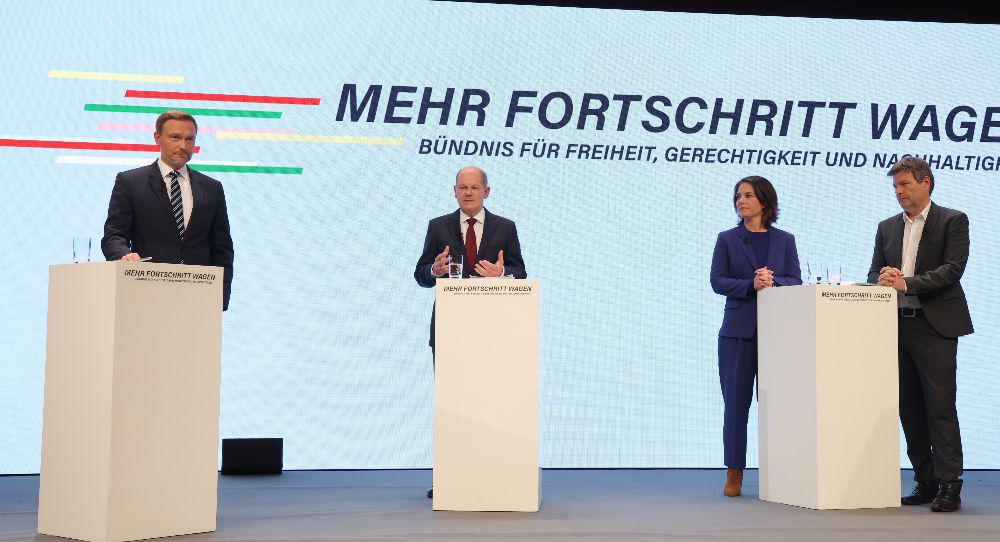
A kind of ritual takes place after every German federal election. The biggest parties huddle together for several weeks to thrash out a coalition agreement. Leaks are few. Speculation is rife.
The talks were wrapped up successfully on November 24, 2021. All going well, by Christmas Olaf Scholz will step into the chancellery, ending Angela Merkel’s sixteen years at the helm.
German analysts warn that the coalition agreement is more for domestic consumption. The parties concerned have to get the final say from their members or at special conferences so as to receive the ultimate mandate to govern.
It’s not entirely true that a coalition agreement is just for the supporters. And particularly not now, when a new coalition—and the first of its kind—led by the Social Democrats (SPD), the pro-business Free Democrats (FDP) and the Greens is saddled with changing the status quo.
Under Merkel, the status quo shunned modernizing the German economy, society, migration procedures, digitization, not to mention the functioning of the EU.
This is why what happens in Germany, Europe’s biggest economy and one of the world’s leading exporters, matters beyond its borders. Its views on security, values, migration, and climate change can have a profound influence—positive or negative—on Germans themselves but also on Berlin’s allies.
In this context, the whopping 177-page coalition agreement is not about ticking off the boxes about Germany’s commitment to the transatlantic alliance and NATO, or strengthening the EU, or supporting the multilateral order.
It is something deeper and more complex. The traffic light coalition (named after the colours of the three parties) is about modernizing the country in a way that will upend the status quo, said Christian Lindner, Free Democrat leader and finance minister-designate.
On security and foreign policy, there’s quite a lot on arms control that includes the nuclear disarmament of short and medium-range systems. This is not only aimed at the pacifist—if not anti-NATO—factions among the Social Democrats and the Greens. It is also about recognizing the need to revive arms control talks and this cannot be done without bringing in China.
Furthermore, the coalition text doesn’t shy away from the commitment to nuclear sharing and deterrence—one of the bedrocks of NATO security for European allies.
These security considerations feed into foreign policy. With the Greens’ co-leader Annalena Baerbock becoming the country’s first female foreign minister, the status quo in this regard is bound to change.
In the ebbing days of the Merkel coalition, Merkel’s interest and commitment to human rights and values waned. Interests often took precedence.
Baerbock has no illusions about China, Beijing’s clampdown in Hong Kong, or Russia’s unremitting pressure on civil society activists and organizations, with the closing of Memorial the latest development. Nor have the Greens illusions about how Russia uses its energy as a geopolitical weapon to divide Europe and increase its dependence on Russian gas.
The Greens are still against the highly controversial Nord Stream 2 pipeline through which Russia will send more gas to Germany via the Baltic Sea. The pipeline is all but completed. But a final legal hurdle by the German energy regulators and renewed pressure from the United States means that Russian President Vladimir Putin now has to deal with the Greens even though incoming Chancellor Olaf Scholz is pro-Nord Stream 2 and, well, not a firm Russian critic.
This element of foreign policy links to human rights and climate change. Both matter hugely to the Greens but also to the other coalition partners.
With the EU’s COVID-19 recovery fund slowly being disbursed, the coalition agreement makes the rule of law an issue. With an implicit reference to Poland and Hungary, the text states: “We urge the European Commission ... to use the existing rule-of-law instruments more consistently and in a timely manner.” Berlin will sign off payment of these funds to those countries “if preconditions such as an independent judiciary are secured.”
As for climate change, the coalition contract is radical. Coal will be phased out by 2030. The expansion of renewable energy will be speeded up so that the share of renewable energies in electricity will be 80 percent by 2030. Among other measures, freight trains and electric cars will be increased.
Digitization, an issue that Merkel talked a lot about but did very little, is another major plank of the coalition. The agreement refers to a “comprehensive digital awakening” for people’s “prosperity, freedom, social participation and sustainability.”
In his deadpan manner, Scholz said: “We are expanding the digital infrastructure so that there is fast internet and reliable cell phone reception everywhere.” And state and local services will go digital. Finally!
The coalition agreement includes quite a lot on how to make the EU more accountable and more efficient, which will be welcomed in Paris. The text refers to developing a “federal European state,” more qualified majority voting at the expense of unanimity (which often paralyses decisionmaking and waters down statements), and transnational candidates for some of the top EU posts.
The coalition is well aware of how difficult it’s going to be to give a new impulse to Europe. It starts at home by considering a points-based immigration system and introducing dual citizenship, with immigrants able to apply for citizenship after five years. The voting age has been reduced from eighteen to sixteen. These social measures are long overdue and are about changing the status quo.
If the coalition sticks together and communicates its policies, Germany’s newfound energy might be contagious. But as Scholz said, the first challenge is ending the contagion of coronavirus.


