

Commentary
Judy Dempsey
{
  "authors": [
    "Judy Dempsey"
  ],
  "type": "commentary",
  "blog": "Strategic Europe",
  "centerAffiliationAll": "",
  "centers": [
    "Carnegie Endowment for International Peace",
    "Carnegie Europe"
  ],
  "collections": [
    "Europe’s Eastern Neighborhood",
    "EU Integration and Enlargement"
  ],
  "englishNewsletterAll": "",
  "nonEnglishNewsletterAll": "",
  "primaryCenter": "Carnegie Europe",
  "programAffiliation": "",
  "programs": [],
  "projects": [],
  "regions": [
    "Europe",
    "Eastern Europe",
    "Ukraine",
    "Western Europe",
    "Russia"
  ],
  "topics": [
    "Foreign Policy",
    "Security",
    "EU",
    "Climate Change"
  ]
}
Source: Getty
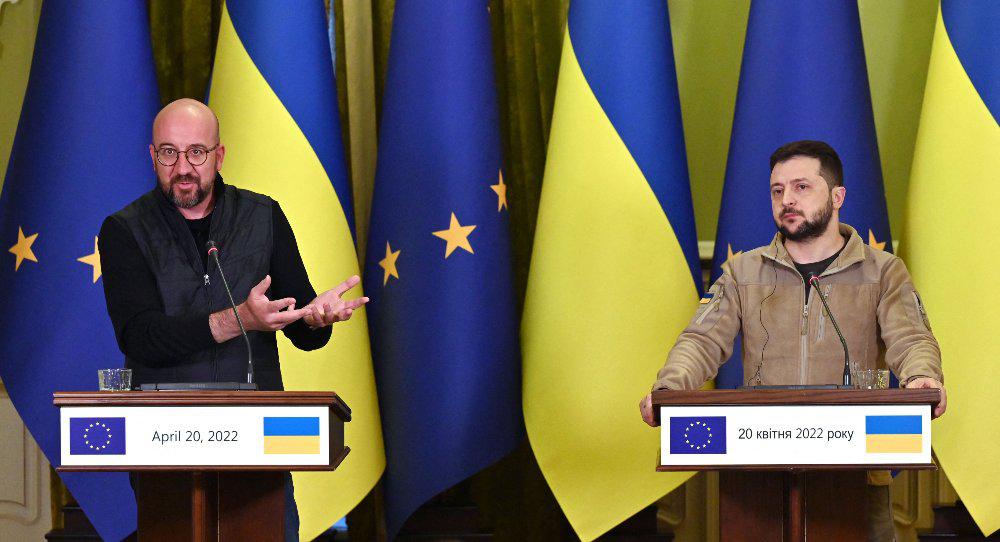
At this critical moment, Europeans must show commitment and resolve in their support for Kyiv. Divisions within the EU risk buying Russia time and weakening Ukraine.
Russia and Ukraine are in a race against time.
President Vladimir Putin wants some kind of victory by May 9. He wants to use the seventy-seventh anniversary of Russia’s defeat of Nazi Germany to celebrate the end of his devastating war in Ukraine that has led to thousands of civilian deaths and wanton destruction in a country unwilling to give up its independence and sovereignty.
Ukraine’s President Volodymyr Zelensky, as he keeps repeating, doesn’t have time on his side. He needs more military support, not standing ovations, from Western leaders to keep resisting Russian forces.
As for the Europeans, despite their unity over imposing sanctions on Russia and their repeated condemnation of Putin’s war against Ukraine, visible cracks are emerging. And over time, these divisions will deepen.
If and when this war ends, these differences will make it more difficult, not easier, for the EU to create a strong foreign, security, and defense policy. This is because the war in Ukraine is not just about Europe’s future relationship with Ukraine and with Russia. The war, whatever its outcome, will deepen the mistrust among EU members—if it is not already doing that.
Estonia, Latvia, Lithuania, and Poland, along with Slovakia and the Czech Republic understand what Russia’s invasion of Ukraine is about. It is about redrawing the map of the post–Cold War era. They don’t want their eastern neighbors to become a cordon sanitaire under the tutelage of Russia. They also support Ukraine’s application to join the EU.
Over the years, these countries repeatedly warned their West European counterparts of the strategic folly of depending on Russian energy. They themselves have moved quickly to find alternative sources of energy, unlike several other EU countries, including Germany, Austria, and Hungary.
Furthermore, because of their history and proximity to Ukraine—as well as their experience of living under Soviet domination—the publics in this part of Europe show few signs of weakening their support for Zelensky even if it means higher energy and consumer prices. These countries are also providing as much military support as possible to Kyiv.
Their historical and political experiences contrast sharply with those of some other EU countries. Germany, Austria, and Hungary are reluctant to send heavy weapons to Ukraine, one of their arguments being that this would lead to more escalation.
In Germany, Chancellor Olaf Scholz’s coalition government is now bitterly divided over what kind of military support it should give Kyiv. The Greens and the Free Democrats want to provide heavy weapons. But Scholz’s Social Democrats who are still wedded to a pacifist, anti-American, and Russia-friendly outlook, are stonewalling.
And when the issue of imposing an oil and gas embargo on Russia is repeatedly raised, Berlin says such an embargo would lead to higher energy prices for German households. That is true. But what Scholz, and indeed other leaders, including Hungary’s Prime Minister Viktor Orbán, Putin’s staunchest supporter in the EU, refuse to explain to their publics is that this war is not only about Ukraine’s future but also the future stability of Europe. It carries a high price.
The high price that Italy is worried about is an increase in interest rates. Prime Minister Mario Draghi has been vocal in his support of Ukraine, even pushing for an energy embargo. And similar to Germany, he has to contend with pacifist movements that want an end to the war and a ban on sending weapons to Ukraine. For the moment, that is not Draghi’s biggest problem. Instead, it is what happens at the European Central Bank in Frankfurt.
If the European Central Bank were to raise interest rates this would have a devastating impact on Rome’s ability to service is very high public debt. It is 147 percent of gross domestic product, the second highest among the eurozone countries after Greece.
The EU cannot afford one of its leading economies to come under such pressure. It would seriously undermine the Euro currency at a time when economic growth across Europe is slowing.
In France, the economic impact of the war has played into the presidential election, where the runoff between President Emmanuel Macron and the populist candidate Marine Le Pen takes place on April 24. A Le Pen victory, as Marc Pierini recently wrote, would shake the foundations of NATO and the EU. In short, for several EU countries, the economic fallout from Russia’s war in Ukraine cannot be underestimated.
This picture of Europe exposes how governments have their own interests in ways that could buy Putin some time. Yes, the sanctions are biting. The Russian military could not take Kyiv. But neither deter Putin from prolonging a cruel siege on Mariupol, where 100,000 people are starving and being prevented from leaving—not to mention the pounding of other towns and cities.
It is the time factor that matters so much to Ukraine as Zelensky continues to fight for his country’s independence. That time factor should matter to all of Europe as well.

Nonresident Senior Fellow, Carnegie Europe
Judy Dempsey is a nonresident senior fellow at Carnegie Europe
Recent Work
Judy Dempsey
Judy Dempsey
Carnegie does not take institutional positions on public policy issues; the views represented herein are those of the author(s) and do not necessarily reflect the views of Carnegie, its staff, or its trustees.

The EU can impose sanctions but struggles to enforce them without the United States. With Washington increasingly disinterested in backing European interests, the bloc must now fend for itself.


Nicu Popescu, Tiago Antunes

Russia is testing the waters of NATO’s mutual defense clause. What do strikes in Romanian territorial waters mean for the alliance’s posture toward Moscow?

Dimitar Bechev

With its public finances in shambles, the far right polling at 35 percent ahead of the 2027 presidential election, and a growing protest movement, is France’s crisis a threat to the EU’s geopolitical awakening?

Rym Momtaz, ed.

Ahead of a tough winter for Ukraine, Donald Trump’s swing back toward Russia bodes ill. But instead of panicking, Kyiv’s European allies are focusing on action.
Rym Momtaz

While the EU and European governments are embracing the much-lauded middle-power moment, this entails three difficult conundrums.

Richard Youngs