

Commentary
Judy Dempsey
{
  "authors": [
    "Judy Dempsey"
  ],
  "type": "commentary",
  "blog": "Strategic Europe",
  "centerAffiliationAll": "",
  "centers": [
    "Carnegie Endowment for International Peace",
    "Carnegie Europe"
  ],
  "collections": [
    "Europe’s Eastern Neighborhood"
  ],
  "englishNewsletterAll": "",
  "nonEnglishNewsletterAll": "",
  "primaryCenter": "Carnegie Europe",
  "programAffiliation": "",
  "programs": [],
  "projects": [],
  "regions": [
    "Russia",
    "Europe",
    "Eastern Europe",
    "Ukraine",
    "Western Europe",
    "Germany"
  ],
  "topics": [
    "Security",
    "Economy",
    "EU",
    "Climate Change"
  ]
}
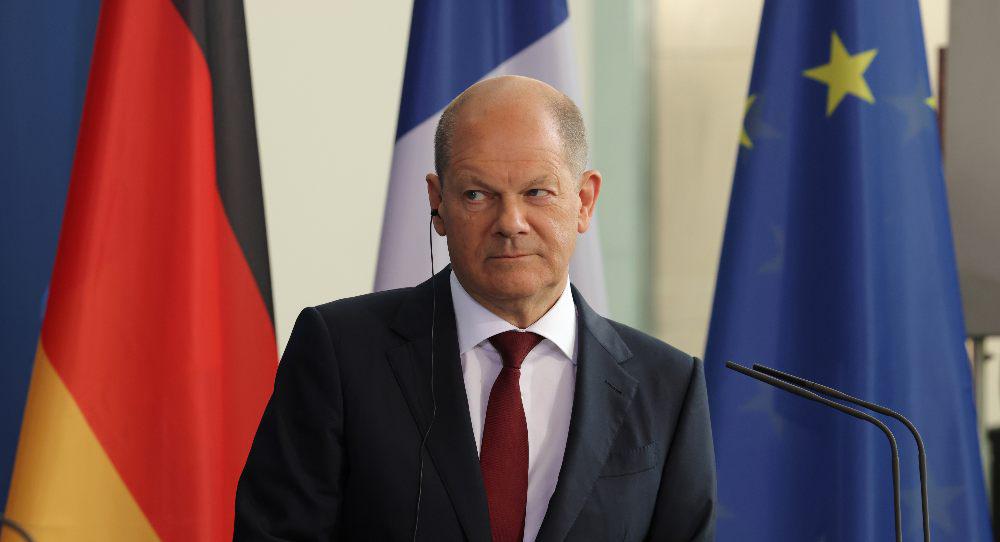
Source: Getty
Chancellor Scholz’s delay in sending heavy weapons to Ukraine is hurting Kyiv’s chances of preserving its sovereignty. It is also damaging Germany’s standing across Europe.
EU governments were in buoyant mood on May 30. They congratulated themselves on agreeing to impose a partial energy embargo on Russia.
That was after weeks of discord caused by Hungary’s Prime Minister Viktor Orbán, who fosters friendly relations with Russian President Vladimir Putin and has been blocking the EU’s sixth sanctions package.
The compromise reached was to stop imports of seaborne oil purchases. It would cut “a huge source of financing for [Russia’s] war machine” and would deliver maximum “pressure on Russia to end the war,” tweeted European Council President Charles Michel.
Oil, however, will continue to be delivered via pipelines. And so will gas. So much for denying Putin cash to finance his war in Ukraine.
Ukraine’s armed forces and its civilian population, especially in the east of the country, are in desperate need of Western military support.
Putin, so far, may have given up on capturing Kyiv. But Russia’s bombardment of Severodonetsk brings to a new level the brutality and indiscriminate nature of this offensive. Here is how BBC correspondent, Quentin Sommerville, described the situation on the ground:
“Having failed to conquer all of Ukraine, Russian forces are now targeting Donbas - made up of the Donetsk and Luhansk regions. If Severodonetsk and Lysychansk fall, the whole of Luhansk would be occupied.”
He added: “Here, Russia isn’t fighting a campaign of attrition, it’s waging a war of oblivion. And, for the moment on this front, it is winning.”
Sabine Fischer, a leading Russian expert at the German Institute for International and Security Affairs (SWP) in Berlin, warned that Russia could still win the war.
“It is essential to understand the implications: should Moscow be able to sustain full occupation of the Donbas and the land bridge to Crimea, they will feel encouraged after some time to move on towards Odesa and even Kyiv again,” she wrote.
Fischer added that the pressure on Ukrainian President Volodymyr Zelensky’s leadership could then not be ruled out. For Fischer, the bottom line is that Germany has to recognize what is at stake. It is the very existence of Ukraine as an independent, sovereign state—and the future of the region.
Yet German Chancellor Olaf Scholz continues to procrastinate and prevaricate.
He keeps saying that Berlin supports Ukraine and that Putin will not win this war. Notably, however, he never talks about wanting Ukraine to win.
The Bundestag has insisted that the chancellery deliver heavy weapons—which it promised to do some time ago. The armament companies are ready to do so. But Scholz continues to block their delivery. Just as he blocks Ukraine’s ambitions to join the EU.
In short, despite the big political and military support being offered by U.S. President Joe Biden’s administration, without which Ukraine might have already lost the war, Kyiv needs more help. It has repeatedly asked Germany to provide it.
By holding back on weapons deliveries, Scholz is damaging Germany’s reputation not only in Ukraine but in Central Europe and the Baltics.
These governments cannot understand why Germany won’t defend a country that is being bombarded to such an extent that the destruction of cities such as Mariupol resembles that of Grozny and Aleppo after Russian attacks.
To justify his stance, Scholz said he was adhering to NATO’s decision not to send heavy weapons. Liz Truss, UK foreign secretary, called that statement “completely untrue.” NATO never made such a formal declaration. It was left up to each member state to decide.
Why is Scholz saying one thing but doing the opposite? Some suggest the chancellor is afraid of alienating the pacifist wing in his Social Democratic Party; or of fuelling anti-American sentiment; or of being dragged into war. Others suggest he is unwilling to send weapons to conflict zones. (Doesn’t Berlin export weapons to such zones and authoritarian regimes?)
Fundamentally, German Social Democrats have long believed they could bring Russia closer to Europe through their Ostpolitik (“Eastern policy”). The chancellor’s speech on February 27 suggested a radical policy shift.
Meanwhile, while the German public remains divided on the issue of weapons deliveries, the majority—58 percent, according to a Forschungsgruppe Wahlen poll this May—would support sending heavy weapons to Ukraine.
Scholz’s position reveals a lack of leadership and with it a lack of conviction and consistency. It is also about a fear of antagonizing the Kremlin. The German political elites that grew up during the Cold War don’t want to give up their special business and political ties to Moscow. They are still reluctant to accept Russia’s motives in Georgia, Syria, Belarus, and now Ukraine.
These motives are about Russia positioning itself to reshape Europe’s post–Cold War order. The longer Scholz continues his ambiguity toward Ukraine, the greater the likelihood that Putin will use the German chancellor and French President Emmanuel Macron to push Ukraine into a compromise and ultimately change Europe’s security architecture.
In practice, that would have devastating consequences for the transatlantic relationship which Putin has long sought to weaken. It would divide Europe. As it is, Poland and the Baltic states are deeply distrustful of France’s and Germany’s relations with Putin. They are also frustrated that Paris and Berlin do not take the Russian imperialist agenda seriously.
Beyond Ukraine, Scholz’s ambiguity is hurting all of Europe. Putin will not hesitate to exploit it both militarily and politically.

Nonresident Senior Fellow, Carnegie Europe
Dempsey is a nonresident senior fellow at Carnegie Europe
Recent Work
Judy Dempsey
Judy Dempsey
Carnegie does not take institutional positions on public policy issues; the views represented herein are those of the author(s) and do not necessarily reflect the views of Carnegie, its staff, or its trustees.
The war in Iran proves the United States is now a destabilizing actor for Europe and the Arab Gulf. From protect their economies and energy supplies to safeguarding their territorial integrity, both regions have much to gain from forming a new kind of partnership together.

Rym Momtaz
French President Emmanuel Macron has unveiled his country’s new nuclear doctrine. Are the changes he has made enough to reassure France’s European partners in the current geopolitical context?
Rym Momtaz, ed.
European reactions to the war in Iran have lost sight of wider political dynamics. The EU must position itself for the next phase of the crisis without giving up on its principles.

Richard Youngs
Europe isn’t as weak in the new geopolitics of power as many would believe. But to leverage its assets and claim a sphere of influence, Brussels must stop undercutting itself.

Dimitar Bechev
Europe’s reaction to the war in Iran has been disunited and meek, a far cry from its previously leading role in diplomacy with Tehran. To avoid being condemned to the sidelines while escalation continues, Brussels needs to stand up for international law.

Pierre Vimont