

Commentary
Judy Dempsey
{
  "authors": [
    "Judy Dempsey"
  ],
  "type": "commentary",
  "blog": "Strategic Europe",
  "centerAffiliationAll": "",
  "centers": [
    "Carnegie Endowment for International Peace",
    "Carnegie Europe"
  ],
  "collections": [
    "Europe’s Eastern Neighborhood"
  ],
  "englishNewsletterAll": "",
  "nonEnglishNewsletterAll": "",
  "primaryCenter": "Carnegie Europe",
  "programAffiliation": "",
  "programs": [],
  "projects": [],
  "regions": [
    "Russia",
    "Europe",
    "Eastern Europe",
    "Western Europe"
  ],
  "topics": [
    "Foreign Policy",
    "Security",
    "EU"
  ]
}
Source: Getty
Russia’s brutal war in Ukraine has exposed European countries’ diverging views of Moscow. These fissures will affect the EU’s policies toward Ukraine and Russia.
First, the good news. The EU is still united over sanctions against Russia. Member states have stuck together since 2014, when Russian President Vladimir Putin illegally annexed Crimea, and have agreed to prepare yet another sanctions package after Moscow’s annexation referenda in Eastern Ukraine—though Cyprus, Greece, and Malta are pushing back.
Second, many EU countries are sending weapons and other military equipment to Ukraine. They have been generous in providing security, housing, and education to the millions of Ukrainians who have fled the war.
Third, Russia has galvanized NATO to an unprecedented degree. Finland and Sweden’s long-cherished neutrality has given way to both voting to join the U.S.-led military alliance. Except for Turkey and Hungary, all the other NATO countries have ratified their membership.
Fourth, Europeans have realized why and how they have to end their dependence on Russian energy. It took them far too long to react to how Putin used gas exports to Europe, especially to Germany, as a geopolitical instrument.
Despite these impressive achievements, there are fundamental differences among European governments—not so much on Ukraine but on how they see Russia. These divisions will continue to exist if and when the war ends. And they will have consequences for Europe ever hoping to forge a coherent foreign and security policy, let alone a common strategy toward Russia.
The war in Ukraine has exposed fundamental differences in narratives between Central Europe and the old member states of the EU, notably France and Germany. The narratives are about Russia.
From the outset of Russia’s invasion of Ukraine in February 2022, Poland, the Baltic states, and the Czech Republic have been unswerving in their support of Kyiv. They have done what they can to supply military assistance and provide help for refugees.
Their support for Ukraine is not only based on a moral principle as often described with a hint of a patronizing tone by France and Germany. It is based on a historical and cultural narrative. For the Baltics in particular, this narrative has been shaped by the former Soviet Union’s occupation of their countries in 1940 and again from 1944, not to mention what Poland and the rest Central Europe suffered. The legacy of occupation forms their understanding about what Ukrainians are trying to achieve. That legacy forms their narrative about Russia.
These countries repeatedly warned the “old” Europe about the danger of replying on Russian gas, of building the Nord Stream pipelines, of repeatedly seeing Eastern Europe through a Russian lens. In short, they had no illusions about Russia’s intentions.
Some leading German politicians have said publicly that they should have heeded warnings from Poland and the Baltic states about Russia’s intentions toward Ukraine and the post-Soviet space. Yet in Paris and Berlin, the political elites have not revised their narrative about Russia. It is never expressed explicitly. But there is a sentiment that if and when the war in Ukraine ends, relations with Russia can be restored, even going back to business as usual.
This narrative is steeped in a tradition of peace and freedom that has prevailed in Western Europe since 1945. It is steeped in a tradition of stability even through that stability and security was based on the division of Europe and which was based on a false sense of stability and security and which relied on the United States’ security umbrella. All were at the expense of Eastern Europe’s freedom.
The “old” Europe narrative still prevails. It views Paris and Berlin as the (sometimes) questionable engine of European integration. It is these two countries that over the decades have been instrumental in forging a policy toward Russia.
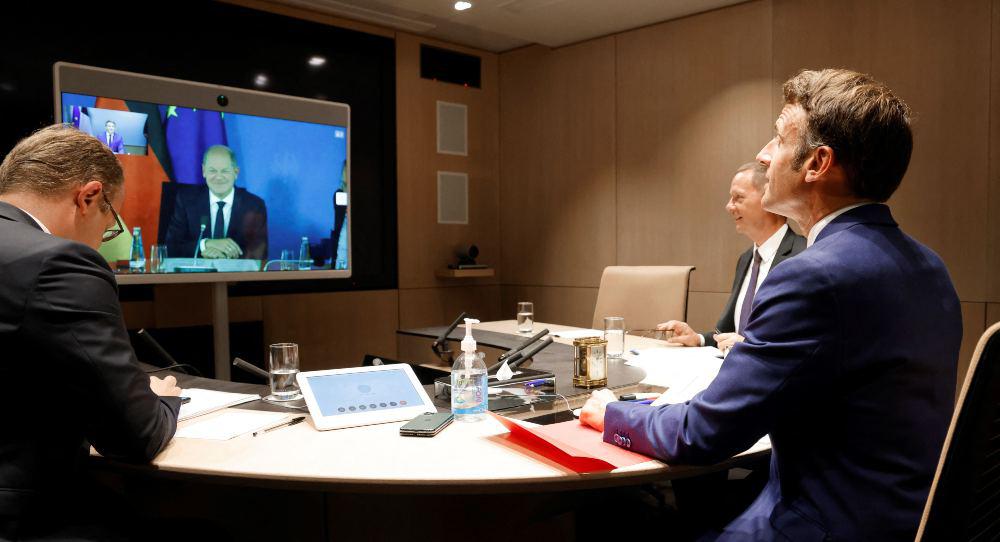
So when President Emmanuel Macron warned about “humiliating Russia,” it was an extraordinary comment that shocked Kyiv as much as East Europeans. It confirmed how Paris viewed Ukraine through the prism of Russia.
And when German Chancellor Olaf Scholz tries to justify not sending heavy weaponry to Ukraine for fear of “escalating” the war—as if Putin has not escalated it, with his invasion, annexation, and his threat of a nuclear strike—what emerges is the old Europe narrative about Russia. It’s as if France and Germany are in a time warp; that they believe they still set the agenda for Europe’s underperforming foreign, security, and defense policy. If Russia’s war in Ukraine doesn’t dent that mindset then Europe is a big trouble.
So what to do?
Poland and the Baltic states are doing themselves no favors by just criticizing Russia and the reluctance of Paris and Berlin to arm Ukraine. As it is, Paris and Berlin regard these northeastern Europeans as whingers with an inferiority complex. Macron said as much in a recent speech. These countries need to find allies in other EU countries, including the Netherlands and Sweden. Above all, together they have to lobby Paris and Berlin.
Poland is the key. But relations between Poland and Germany are poisonous. The governing nationalist and conservative Law and Justice Party (PiS), ahead of next year’s election, is running a nasty anti-German campaign. It is demanding that Berlin pay reparations for the Nazi occupation. It is lambasting Germany for not doing enough to support Ukraine.
All that aside, Poland is squandering its potential. Its size alone should give it an automatic influence on the EU’s foreign, security, and defense policy. This is what the former Civic Platform party tried to do when it was in power between 2007 and 2015.
But PiS, which is Eurosceptic and anti-German, has been hell-bent on controlling the judiciary and undermining the rule of law. It has won few friends in Brussels, where its influence is minimal. That is Eastern and Western Europe’s loss.
These competing views and narratives will come home to roost when the war in Ukraine ends. The blame game will begin. The cracks will deepen. Unless Paris, Berlin, and Warsaw talk to each other—now, before the war ends.

Nonresident Senior Fellow, Carnegie Europe
Judy Dempsey is a nonresident senior fellow at Carnegie Europe
Recent Work
Judy Dempsey
Judy Dempsey
Carnegie does not take institutional positions on public policy issues; the views represented herein are those of the author(s) and do not necessarily reflect the views of Carnegie, its staff, or its trustees.

Are Germany’s economic, industrial, and political struggles becoming a liability for the EU’s ability to rise to the geopolitical moment?

Rym Momtaz, ed.

European Commission President Ursula von der Leyen is about to give her annual address on the state of the EU. Here’s what she won’t—but should—say.
Rym Momtaz

The aftermath of the Ceuta crisis shows Europe has drawn the wrong lessons. Rather than doubling down on failed migration policies, the EU needs to address the underlying roots of such episodes.

Richard Youngs

An overwhelming victory by a far-right-wing party in a small state in eastern Germany will have major repercussions for Chancellor Friedrich Merz’s coalition.
Judy Dempsey

Canadian Prime Minister Mark Carney has twice inspired praise for standing up to U.S. President Donald Trump: at the 2026 World Economic Forum in Davos and on Canada-U.S. trade negotiations. Is Carney showing a third way better than the EU has in dealing with the Trump administration?
Rym Momtaz, ed.