

Article
Thomas de Waal
{
  "authors": [
    "Thomas de Waal"
  ],
  "type": "commentary",
  "blog": "Strategic Europe",
  "centerAffiliationAll": "",
  "centers": [
    "Carnegie Endowment for International Peace",
    "Carnegie Europe",
    "Carnegie Russia Eurasia Center"
  ],
  "collections": [
    "EU Integration and Enlargement",
    "Aso Tavitian Initiative"
  ],
  "englishNewsletterAll": "",
  "nonEnglishNewsletterAll": "",
  "primaryCenter": "Carnegie Russia Eurasia Center",
  "programAffiliation": "",
  "programs": [],
  "projects": [],
  "regions": [
    "Russia",
    "Europe",
    "Eastern Europe",
    "Western Europe",
    "Moldova"
  ],
  "topics": [
    "Foreign Policy",
    "EU",
    "Political Reform",
    "Security",
    "Democracy",
    "Economy"
  ]
}
Source: Getty
Moldova lacks technical and administrative capacity required for EU accession. Brussels needs to do much more to put its European perspective on track.
For Moldova, 2022 was the worst of years and the best of years.
Russia’s war in Ukraine turned life upside down. The country, often ranked as the poorest in Europe, took in 80,000 Ukrainian refugees almost overnight. Inflation was rampant and the economy crashed. Helped by the EU, Moldova managed to completely wean itself off dependence on gas from its main provider, Russia, but utility bills soared. Ukraine had been Moldova’s main electricity provider and on two days in November 2022, there were almost complete power blackouts.
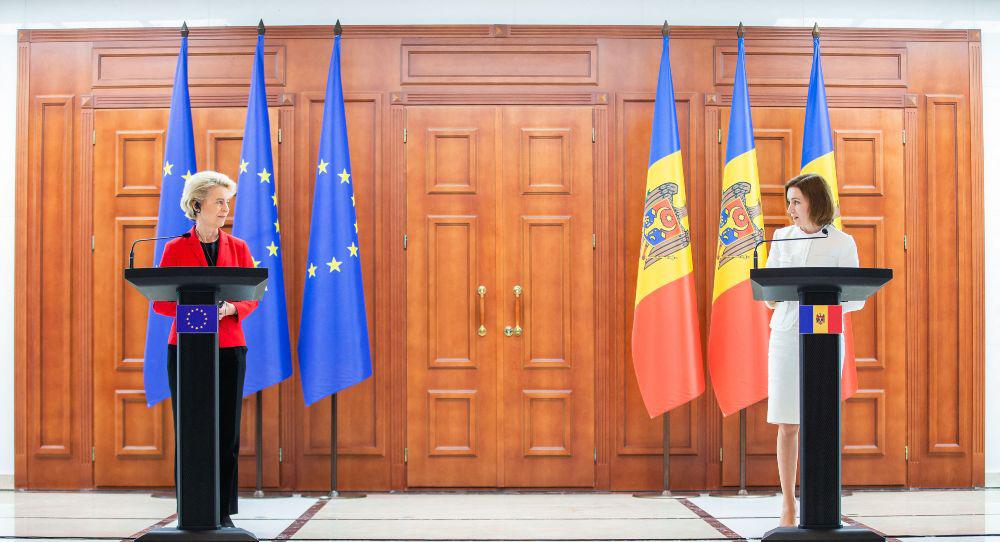
But Ukraine also saved Moldova, at great cost. The war receded as the Russians retreated along the Black Sea coast. And in June, Chișinău—alongside Kyiv—received something precious it might have waited decades for in less extreme circumstances: EU candidate status. Moldova’s pro-European president, Maia Sandu, and her government want to build on that and open EU accession talks by the end of this year.
On a recent visit to Chișinău as part of a group affiliated with IWM Vienna*, the talk I heard was not so apocalyptic; it was about managing longer-term threats, not day-to-day survival. It was also a lot about what Brussels is and is not doing.
That the EU process is happening at all owes a lot to the personal diplomacy of Sandu and Nicu Popescu, foreign minister—and former think-tanker. They had to do a lot of lobbying—and still do—to convince European capitals that Moldova was no longer the same morass of corruption it had been for the last two decades, and also that a tandem with Ukraine was a positive, something that many in Kyiv were also initially not happy about.
But Sandu and her government are paying the price for the tumult of 2022. Their popularity has dropped sharply since she and her party won first presidential and then parliamentary elections in 2020 and 2021. An International Republican Institute (IRI) opinion poll at the end of last year registered a high disapproval rating for the president and an even higher one for the government. Voters had an overwhelming preoccupation with the economy and rising energy bills in particular.
Sandu wants to remobilize the public behind her and the government with a big pro-European rally on May 21. That will be followed on June 1 by the summit of the European Political Community, attended by some of the major heads of state of Europe. The same IRI poll suggested 63 percent supported EU membership, but many of our interlocutors were worried that EU accession could get stuck before the public sees any benefit from it.
Moldova is not Ukraine and the Russian threat is more indirect. It cannot be stated often enough that Transdniestria, the mainly Russian-speaking territory which has been de facto separate from the rest of Moldova since 1992, is not Donbas, or even Abkhazia. Moscow is much less invested there. On paper there are 1,500 Russian troops on the ground, but most experts agree that most are locals in Russian uniforms and the number of actual Russian officers who remain is less than 100. It is not an invading force.
The dangers are of a different kind. For the last decade, Transdniestria has been run by the Sheriff business conglomerate which has looked both east and west, keeping Russian political support while pursuing partial economic integration with right-bank Moldova. When war broke out, the leadership did its best to keep its head down and not get dragged in.
But Sheriff’s business model is now under severe stress. Ukraine shut its border with Transdniestria, cutting both legal and illegal trade. The territory runs on what is basically free gas from Russia, supplied via Moldova, with nobody picking up the bill. That gas in turn fuels the Kuchurgan power plant which still supplies right-bank Moldova with half of its electricity.
But what happens if Moscow stops supplying gas or the archaic Kuchurgan plant needs to close? Within a few months a territory with a population of 400,000 people, many of them pensioners, would run out of cash. It would be a scenario of crash integration with the rest of Moldova, with huge consequences. But as one expert told us: “[Moldova is] not ready for the integration of Transdniestria.” More people, in Chișinău and in European capitals, need to start thinking about that.
If Russia has a light touch on Transdniestria, that is also because it still has bigger designs for Moldovan politics as a whole. It is not so long before Sandu and her Party of Action and Solidarity (PAS) face a presidential election in 2024 and a parliamentary election in 2025.
There is a broad societal spectrum of voters in Moldova. Elections are won in the middle ground. A large minority of the population still looks to Russia, with about 10 percent of them speaking only Russian, not the state language. Moscow still has soft power, through Russian-language media outlets and the broadly anti-Western Orthodox Church. In the next election, Moscow still has a constituency it can try to rally, through anti-Western political forces, playing on economic grievances.
Missteps from the governing party do not help. A recently passed law designating the state language as Romanian instead of Moldovan was symbolic but sent the wrong signal to those who identify as Moldovan rather than Romanian, and those, in Transdniestria in particular, who associate Romania with wartime occupation.
“We are not ready.” “Capacity is limited.” “We don’t have the people.” Our group heard these lines a few times in Chișinău. A proper EU accession process requires big technical and administrative capacity that simply is not there at the moment. Most of our government interlocutors were running on patriotic enthusiasm, drawing salaries of just a few hundred euros a month. Much of the bureaucracy lacks professionalism or, worse, used to receive their salaries directly from oligarchs who are still lurking in the background.
Thus far there is not so much evidence in Brussels either that Moldova is a priority, or that anyone is planning a big assistance mission to boost capacity and put the country’s European perspective on track. Yet if large swathes of the public do not see real-life benefits from the accession process sooner, rather than later, the worry is that 2022–23 may end up being Moldova’s “European moment” that came and then went, before the country returned to gray business as usual.
In short, it’s time to get more serious about Moldova.
* Thomas de Waal is a senior fellow with Carnegie Europe and a Europe’s Futures fellow with the Institute for Human Sciences Vienna (IWM) for 2022–23.

Senior Fellow, Carnegie Europe
Thomas de Waal is a senior fellow at Carnegie Europe, specializing in Eastern Europe and the Caucasus.
Recent Work
Thomas de Waal
Thomas de Waal
Carnegie does not take institutional positions on public policy issues; the views represented herein are those of the author(s) and do not necessarily reflect the views of Carnegie, its staff, or its trustees.

European Commission President Ursula von der Leyen is about to give her annual address on the state of the EU. Here’s what she won’t—but should—say.

Rym Momtaz

The aftermath of the Ceuta crisis shows Europe has drawn the wrong lessons. Rather than doubling down on failed migration policies, the EU needs to address the underlying roots of such episodes.

Richard Youngs

An overwhelming victory by a far-right-wing party in a small state in eastern Germany will have major repercussions for Chancellor Friedrich Merz’s coalition.

Judy Dempsey

Canadian Prime Minister Mark Carney has twice inspired praise for standing up to U.S. President Donald Trump: at the 2026 World Economic Forum in Davos and on Canada-U.S. trade negotiations. Is Carney showing a third way better than the EU has in dealing with the Trump administration?
Rym Momtaz, ed.

The EU’s responses to two recent incidents expose the gulf between European perceptions and capabilities. Unless the union can bridge that gap, it will never become a real geostrategic power.
Rym Momtaz