

Commentary
Gwendolyn Sasse
{
  "authors": [
    "Gwendolyn Sasse"
  ],
  "type": "commentary",
  "blog": "Strategic Europe",
  "centerAffiliationAll": "dc",
  "centers": [
    "Carnegie Endowment for International Peace",
    "Carnegie Europe"
  ],
  "collections": [
    "Europe’s Eastern Neighborhood"
  ],
  "englishNewsletterAll": "ctw",
  "nonEnglishNewsletterAll": "",
  "primaryCenter": "Carnegie Europe",
  "programAffiliation": "EP",
  "programs": [
    "Europe"
  ],
  "projects": [],
  "regions": [
    "Russia",
    "Europe",
    "Eastern Europe",
    "Ukraine",
    "Western Europe",
    "Iran"
  ],
  "topics": [
    "Foreign Policy",
    "EU",
    "Security",
    "Military"
  ]
}
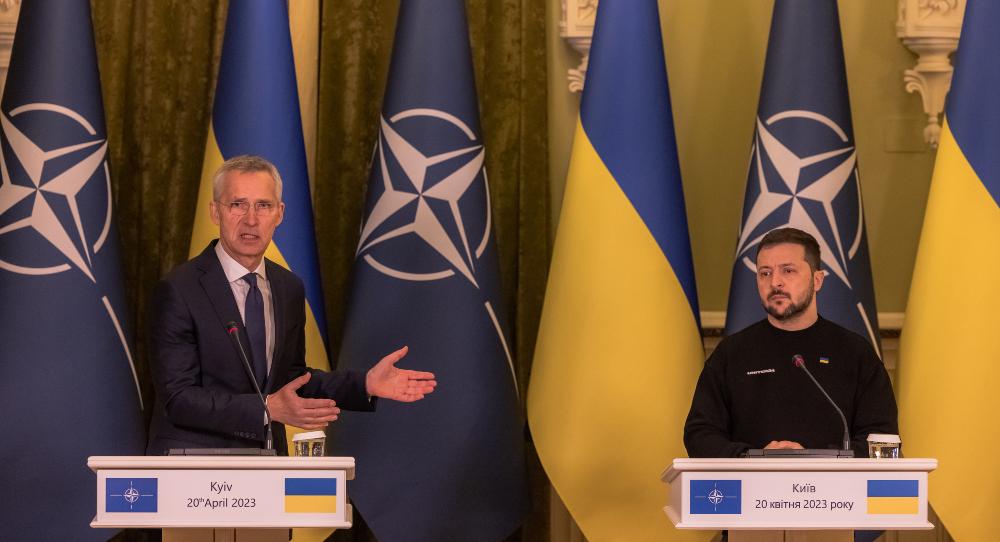
Source: Getty
All the actors supporting Ukraine need to work together now to establish a Euro-Atlantic strategy. Waiting for the war to end is not an option.
The expected Ukrainian counteroffensive is underway.
How it will unfold, how long it will last, and how much of the occupied territory Kyiv will be able to free in the east and south of the country—particularly the areas that would restore Ukraine’s access to the Azov Sea and Crimea—remain open questions at this point.
Some Ukrainian villages and towns on the eastern front are flying the Ukrainian flag again, but the human and material costs of the reconquest have been high. Moreover, the Ukrainians are forced to use their air defense systems to protect their cities against Russian attacks rather than utilizing them as part of their offensive on the frontline. The dramatic consequences of the explosion of the Kakhovka dam ties down further Ukrainian resources during the rescue efforts.
Ukraine’s military force remains dependent on continuous Western military aid, including support for the repairs of damaged tanks and other vehicles.
With the specter of a long-lasting war looming, a number of pressing issues are not being addressed in a concentrated and integrated fashion—as it would be necessary.
Ukraine’s security guarantees, its EU accession process, and reconstruction are closely interlinked. These three issues need to be fused into a coherent strategy now rather than at an uncertain point after a ceasefire or a more comprehensive negotiated end to the hostilities.
On the first account, with the NATO summit in Vilnius on July 11-12 fast approaching, there have been more and more calls in favor of the alliance sending a clear signal that would open a concrete path towards membership.
However, there are diverging views within NATO on this point. The alliance needs to avoid a public display of disagreements at the summit. Even in the absence of a consensus, NATO members have to offer something concrete to Ukraine and its citizens as an anchor and perspective. Only by doing so will the summit also send a clear message to the Kremlin, which is banking on Western unity to falter any time soon. Internal unity is the biggest asset NATO—and the EU—have.
At NATO’s 2008 summit the compromise formula resulting from diverging views on Kyiv’s membership was the promise that Ukraine (and Georgia) would become NATO members in the future, without specifying a path or timeline. This may well have been the worst of all compromises, as it left everything vague and ultimately offered Russia scope for action.
In this particular crisis, NATO will not go against its earlier commitment in principle to membership. There is even a sentiment inside the alliance that instead of developing a security pact, it may be more straightforward and effective to integrate Ukraine into NATO directly.
Falling short of a pathway to membership, the issue of future security guarantees for Ukraine will be on the table in Vilnius. While the summit may not yet generate a concrete set of guarantees and ways to enforce them, a serious discussion of them is overdue.
As the 1994 Budapest Memorandum, which was meant to guarantee Ukraine’s territorial integrity in return for transferring the Soviet-era nuclear weapons to the Russian Federation, has shown, it does not suffice to have guarantors sign an agreement. What is needed is a specific mechanism that spells out what exactly happens if Ukraine’s integrity is threatened again by Russia in the future, in particular as the role of the United Nations is limited due to Russia’s veto power in the UN Security Council.
New security guarantees revolve around more long-term military aid for Ukraine and a commitment to step up this aid in the case of Russia launching a new attack. Such security guarantees could mark the way towards NATO membership in the future, though there is also a possibility that—by design or by default—they come to replace the issue of full NATO membership.
The second complex issue that needs to be tackled sooner rather than later is Ukraine’s path towards EU accession.
Ukraine was given candidate status in 2022. Some EU member states, among them Germany, seemed to delay their actual decision on this until the last moment. There is a widespread realization that the European Union itself has to reform to effectively manage the accession of the remaining Western Balkan countries, Ukraine, and Moldova.
Speeches by the German chancellor Olaf Scholz and French president Emmanuel Macron have repeatedly highlighted the difficult reforms the EU needs to become a more sovereign actor on the world stage—for instance, moving to majority voting on some foreign policy issues. While true in principle, this framing could effectively stall the accession process.
A strategy for pursuing the accession of the Western Balkans, Ukraine, and Moldova in parallel to these reforms is needed, including the possibility that accession countries will be able to gradually participate in an increasing number of EU policy initiatives on the way towards full accession.
The third issue that calls for a more strategic discussion is Ukraine’s reconstruction. While there have been several high-profile plans generated in Ukraine, in various European capitals, and in the United States, they remain rather separate from one another and do not yet connect the various actors at different working levels. There is a sense of urgency around this topic, as the reconstruction needs to effectively start now. But there is a risk that many actors will seriously commit to reconstruction only when the war has ended—and valuable time has been lost.
The donor conference in London on June 21-22, following on from the Lugano conference of 2022, could make a further push towards galvanizing not only financial support but also ideas for a reconstruction that goes beyond a neat sequencing model starting with the end of the war.
In short, what is urgently needed is a Euro-Atlantic strategy that links the three issues of Ukraine’s security guarantees, EU accession, and reconstruction.
Gwendolyn Sasse is a nonresident senior fellow at Carnegie Europe and director of the Centre for East European and International Studies (ZOiS) in Berlin.

Nonresident Senior Fellow, Carnegie Europe
Sasse is a nonresident senior fellow at Carnegie Europe. Her research focuses on Eastern Europe, with a particular focus on Ukrainian politics and society, EU enlargement, and comparative democratization.
Recent Work
Gwendolyn Sasse
Gwendolyn Sasse
Carnegie does not take institutional positions on public policy issues; the views represented herein are those of the author(s) and do not necessarily reflect the views of Carnegie, its staff, or its trustees.
Hungarians head to the polls on April 12 for an election of national and European consequence. Three different outcomes are on the cards, each with their own implications for the EU.
Zsuzsanna Szelényi
The far right failed to win big in France’s municipal elections. But that’s not good news for the country’s left wing, which remained disunited while the broader right consolidated its momentum ahead of the 2027 presidential race.
Catherine Fieschi
Donald Trump has demanded that European allies send ships to the Strait of Hormuz while his war of choice in Iran rages on. He has constantly berated NATO while the alliance’s secretary-general has emphatically supported him.

Rym Momtaz, ed.
The EU is structurally incapable of reacting to today’s foreign policy crises. The union must fold the EEAS into the European Commission and create a security council better prepared to take action on the global stage.

Stefan Lehne
The war in Ukraine is costing Russia its leverage overseas. Across the South Caucasus and Middle East, this presents an opportunity for Europe to pick up the pieces and claim its own sphere of influence.

William Dixon, Maksym Beznosiuk