

Commentary
Judy Dempsey
{
  "authors": [
    "Judy Dempsey"
  ],
  "type": "commentary",
  "blog": "Strategic Europe",
  "centerAffiliationAll": "dc",
  "centers": [
    "Carnegie Endowment for International Peace",
    "Carnegie Europe"
  ],
  "collections": [
    "Europe’s Eastern Neighborhood"
  ],
  "englishNewsletterAll": "ctw",
  "nonEnglishNewsletterAll": "",
  "primaryCenter": "Carnegie Europe",
  "programAffiliation": "EP",
  "programs": [
    "Europe"
  ],
  "projects": [],
  "regions": [
    "Russia",
    "Europe",
    "North America",
    "Eastern Europe",
    "United States",
    "Ukraine",
    "Western Europe",
    "Iran"
  ],
  "topics": [
    "Foreign Policy",
    "Security",
    "Military",
    "NATO"
  ]
}
Source: Getty
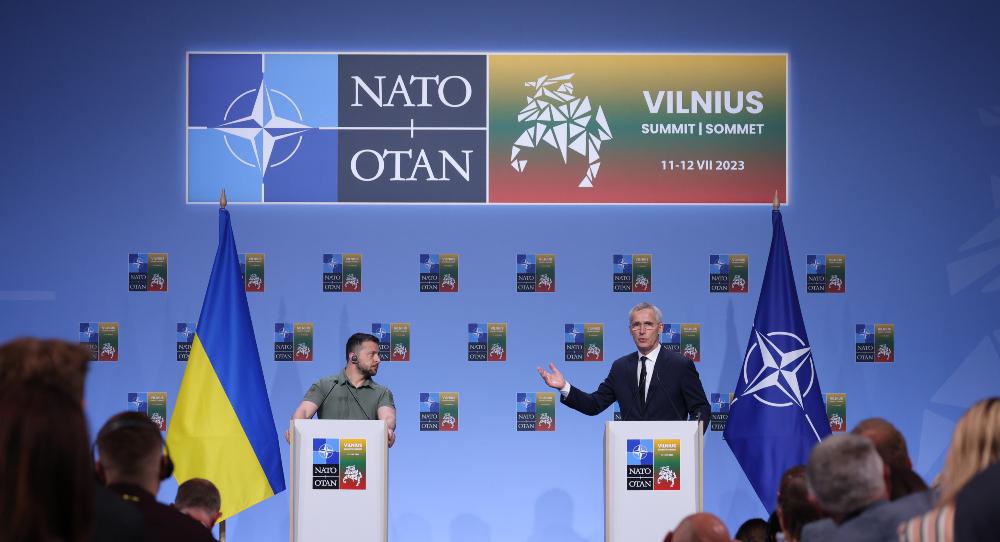
Led by the United States and Germany, NATO gave Kyiv no date for joining the military alliance. This is a short-sighted decision that Russia will exploit.
It was called the “Bakhmut-Vilnius Marathon—Raise the Flag of Ukraine in NATO.” It started off in Kyiv.
For over a week, groups of Ukrainians took turns to run the distance from their capital to the Lithuanian capital of Vilnius. They carried a ragged national flag from Bakhmut, a city on the frontlines of Eastern Ukraine that was almost completely destroyed by Russia. The runners wore white t-shirts, each with the same number – 33 – and with NATO written on them as well.
On a warm and sunny evening on July 11, they reached a square in downtown Vilnius. Crowds, many with the Ukrainian flag draped around them, gathered to welcome the tired runners. Then, a few minutes later, Ukrainian president Volodymyr Zelensky took to the podium accompanied by his wife. The crowds burst into applause and shouted “Slava Ukraini”.
Zelensky’s visit to Vilnius coincided with the first day of a crucial NATO summit hosted by Lithuania. Kyiv had positive expectations about the outcome, as did its staunchest supporters: Poland and the three Baltic states of Estonia, Latvia, and Lithuania. They hoped the military alliance would state that Ukraine would join NATO once the war ended. There were even some who wanted Ukraine to be admitted sooner than that.
Neither happened.
Instead, the long communiqué—with surprisingly little content about the war in Ukraine—stated: “We will be in a position to extend an invitation to Ukraine to join the Alliance when Allies agree and conditions are met.”
It was almost a re-run of the ill-fated 2008 NATO Bucharest Summit, which promised that Ukraine would one day join NATO. In Bucharest, Kyiv wasn’t offered the Membership Action Plan (MAP)—which sets out a path towards accession—because of huge pressure from France and Germany. That lack of strategic foresight was exploited by Russia. It gave Vladimir Putin the green light to invade Georgia in 2008, to occupy Crimea and parts of Eastern Ukraine in 2014, and to wage war against Ukraine in 2022.
This time round, NATO said Ukraine didn’t need the MAP stage. It’s as if the communiqué was looking for a sweetener to give Kyiv but also excuses for not giving it a firm timetable for its membership. “Allies”, it stated, “will continue to support and review Ukraine’s progress on interoperability as well as additional democratic and security sector reforms that are required.”
On these issues, the communiqué was contradictory. It stated that “Ukraine has become increasingly interoperable and politically integrated with the Alliance, and has made substantial progress on its reform path. The Alliance will support Ukraine in making these reforms on its path towards future membership.”
In practice, the interoperability issue is a red herring. One of the big weaknesses of NATO is that it is not interoperable in a way that would allow members’ weapons systems to work seamlessly together. The multitude of different standards has always held back interoperability.
Indeed, during the NATO Public Forum, a major side event during the Vilnius Summit, the Swedish defense minister actually said that European countries were “exporting to Ukraine a fragmented armaments industry. There are 600 different types of armaments being sent to Ukraine,” he said. Just think of the complex maintenance efforts required for them, he added.
That aside, there is a bigger reason why Germany and the United States did not want to give Ukraine a clear timeline for NATO membership. Both countries see the war in Ukraine through the prism of confrontation with Russia. They worry about a potential escalation. For Berlin and Washington but also some other allies, Ukrainian membership would mean NATO defending the country if it was attacked. And NATO officials told me that if they did give a date once the war ended, Putin could drag out the war as long as possible.
Over the past few months in the run-up to the summit, Putin sufficiently intimidated Berlin with his threats to use nuclear weapons. Chancellor Olaf Scholz believed a date for Ukrainian membership could lead to a direct military confrontation with Russia. Yet Germany continues to lack a coherent security strategy about how to deal not only with Russia, but also with Ukraine and the rest of Eastern Europe.
Supplying weapons to Ukraine, something that Germany and many other NATO countries are doing, is a necessity—but not a strategy. It is not something that is done to end the war quickly. In Vilnius, Germany and other countries repeated ad nauseam that Ukraine’s future is in NATO, and they will support Kyiv “for as long as it takes.” But for how long is that, and how many more casualties, destruction, and war crimes will that amount to?
In short, at Vilnius, NATO lacked the political courage and the strategic outlook to give Ukraine a date to join the alliance. Putin’s threats have prevailed.
So much for the hopes of the runners from Kyiv. The number 33 on their t-shirts was supposed to represent Ukraine becoming the 33rd member of NATO (after Turkey this week lifted its veto on Sweden’s joining the alliance). After crossing the finishing line in Vilnius, they go back home to more bombing by Russia—and no finishing line from NATO.

Nonresident Senior Fellow, Carnegie Europe
Judy Dempsey is a nonresident senior fellow at Carnegie Europe
Recent Work
Judy Dempsey
Judy Dempsey
Carnegie does not take institutional positions on public policy issues; the views represented herein are those of the author(s) and do not necessarily reflect the views of Carnegie, its staff, or its trustees.

Before the next wave of EU enlargement takes place, the union needs to grapple with thorny questions of how power is distributed among its members.


Emil Sondaj Hansen, Ditte Brasso Sørensen

A summer of escalation in the Black Sea has hurt Ukraine economically and is exacerbating world food security. A truce is needed—as is a broader reframing of Europe’s Ukraine strategy.

Thomas de Waal

Are Germany’s economic, industrial, and political struggles becoming a liability for the EU’s ability to rise to the geopolitical moment?

Rym Momtaz, ed.

European Commission President Ursula von der Leyen is about to give her annual address on the state of the EU. Here’s what she won’t—but should—say.
Rym Momtaz

The aftermath of the Ceuta crisis shows Europe has drawn the wrong lessons. Rather than doubling down on failed migration policies, the EU needs to address the underlying roots of such episodes.

Richard Youngs