

Commentary
Gwendolyn Sasse
{
  "authors": [
    "Gwendolyn Sasse"
  ],
  "type": "commentary",
  "blog": "Strategic Europe",
  "centerAffiliationAll": "",
  "centers": [
    "Carnegie Endowment for International Peace",
    "Carnegie Europe"
  ],
  "collections": [
    "Europe’s Eastern Neighborhood",
    "EU Integration and Enlargement"
  ],
  "englishNewsletterAll": "",
  "nonEnglishNewsletterAll": "",
  "primaryCenter": "Carnegie Europe",
  "programAffiliation": "",
  "programs": [],
  "projects": [],
  "regions": [
    "Europe",
    "North America",
    "Eastern Europe",
    "United States",
    "Western Europe"
  ],
  "topics": [
    "Foreign Policy",
    "Security",
    "EU",
    "Democracy"
  ]
}
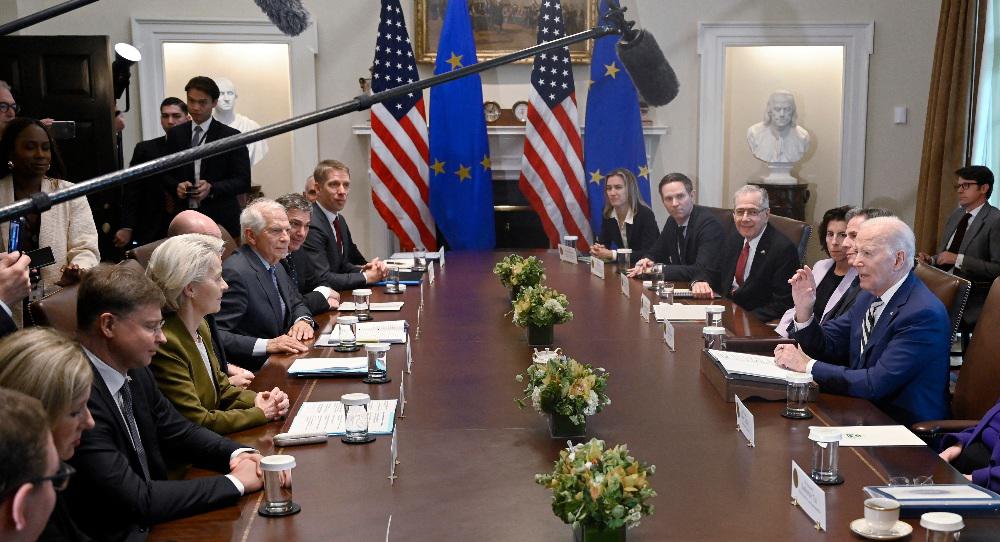
Source: Getty
War in the Middle East and U.S. domestic politics risk weakening Western support to Ukraine. The EU must remember the stakes in Russia’s war and be ready to step up.
The Hamas attack, Israel’s military response, and the conflict’s wider regional and global ramifications have reinforced a trend that has been worrying Ukraine for some time: Public attention and political priorities are shifting and risk sidelining Russia’s war against Ukraine at a critical moment.
Domestic U.S. politics had already called into question the cross-party consensus on the level of military and financial assistance for Ukraine before the Hamas attacks and before the gloves are off in the U.S. election campaign.
The case of the Republican speaker of Congress, the difficulties of electing a new speaker, and the eventual compromise on Mike Johnson, a Republican who has called Ukraine aid into question and now wants to split it from aid for Israel, illustrate how domestic polarization is affecting U.S. leadership on military and financial support for Ukraine. There is too little strategic thinking in Europe about these dynamics or, in fact, a possible Republican electoral victory in autumn 2024.
Despite rhetoric to the contrary, the EU and its member states are currently neither able nor willing to fill a potential gap left by the United States in supporting Ukraine. This suggests a closing window of opportunity for maximizing Western—and in particular European—military and financial support to increase Ukraine’s chances of reaching a military position from which to end the war. There is little political will to do so.
In Europe, the extent to which the war and its consequences can be instrumentalized in domestic elections recently became apparent in Slovakia and Poland.
The initial shock of Russia’s full-scale invasion has passed, images of the war no longer touch their audiences in the same way—and now these images are quite literally pushed aside by the more recent news from the Middle East and the ensuing political fallout in Western societies. The simultaneity of wars with direct repercussions for European societies increases a public sense of uncertainty that leads citizens to turn inward.
Russia’s war against Ukraine is near and yet so far. Bizarrely, the central question has disappeared from view in recent months: What is this war about? If one takes a closer look at the seemingly familiar images from Ukraine, one catches a glimpse of the personal stories behind each photo.
Behind every personal story lies the fundamental choice by Ukrainians to live in an independent country, to shape their country’s political path, and the necessity to defend these basic rights enshrined in international law through military and civilian resistance.
In various cycles of mass protest—the biggest being the Orange Revolution of 2004 and the Euromaidan of 2013-14—Ukrainian society clearly stated its political choice. The juxtaposition between Ukraine’s democratic system on the one hand and Russian-style authoritarianism is the central issue in Russia’s war against Ukraine. This simple and powerful fact should not get lost amid the challenges this war and that in the Middle East pose for Western democracies.
The EU and its member states cannot afford to adopt a “wait-and-see” attitude to the United States’ policy toward Ukraine. Concrete political reference points can act as a reminder of what Russia’s war is about.
On November 8, the European Commission is expected to publish its progress report on Ukraine. The decision in June 2022 to make Ukraine and Moldova EU candidate countries was an important signal. But a decision by the European Council in December 2023 to actually start accession negotiations would be a major step both for the two candidates and the EU.
Even though a positive recommendation on the part of the European Commission is widely expected, the required unanimity of the member states on opening accession talks is not yet a done deal—just as the decision on the candidate status was not, until almost the last moment.
While the results of the parliamentary election in Poland in October pave the way for a reset in Polish politics, including the country’s position in the EU, Hungary’s veto power may require some concessions. There is a chance to strike a deal with a single member state, even if it leaves a bad aftertaste about the inability to sanction democratic backsliding within the EU.
At this point, the opening of EU accession talks with Ukraine and Moldova—and possibly a decision to grant Georgia candidate status—is a test of the EU’s resolve and capacity to act in a multilayered geopolitical crisis. Currently, it is the most effective way to turn (some) attention back to Ukraine and underline the EU’s role in actively shaping policy responses to this war.
It would mark only the beginning of a challenging process that has to address Ukraine’s reform needs amid war and reconstruction efforts, as well as the necessity for internal EU reforms that may change the union beyond recognition.
But the political choice needs to be made now—in an increasingly complex global setting.
Gwendolyn Sasse is non-resident senior fellow at Carnegie Europe and the Director of the Centre for East European and International Studies (ZOiS), Berlin.

Nonresident Senior Fellow, Carnegie Europe
Gwendolyn Sasse is a nonresident senior fellow at Carnegie Europe. Her research focuses on Eastern Europe, with a particular focus on Ukrainian politics and society, EU enlargement, and comparative democratization.
Recent Work
Gwendolyn Sasse
Gwendolyn Sasse
Carnegie does not take institutional positions on public policy issues; the views represented herein are those of the author(s) and do not necessarily reflect the views of Carnegie, its staff, or its trustees.

Canadian Prime Minister Mark Carney has twice inspired praise for standing up to U.S. President Donald Trump: at the 2026 World Economic Forum in Davos and on Canada-U.S. trade negotiations. Is Carney showing a third way better than the EU has in dealing with the Trump administration?

Rym Momtaz, ed.

The EU’s responses to two recent incidents expose the gulf between European perceptions and capabilities. Unless the union can bridge that gap, it will never become a real geostrategic power.
Rym Momtaz

In supporting Europe’s far-right, MAGA and Russia both want the same thing: a weaker EU. Europe must defend itself without abandoning the openness these forces exploit.

Armida van Rij

As we close out another season of Strategic Europe, it is worth taking stock of the deep shifts underway.
Rym Momtaz
The EU had to compromise to adopt a twenty-first sanctions package against Russia, exposing growing cracks in the union’s resolve. Is this latest, weaker round worth it to keep pressure on Moscow?
Rym Momtaz, ed.