

Commentary
Russia is testing the waters of NATO’s mutual defense clause. What do strikes in Romanian territorial waters mean for the alliance’s posture toward Moscow?
Dimitar Bechev
{
  "authors": [
    "Marc Pierini",
    "Francesco Siccardi"
  ],
  "type": "commentary",
  "blog": "Strategic Europe",
  "centerAffiliationAll": "",
  "centers": [
    "Carnegie Endowment for International Peace",
    "Carnegie Europe"
  ],
  "collections": [
    "Europe’s Southern Neighborhood",
    "EU Integration and Enlargement"
  ],
  "englishNewsletterAll": "",
  "nonEnglishNewsletterAll": "",
  "primaryCenter": "Carnegie Europe",
  "programAffiliation": "",
  "programs": [],
  "projects": [],
  "regions": [
    "Europe",
    "Türkiye",
    "Middle East"
  ],
  "topics": [
    "Foreign Policy",
    "Economy",
    "Political Reform",
    "EU",
    "Climate Change",
    "Security",
    "Democracy"
  ]
}
Source: Getty
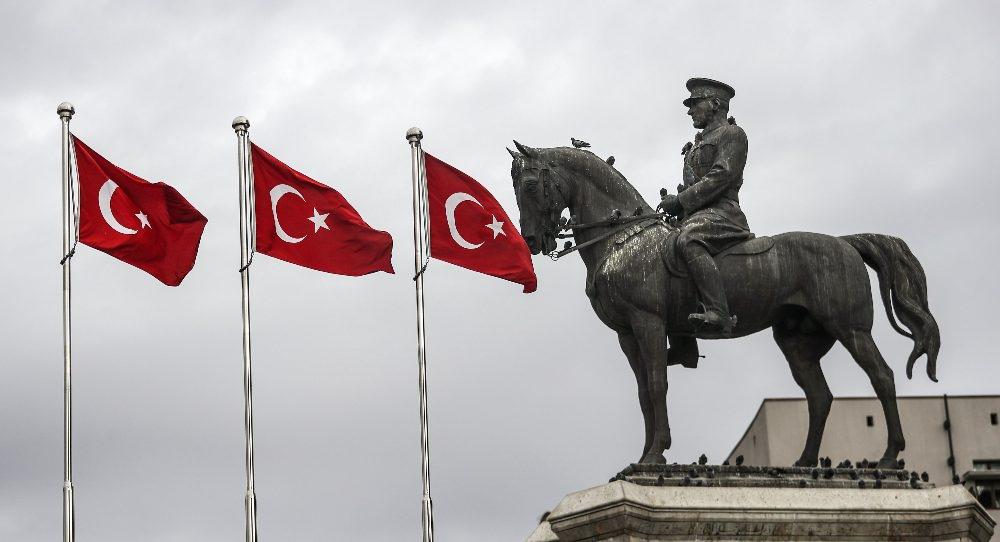
President Erdogan has sought to rally the Turkish people around the republic’s centenary. But to realize its domestic and global ambitions, Ankara must tend to its economic crisis and rule-of-law deficiencies.
On Sunday, October 29, Turkey will celebrate its centennial with much pride. It will be a celebration of the republic installed by Mustafa Kemal Atatürk in 1923 and a personal milestone for President Recep Tayyip Erdoğan. But uncertainties loom large for the country’s second century.
After being a non-belligerent state during World War II, Turkey’s geopolitical choice was to anchor itself to the West by joining the international institutions that shaped the global order at the end of the hostilities. These included the United Nations, the International Monetary Fund and the World Bank, the Council of Europe, NATO, and the Organization for Economic Cooperation and Development.
Later, Ankara was a founding member of the Organization of the Islamic Conference (1969) and of the Organization of Turkic States (2009). It is the only country to have integrated its manufacturing industry with the European Union through a customs union (1995).
Before the Justice and Development Party’s (AKP’s) rise to power in November 2002, Turkey’s trajectory was marked by a series of political and economic crises that saw the military repeatedly reaffirm its power over the rest of the republic’s institutions.
Under AKP rule, Turkey has undertaken a vigorous process of economic and social modernization while curtailing the role of its army. Improved infrastructure, health services, and social housing literally changed the face of the country. It is in this context that Ankara began negotiating its accession to the EU in 2005, initially reforming several aspects of its economic policies as well as its rule-of-law architecture.
However, fundamental freedoms have been sharply reduced in recent years. With the adoption of a new constitution in 2017, the 2018 presidential election, and the persistent refusal to abide by the judgments of the European Court of Human Rights, Turkey has clearly moved away from its initial EU path.
Having served as prime minister from March 2003, then elected president three times—in 2014, 2018, and 2023—and having reorganized the country’s governance around his function, Recep Tayyip Erdoğan will also celebrate on October 29 his own entry in the country’s history.
At a 2003 rally, Erdoğan declared: “In this country, there is a segregation of Black Turks and White Turks. Your brother Tayyip belongs to the Black Turks.”
By “White Turks” Erdoğan meant the urban, secular, Kemalist elites who dominated the country’s life for most of the first eighty years of the republic, running its administration, military, judiciary, academia, media, and business. This theme has been a core feature of Erdoğan’s political career, as he consistently positioned himself as representing the popular, religiously conservative segment of the electorate.
With economic modernization and a governance revolving around the leader (“Reis”), an emphasis on religious rights, and a neo-Ottoman cultural revival, Turkey’s success was initially seen as Erdoğan’s own, both domestically and internationally.
However, over the last decade, the Turkish president has introduced a one-man-rule system of governance and an inefficient economic policy linked to his belief that low interest rates would bring inflation down.
His goal of “raising a pious generation” has been progressively rejected by younger Turks, especially since the Gezi protests in June 2013, which marked the moment fundamental freedoms started being consistently curtailed in Turkey. The governing party suffered a significant loss of support after the 2015 election and had to resort to political alliances with nationalist parties to retain its parliamentary majority.
More recently, Erdoğan used Turkey’s second century as a campaign motto, heralding the Century of Türkiye as a roadmap to lift the country “above the level of contemporary civilizations.” A massive communications campaign around this idea has helped divert attention away from the deep economic and monetary crisis.
But beyond the campaign narratives, it remains true that Turkey has become an independent and assertive actor on the international stage. Served by a vast diplomatic network, over the years Ankara has navigated the end of the Cold War, the collapse of the Soviet Union, and decades of turmoil in its neighborhood driven by a univocal goal: to pursue its own interest.
From the occupation of Northern Cyprus in 1974 to its support to Arab countries in their confrontations with Israel; from the rejection of the U.S. troops’ transit on Turkish soil at the onset of the second Gulf War to its backing of Egypt’s Muslim Brotherhood and recent military operations in Iraq, Libya, and Syria, Turkey has shaped its foreign policy—and its increasingly autonomous defense industry—around its ambition to play a leadership role in the Middle East and beyond.
During the past decade, relations between Ankara and Moscow have become a flashpoint in Turkey’s relations with its Western allies. In 2019, Turkey took delivery of a Russian missile defense systems, illustrating how the Kremlin has managed to make Turkey an instrument of its own policy against the West and NATO.
Ankara’s military operations in northern Syria and its “balanced policy” between Russia and Ukraine have made Turkey’s foreign and security policy less consistent with its membership of the Atlantic Alliance. The May 2023 elections have also resulted in a more autonomous, nationalist, and conservative foreign policy which has been hampered by frequent inconsistencies and abrupt changes of narratives.
These are visible in the context of Russia’s invasion of Ukraine, in the competition with Egypt and Saudi Arabia for Middle East leadership, and in the willingness to mediate the Israel-Hamas war while simultaneously siding with the Hamas leadership.
Ultimately, Turkey at 100 faces the challenge of making its domestic and foreign ambitions compatible with its structural economic constraints and its massive rule-of-law deficiencies.
Poor in natural resources, the country depends on foreign financial flows—short-term and direct investment—and a foreign influx of technology and innovation. Both domains are heavily reliant on Turkey’s rule-of-law record. Until this linkage is acknowledged in Ankara, Turkey will struggle to convince Western investors to return to the country.
The country’s future prosperity rests on shaky grounds. Its influence also hinges on its ability to clarify its alliances and goals instead of playing them against each other.

Senior Fellow, Carnegie Europe
Marc Pierini is a senior fellow at Carnegie Europe, where his research focuses on developments in the Middle East and Turkey from a European perspective.
Deputy Director, Carnegie Europe
Francesco Siccardi is deputy director at Carnegie Europe.
Carnegie does not take institutional positions on public policy issues; the views represented herein are those of the author(s) and do not necessarily reflect the views of Carnegie, its staff, or its trustees.

Russia is testing the waters of NATO’s mutual defense clause. What do strikes in Romanian territorial waters mean for the alliance’s posture toward Moscow?

Dimitar Bechev

With its public finances in shambles, the far right polling at 35 percent ahead of the 2027 presidential election, and a growing protest movement, is France’s crisis a threat to the EU’s geopolitical awakening?

Rym Momtaz, ed.

Ahead of a tough winter for Ukraine, Donald Trump’s swing back toward Russia bodes ill. But instead of panicking, Kyiv’s European allies are focusing on action.
Rym Momtaz

While the EU and European governments are embracing the much-lauded middle-power moment, this entails three difficult conundrums.

Richard Youngs

Much has been said of the changes Brussels is trying to make to the EU enlargement process. Here’s why gradual integration might—or might not—be the answer.
Dimitar Bechev