

Commentary
Gwendolyn Sasse
{
  "authors": [
    "Gwendolyn Sasse"
  ],
  "type": "commentary",
  "blog": "Strategic Europe",
  "centerAffiliationAll": "",
  "centers": [
    "Carnegie Endowment for International Peace",
    "Carnegie Europe"
  ],
  "collections": [
    "Europe’s Eastern Neighborhood",
    "EU Integration and Enlargement"
  ],
  "englishNewsletterAll": "",
  "nonEnglishNewsletterAll": "",
  "primaryCenter": "Carnegie Europe",
  "programAffiliation": "",
  "programs": [],
  "projects": [],
  "regions": [
    "Europe",
    "Eastern Europe",
    "Ukraine"
  ],
  "topics": [
    "Foreign Policy",
    "Security",
    "Democracy",
    "EU"
  ]
}
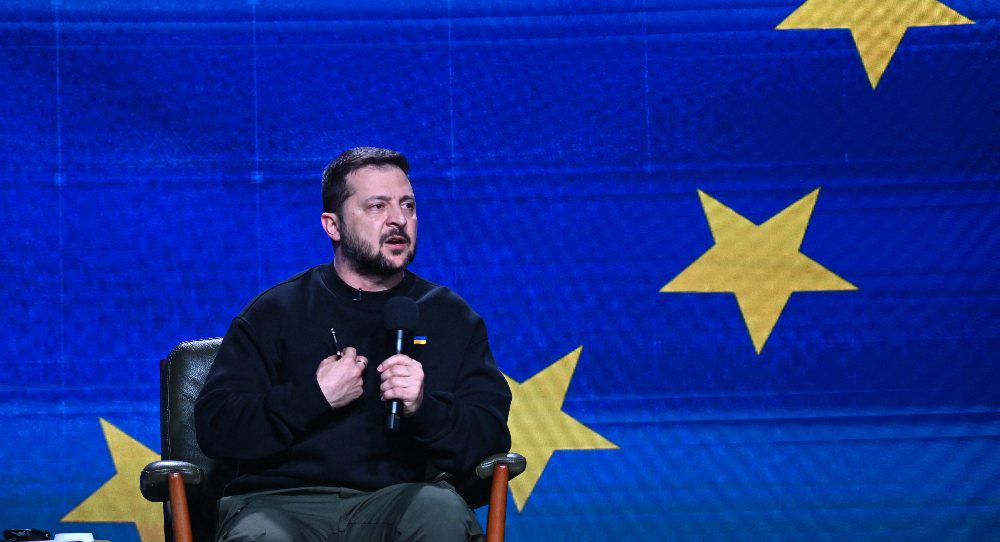
Source: Getty
Ukrainians’ continued trust in President Zelensky and the armed forces suggests Kyiv can navigate domestic political turbulence. But Ukraine’s military success hinges on stronger European support.
It is only mid-January and the list of worrying developments regarding Ukraine is already very long: the renewed intensity of Russian airstrikes on Ukrainian cities; the prospect of a drawn-out war of attrition along the eastern front; the recognition that the 2023 counteroffensive did not disrupt Russian supply routes in the south; the failure of EU countries to produce and deliver promised ammunition; stalling discussions on the delivery of Taurus; the blockage of aid in the U.S. Senate before the presidential election campaign even kicks off in earnest; and the looming Russian presidential election in March, ahead of which Vladimir Putin will want to demonstrate his resolve with regard to Ukraine.
Add to this the scenario the return of politics to Kyiv, with some disagreements between President Volodymyr Zelensky and Commander-in-Chief Valery Zaluzhny becoming public at the end of 2023. So is it all doom and gloom?
According to opinion poll data collected by the Kyiv Institute of International Sociology (KIIS) in November-December 2023 across Ukraine-controlled territory, pessimism about Ukraine’s future has been on the rise, with 19 percent—up from 5 percent in October 2022—agreeing with the statement that ten years from now, Ukraine will be a country with a destroyed economy and mass emigration. However, as before, a vast majority—73 percent, down from 88 percent in October 2022—envisages Ukraine as a prosperous country within the European Union.
Even if a question like this may tap into hopes or a sense of civic duty rather than actual expectations, the results clearly signal the continued consensus on Ukraine’s political direction. A related question found that the share of those who believe that affairs are going in the wrong direction has increased from 16 percent in May 2022 to 33 percent in December 2023. A long-lasting war takes a toll on society, so the real surprise—and a source of optimism in its own right—is that over 50 percent are still expressing an optimistic perspective.
Ever since Zaluzhny gave his outspoken interview for The Economist, there has been speculation in the West about a potential rift between Zaluzhny and Zelensky. The bottom-up view provides an important corrective: According to a KIIS survey, in December 2023, only 8 percent thought that there were very serious disagreements or misunderstandings between Zelensky and Zaluzhny. Meanwhile, 35 percent believed there were certain disagreements which, however, were not very serious, and 39 percent thought there was little or no disagreement. These results are a reminder of the importance of tracking the societal mood. Society simply expects Zelensky and Zaluzhny to cooperate—and the two leaders are aware of this. Moreover, talk of political divisions is easily amplified by Russia and Zelensky’s political rivals, above all his predecessor Petro Poroshenko who is trailing in the polls.
Trust in the military as a whole and Zaluzhny in particular has remained very high. By comparison, there has been a lot of discussion about Zelensky’s waning public support. Again, it is not surprising that the rallying-around-the flag effect decreases over time in a long war. However, when compared to other political leaders—excluding Zaluzhny who has not declared any political ambitions yet—Zelensky clearly tops the list of trusted politicians.
If trust is measured across different institutions and individuals, pre-invasion patterns continue: The army and Zaluzhny in particular score around or over 90 percent across different polls, closely followed by volunteers and the president—currently about 60 percent. If the question is made more nuanced to ask about the tasks the public entrusts the president with, there is currently simply no alternative to Zelensky in the public’s view.
Looking ahead, as data from the MOBILISE project shows, there is a clear division of responsibilities in people’s minds: Zelensky is highly valued for his future role in reconstruction, preparing for EU accession and preserving Ukraine’s democracy, while Zaluzhny is associated with securing military victory. The expectations tied to these two men are enormous but also complementary—as long as they choose to keep it that way.
Overall, then, there are grounds for hope that Ukraine’s domestic political challenges can be managed in 2024. Militarily, it is a critical year that will test Ukraine’s ability to defend the current frontlines and launch further attacks in the more dynamic warfare around Crimea and the Black Sea more generally. Ukraine’s military momentum will depend on whether the West, especially Europe, sheds its role as an observer of the drama unfolding in Ukraine—and the United States.
Whether Europe can replace the United States in terms of military and financial aid in case of a Donald Trump victory is an open question, but intensifying and pooling of military production now to enable a steady supply to Ukraine should be a realistic starting point.
Gwendolyn Sasse is a nonresident senior fellow at Carnegie Europe and director of the Centre for East European and International Studies (ZOiS) in Berlin.

Nonresident Senior Fellow, Carnegie Europe
Gwendolyn Sasse is a nonresident senior fellow at Carnegie Europe. Her research focuses on Eastern Europe, with a particular focus on Ukrainian politics and society, EU enlargement, and comparative democratization.
Recent Work
Gwendolyn Sasse
Gwendolyn Sasse
Carnegie does not take institutional positions on public policy issues; the views represented herein are those of the author(s) and do not necessarily reflect the views of Carnegie, its staff, or its trustees.

Canadian Prime Minister Mark Carney has twice inspired praise for standing up to U.S. President Donald Trump: at the 2026 World Economic Forum in Davos and on Canada-U.S. trade negotiations. Is Carney showing a third way better than the EU has in dealing with the Trump administration?

Rym Momtaz, ed.

The EU’s responses to two recent incidents expose the gulf between European perceptions and capabilities. Unless the union can bridge that gap, it will never become a real geostrategic power.
Rym Momtaz

In supporting Europe’s far-right, MAGA and Russia both want the same thing: a weaker EU. Europe must defend itself without abandoning the openness these forces exploit.

Armida van Rij
As we close out another season of Strategic Europe, it is worth taking stock of the deep shifts underway.
Rym Momtaz
The EU had to compromise to adopt a twenty-first sanctions package against Russia, exposing growing cracks in the union’s resolve. Is this latest, weaker round worth it to keep pressure on Moscow?
Rym Momtaz, ed.