

Commentary
Judy Dempsey
{
  "authors": [
    "Judy Dempsey"
  ],
  "type": "commentary",
  "blog": "Strategic Europe",
  "centerAffiliationAll": "",
  "centers": [
    "Carnegie Endowment for International Peace",
    "Carnegie Europe"
  ],
  "collections": [
    "Europe’s Eastern Neighborhood"
  ],
  "englishNewsletterAll": "",
  "nonEnglishNewsletterAll": "",
  "primaryCenter": "Carnegie Europe",
  "programAffiliation": "",
  "programs": [],
  "projects": [],
  "regions": [
    "Russia",
    "Europe",
    "Eastern Europe",
    "Western Europe"
  ],
  "topics": [
    "Foreign Policy",
    "Security",
    "EU"
  ]
}
Source: Getty
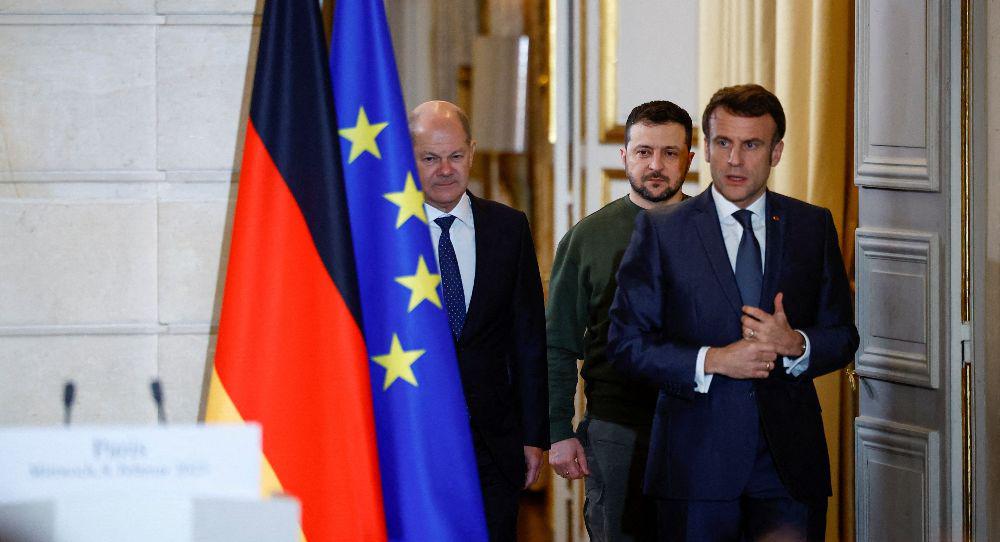
Berlin and Paris are squabbling over how to support Ukraine. To mend divisions and make Europe Kyiv’s number one defender, Chancellor Scholz must take on a leadership role.
This is not the time for wavering or bickering over Ukraine. Yet that is what’s happening in Germany—and Europe.
Germany’s Social Democrat Chancellor Olaf Scholz is mired in a dispute with his coalition partners and the main conservative opposition, the Christian Democrats (CDU), about whether or not to send Taurus cruise missiles to Ukraine.
So far, Scholz has not budged from his position.
For him—and the left wing of his party—sending such missiles would mean three things. First, it would require German military experts on the ground in Ukraine to assist Kyiv—a red line for Scholz. Second, it would make Germany party to the war. Actually, the fact that Berlin has given Ukraine over €17 billion ($18 billion) of military and other aid surely makes it a defender of Ukraine. And third, it would provoke Russia. Well, Russia hardly needs provoking. It invaded Ukraine a decade ago. Its recent attacks on the eastern city of Kharkiv are more than a reminder that President Vladimir Putin has few intentions of stopping the bombardment of the country.
Inside and outside the coalition, those for and against sending Taurus missiles were stunned by revelations of a confidential discussion among Germany’s top generals about the implications of sending such weapons. It included questions about the range of the missiles and if they could strike the new bridge on the Kerch Strait that links Crimea to mainland Russia. The conversation was hacked and then aired by Margarita Simonyan, the head of Russia’s state-run RT channel.
It was a perfect propaganda coup for Putin. Leaving aside the digital illiteracy of Germany as a whole—the conversation took place over Webex instead of a highly secure system—the leaks were aimed at dividing Germany and its allies over Ukraine.
The Europeans aren’t wavering as such. It is something more fundamental: the lack of trust among allies, no thanks to Scholz. He recently gave an interview to the DPA news agency, during which he mentioned that French and British special forces were helping Ukraine in identifying, vetting, and programming targets for the missiles they supply to Kyiv.
Whether that was an open secret or not, such military issues tend to be discussed behind closed doors. Maybe Scholz was sour with President Emmanuel Macron who recently raised the idea of sending European ground troops to Ukraine, without going into detail or consulting his allies first.
Both leaders have now been swiping at each other. Britain has joined the fray. Scholz’s comments were “wrong, irresponsible and a slap in the face to allies,” said Alicia Kearns, the chair of the UK parliament’s Foreign Affairs Committee.
Now is not the time for Europe’s three biggest countries to be squabbling over how to militarily support Ukraine. And especially at a time when there is disunity in the United States about further funding for Ukraine—not to mention the uncertainty ahead of the presidential election. In fact, this should be Europe’s chance to become Ukraine’s number one financial, political, and military defender.
Since the end of the Cold War, Europe has repeatedly failed to act in a strategic manner. The wars in the former Yugoslavia divided Europe, with Germany supporting Croatia and France supporting Serbia. Without American military support, particularly the logistics that NATO’s European allies completely lacked, the war would have dragged on.
The Europeans didn’t learn from those weaknesses. The need to increase military capabilities was not addressed and divisions persisted. Indeed, these mistakes were repeated twenty years ago, when the George W. Bush administration decided to invade Iraq. Germany and France joined with Russia to oppose the war. Britain, along with the Central Europeans and Baltic states supported the U.S. invasion. It was touch and go for the NATO alliance which was mauled by divisions. The healing took a long time.
And so to Ukraine. This war is testing the resolve of Europe. Since February 2022, when Russia launched its full-scale invasion of Ukraine, the EU and NATO have been remarkably united. There is now a realization—that was largely ignored or played down by the big European countries when Russia invaded Georgia in 2008—that the continent’s security is at stake. If Ukraine loses, the consequences for other Eastern European countries are clear. Russia will make them part of Putin’s imperialist ambitions.
Any suggestion, so often championed in the past by Paris and Berlin, of Europe having a security architecture that includes Russia is now discarded. Ukraine is providing Europe with security.
But one particular element affects the German mindset: the past.
When the German military discussion was leaked, Putin’s spokesman said: “The [military conversation] itself suggests that in the bowels of the Bundeswehr, plans for strikes on Russian territory are being discussed in a substantive and concrete manner.” Such comments are designed to further divide Scholz’s social democrats, some of whom still hanker after the country’s special relationship with Russia forged after World War II.
Scholz tried to reassure Germany’s allies. “This hybrid attack aimed to generate insecurity and divide us,” a government spokesman said on Monday. “And that is exactly what we will not allow. We are in constant contact with our partners.”
It’s going to take more than those words to maintain and increase the support for Ukraine. It’s about Berlin assuming leadership in Europe.
The UK is skeptical: Scholz was “the wrong man, in the wrong job at the wrong time,” said Ben Wallace, the UK’s former defense minister. It was he who last year authorized the delivery of long-range Storm Shadow missiles to Ukraine. Will Scholz yield to the pressure?

Nonresident Senior Fellow, Carnegie Europe
Judy Dempsey is a nonresident senior fellow at Carnegie Europe
Recent Work
Judy Dempsey
Judy Dempsey
Carnegie does not take institutional positions on public policy issues; the views represented herein are those of the author(s) and do not necessarily reflect the views of Carnegie, its staff, or its trustees.

The domestic impacts of how long it is taking to end the war in Ukraine have pushed the French electorate to the political extremes and compromised the country’s diplomatic capacity.

Rym Momtaz

Before the next wave of EU enlargement takes place, the union needs to grapple with thorny questions of how power is distributed among its members.


Emil Sondaj Hansen, Ditte Brasso Sørensen

A summer of escalation in the Black Sea has hurt Ukraine economically and is exacerbating world food security. A truce is needed—as is a broader reframing of Europe’s Ukraine strategy.

Thomas de Waal

Are Germany’s economic, industrial, and political struggles becoming a liability for the EU’s ability to rise to the geopolitical moment?
Rym Momtaz, ed.

European Commission President Ursula von der Leyen is about to give her annual address on the state of the EU. Here’s what she won’t—but should—say.
Rym Momtaz