

Commentary
Judy Dempsey
{
  "authors": [
    "Judy Dempsey"
  ],
  "type": "commentary",
  "blog": "Strategic Europe",
  "centerAffiliationAll": "",
  "centers": [
    "Carnegie Endowment for International Peace",
    "Carnegie Europe"
  ],
  "collections": [
    "Europe’s Eastern Neighborhood"
  ],
  "englishNewsletterAll": "",
  "nonEnglishNewsletterAll": "",
  "primaryCenter": "Carnegie Europe",
  "programAffiliation": "",
  "programs": [],
  "projects": [],
  "regions": [
    "Russia",
    "Europe",
    "Eastern Europe",
    "Ukraine",
    "Western Europe"
  ],
  "topics": [
    "Foreign Policy",
    "Security",
    "EU"
  ]
}
Source: Getty
Russia’s war on Ukraine makes cooperation among France, Germany, and Poland more important than ever. Public disagreements can only weaken the EU and play into Putin’s hands.
It happened back in 1991, just as the Cold War was ending and the Eastern and Central European countries were making the transition to democracy.
The foreign ministers of France, Germany, and Poland met in the German city of Weimar, the birthplace of writers Johann Wolfgang von Goethe and Friedrich Schiller.
This was also where a constitution was declared in 1918, aimed at giving Germany a chance to establish democracy while dealing with the devastating consequences of World War I. The short life of what was called the Weimar Republic was plagued by political instability that contributed to the rise of Adolf Hitler and his Nazi movement in 1933.
Packed with symbolism, the 1991 meeting of the three foreign ministers in the newly reunited Germany was designed to create special ties between Berlin, Paris, and Warsaw. If, since 1945, France and Germany could put behind centuries of enmity and war, why couldn’t that model be used to forge reconciliation between Poland and Germany?
The Weimar Triangle, as it was called, created a web of economic, political, social, and cultural relationships to build trust and promote cross-border cooperation.
Since its establishment, this regional alliance has had its ups and downs. One low was when Poland’s conservative Law and Justice (PiS) was in government from 2015 to 2023. The party was anti-German and highly skeptical of the EU. It also sought reparations from Germany for the damage it wrought on Poland during the Second World War.
Russia’s second invasion of Ukraine in February 2022 highlighted differences between Berlin, Paris, and Warsaw. Poland was right to state that it had already warned its Western European counterparts of Vladimir Putin’s imperialist ambitions when Russia invaded Georgia in 2008 and then Ukraine in 2014. Its interlocutors were in no mood to heed such warnings. February 2022 changed all that—and it could yet change the dynamics of the Weimar Triangle.
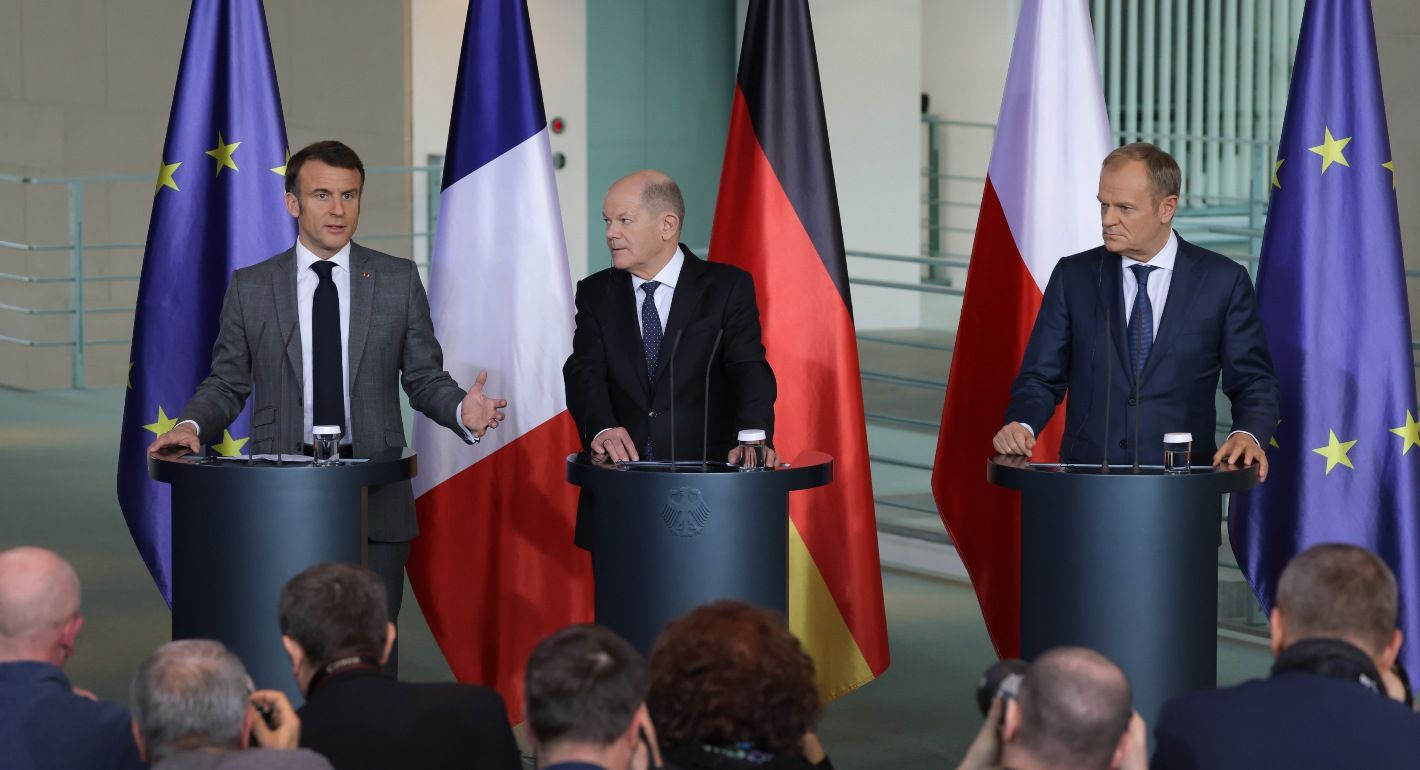
A sense of this change took place on March 15, when Chancellor Olaf Scholz invited French President Emmanuel Macron and Polish Prime Minister Donald Tusk to Berlin.
The summit was so necessary. Questions over how to support Ukraine, especially in recent months, had led to sniping between the three countries, particularly between Germany and France. The public sparring was almost turning into an unseemly competition about who was providing the most political and military assistance to Ukraine.
Indeed, the war has had the potential to pit these three countries against each other at a time when unity in the EU is more critical than ever and when President Vladimir Putin shows no intent of pulling out of Ukraine.
Against that background, the summit was about having these three big EU and NATO members work much more closely together over Ukraine, over Europe’s security, and over the transatlantic relationship.
All three issues are crucial for the continent’s stability as the three leaders do acknowledge. Despite that, for historical and political reasons, they have different views on Europe’s future trajectory.
Take Poland. The Tusk government—as its predecessor—wants Ukraine to win the war. Warsaw’s response has been to provide Ukraine with as much military support as possible to achieve that.
As for Macron, he has changed his attitude toward both Ukraine and Russia. Once intent on creating a European security structure together with Moscow, Paris has abandoned the idea and is supplying sophisticated weaponry to Kyiv. In Berlin, Macron openly said the goal is to “never let Russia win.” Paris and Warsaw are increasingly aligned over Russia.
Scholz, however, has never uttered the “win” word. At the joint press conference on March 15, the chancellor repeated what has become his mantra: Berlin will support Ukraine for “as long as it takes.”
Germany, at least under Scholz’s Social Democratic Party, has yet to come to grips with the consequences for Ukraine in particular and Europe in general, of a Russian victory.
Somehow, those Social Democrats coalesced around the party’s parliamentary group leader, Rolf Mützenich, not only oppose sending Taurus missiles to Ukraine; they seem ambiguous about supporting Ukraine to an extent that would enable it to regain some of its territory occupied by Russia.
“What is needed is understanding, prudence, and clarity. And that’s what the chancellor is doing in his considerations as head of government,” Mützenich said.
But the deputy parliamentary group leader of the opposition Christian Democrats, Johann Wadephul, responded: “Again and again, [the SPD’s] supposed prudence has only ever fueled Mr. Putin in his aggression against Ukraine. That is the result.”
The war in Ukraine is also raising big questions in France, Germany, and Poland about the direction of Europe’s under-performing security, defense, and foreign policies. These issues, which are bones of contention between the three countries, are all linked to the transatlantic relationship and who will enter the White House after the November presidential elections in the United States.
That is why the Weimar Triangle matters. Leaving aside the rhetoric and forced smiles before the cameras in Berlin, these three big countries need to cooperate much more closely to give Europe the leadership it sorely needs. The war in Ukraine demands it.

Nonresident Senior Fellow, Carnegie Europe
Judy Dempsey is a nonresident senior fellow at Carnegie Europe
Recent Work
Judy Dempsey
Judy Dempsey
Carnegie does not take institutional positions on public policy issues; the views represented herein are those of the author(s) and do not necessarily reflect the views of Carnegie, its staff, or its trustees.

A summer of escalation in the Black Sea has hurt Ukraine economically and is exacerbating world food security. A truce is needed—as is a broader reframing of Europe’s Ukraine strategy.

Thomas de Waal

Are Germany’s economic, industrial, and political struggles becoming a liability for the EU’s ability to rise to the geopolitical moment?

Rym Momtaz, ed.

European Commission President Ursula von der Leyen is about to give her annual address on the state of the EU. Here’s what she won’t—but should—say.
Rym Momtaz

The aftermath of the Ceuta crisis shows Europe has drawn the wrong lessons. Rather than doubling down on failed migration policies, the EU needs to address the underlying roots of such episodes.

Richard Youngs

An overwhelming victory by a far-right-wing party in a small state in eastern Germany will have major repercussions for Chancellor Friedrich Merz’s coalition.
Judy Dempsey