

Commentary
The EU can impose sanctions but struggles to enforce them without the United States. With Washington increasingly disinterested in backing European interests, the bloc must now fend for itself.
Nicu Popescu, Tiago Antunes
{
  "authors": [
    "Romain Le Quiniou"
  ],
  "type": "commentary",
  "blog": "Strategic Europe",
  "centerAffiliationAll": "",
  "centers": [
    "Carnegie Endowment for International Peace",
    "Carnegie Europe"
  ],
  "englishNewsletterAll": "",
  "nonEnglishNewsletterAll": "",
  "primaryCenter": "Carnegie Europe",
  "programAffiliation": "",
  "programs": [],
  "projects": [],
  "regions": [
    "Europe",
    "France",
    "Türkiye",
    "Ukraine"
  ],
  "topics": [
    "EU",
    "Foreign Policy",
    "NATO",
    "Security"
  ]
}
Source: Getty
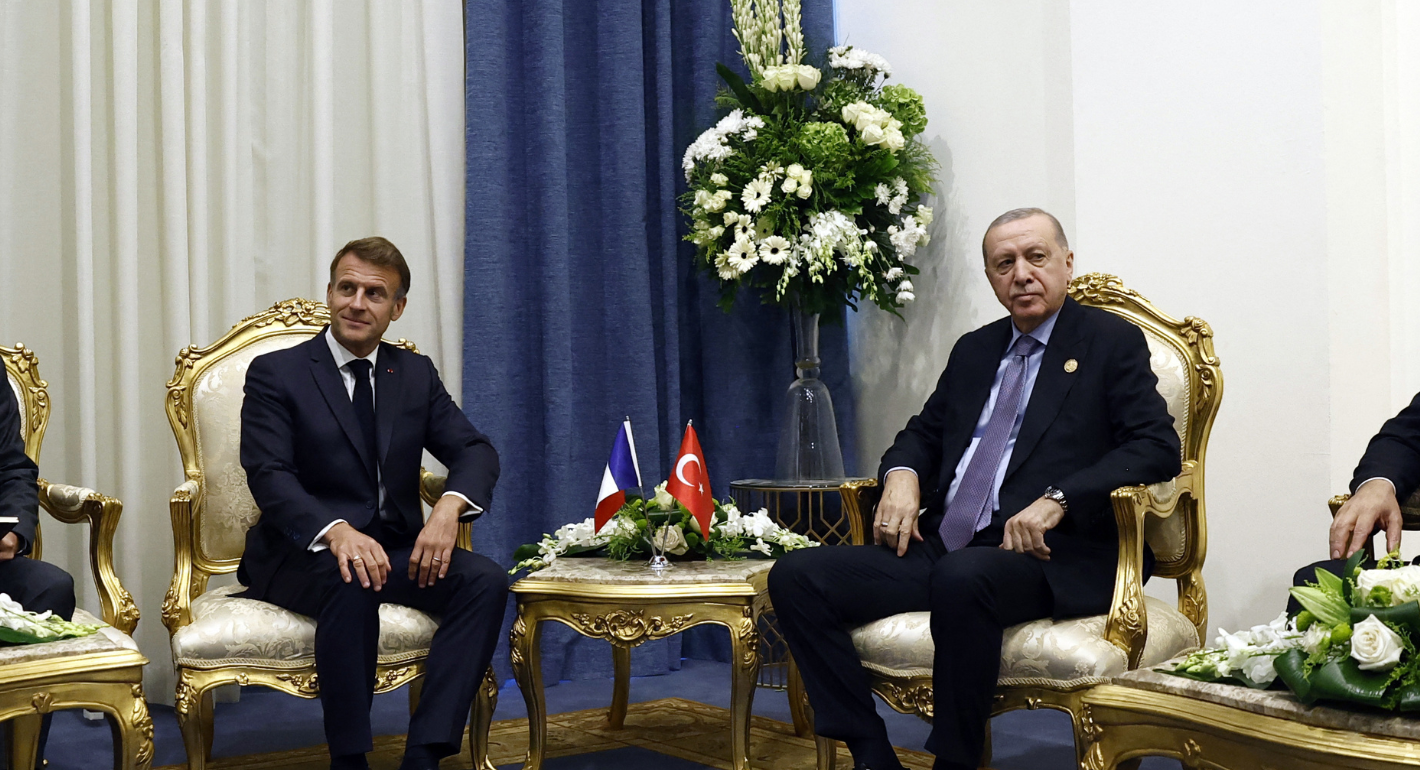
A renewal of relations between France and Turkey is vital to strengthen European strategic autonomy. To make this détente a reality, Paris and Ankara should move beyond personal friction and jointly engage with questions of Black Sea security.
Europe’s push for greater strategic cohesion and autonomy in an uncertain world is held back by poor relations between two of the continent’s most powerful security actors: France and Turkey. Forging a common agenda around Ukraine, and on Black Sea security issues in particular, could be the place to start.
For most of the past decade, Franco-Turkish relations have oscillated between cold pragmatism and open rivalry, fueled by crises in the Eastern Mediterranean, Libya, and more broadly a geopolitical contest over Europe’s neighborhood. The often tense public dynamic between French President Emmanuel Macron and Turkish President Recep Tayyip Erdoğan has at times turned strategic differences into interpersonal friction.
Russia’s full-scale invasion of Ukraine in 2022, however, altered the strategic environment for both countries. Europe’s Eastern flank, with the Black Sea at its core, has become an active war zone and a decisive hinge in the continent’s security order. At the same time, the unpredictability of the United States is forcing Europeans to design its own more credible security architecture.
As a result, Europe and Turkey’s strategic thinking is increasingly aligned—yet concrete outcomes are lacking. Thanks to its leading security role and peculiar relations with Ankara, Paris has a particular responsibility to act. France will not re-engage by pretending their differences have disappeared; they have not. But a common quest for strategic autonomy could help to accelerate a reset, should both leaders focus on a narrow set of shared priorities.
These questions in Franco-Turkish relations are not new. In 1968, then-president Charles de Gaulle visited Turkey and emphasized the strategic importance of a direct political relationship. His remarks still resonate today: Both countries have long sought room for sovereign maneuver and the capacity to act beyond rigid alignments, privileging bilateral channels when core security interests are at stake.
For Paris and Ankara, the war in Ukraine is also a stress test of their capacity to sustain a viable security order.
France frames the defense of Ukraine as a European project backed by military and technological capacity, industrial sovereignty, and credible deterrence. Turkey, meanwhile, presents the war as an issue in which it asserts its interest in achieving regional stability in Eurasia—an interest anchored in the country’s NATO membership, but also one that Ankara holds independently of its ties to the alliance.
The overlap is functional, not ideological. In the context of U.S. withdrawal, both countries have incentives to stabilize the wider Black Sea region and to shape postwar security arrangements, preventing renewed Russian aggression.
Fortunately, several regional disputes that had accentuated divisions between the two countries are, for now, less combustible than they were between 2019 and 2021.
In the eastern Mediterranean, rivalry has not disappeared, but channels between Greece and Turkey have partially reopened. Cyprus may also offer an unexpected opportunity after the October 2025 victory of Tufan Erhürman, who campaigned on reviving reunification talks, in the Turkish Cypriot presidential election.
The prospect of an Armenia–Azerbaijan peace agreement creates a positive dynamic in the South Caucasus. The current Armenian government is actively seeking normalization with Turkey—an evolution France, as Yerevan’s closest European ally, should welcome and encourage. Paris and Ankara can seek to develop pragmatic trilateral coordination with Yerevan where interests overlap.
In the Middle East, alignment is selective but real. France’s recognition of Palestinian statehood is one area of convergence. In Africa, competition endures but there have been fewer discrepancies since Libya has moved toward a less confrontational phase of its political process.
Meanwhile the Black Sea offers something rare: a theater where neither Turkey nor the EU can reach its objectives alone.
Ankara’s posture is anchored in a long-standing doctrine of regional responsibility, while hedging between Russia and the West. Since 2022, Erdoğan has played a distinctive role, brokering the Black Sea Grain Initiative and refusing to align with EU sanctions on Russia while also facilitating early transfers of Turkish defense technology to Ukraine. Turkey also seeks a defined place in any postwar security architecture, with a particular emphasis on the maritime dimension within the coalition of the willing format.
Paris, meanwhile, has made the Black Sea a long-term strategic priority, through NATO posture, EU tools, and reinforced bilateral partnerships. The country also developed an interministerial regional strategy in 2024, confirming its ambition to scale up its presence and influence.
A Franco-Turkish Black Sea agenda should therefore be built on three concentric circles.
First, the two countries should stabilize their ties with a stronger bilateral trading relationship and economic cooperation in sectors that matter for regional security and connectivity. Second, they should work to strengthen minilateral formats with key Black Sea allies. Romania is not only France’s principal anchor on the Black Sea; it can also function as a bridge to Ankara, providing an operationally credible platform for a pragmatic trilateral partnership. Third, they should strive for a realistic, mutually beneficial regional agenda in an area where EU-Turkey relations are sometimes strained. Ankara remains skeptical about parts of the union’s Black Sea strategy and it proved impossible to discuss the inclusion of Turkey within the Security Action For Europe mechanism.
One key priority is to renegotiate and modernize the terms of Turkey’s access to the customs union, in part to design a more robust economic framework aligned with Europe’s geoeconomic needs; one which maximizes Ankara as a critical connector with Asia. As a major investor in Turkey and an influential voice in the EU, France can—and should—play a dynamic role in promoting this.
The new importance of the Black Sea for Europe’s security has opened the window for Franco-Turkish reengagement. The challenge is now to convert necessity into tangible results before upcoming electoral cycles in both countries once again politicize the relationship and decrease the room for maneuver.
Romain Le Quiniou is managing director and co-founder of French think tank Euro Créative, and co-founder of the Iron Bridge consultancy.
Romain Le Quiniou
Managing Director, Euro Créative
Romain Le Quiniou is managing director and co-for of Euro Créative and co-founder of Iron Bridge.

The EU can impose sanctions but struggles to enforce them without the United States. With Washington increasingly disinterested in backing European interests, the bloc must now fend for itself.


Nicu Popescu, Tiago Antunes

Russia is testing the waters of NATO’s mutual defense clause. What do strikes in Romanian territorial waters mean for the alliance’s posture toward Moscow?

Dimitar Bechev

With its public finances in shambles, the far right polling at 35 percent ahead of the 2027 presidential election, and a growing protest movement, is France’s crisis a threat to the EU’s geopolitical awakening?

Rym Momtaz, ed.

Ahead of a tough winter for Ukraine, Donald Trump’s swing back toward Russia bodes ill. But instead of panicking, Kyiv’s European allies are focusing on action.
Rym Momtaz

While the EU and European governments are embracing the much-lauded middle-power moment, this entails three difficult conundrums.

Richard Youngs