

{
  "authors": [
    "Marina Ottaway",
    "Michele Dunne",
    "William Zartman",
    "Abdeslam Maghraoui"
  ],
  "type": "event",
  "centerAffiliationAll": "dc",
  "centers": [
    "Carnegie Endowment for International Peace"
  ],
  "collections": [],
  "englishNewsletterAll": "democracy",
  "nonEnglishNewsletterAll": "",
  "primaryCenter": "Carnegie Endowment for International Peace",
  "programAffiliation": "DCG",
  "programs": [
    "Democracy, Conflict, and Governance",
    "Middle East"
  ],
  "projects": [],
  "regions": [
    "North Africa",
    "Morocco"
  ],
  "topics": [
    "Political Reform",
    "Democracy",
    "Economy",
    "Foreign Policy"
  ]
}
Morocco: From Top-Down Reform to Democratic Transition?
Wed, November 1st, 2006
Washington, D.C.
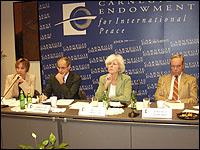
Marina Ottaway emphasized that the Middle East Series, of which her paper is a part, assumes that reform processes are bound to vary in different Arab country. Morocco exemplifies an extreme case of top-down reform, because reform comes from the king without much involvement by the opposition. Ottaway argued that while many changes have taken place in Morocco, none could be described as democratic. Political power remains in the hands of the palace, which has deliberately monopolized the reform process. Significant changes in the Moroccan political scene include a dramatically improved human rights situation, and the adoption of a new personal status code, that is by far one of the most progressive by regional standards. The press is also freer than it was in the past, although some journalists point to a relapse in the past few months. Despite these changes, there have been no constitutional reforms and the system of alternance was reversed when the king handed the prime ministership to a technocrat in 2003.
IMGXYZ550IMGZYXOttaway emphasized that her analysis does not mean that Morocco’s socio-economic reform process has come to end, but it does suggest that there is little reason to believe that Morocco will embark on a political reform process anytime soon. The Islamist Justice and Development party (PJD) aside, there is a lack of powerful opposition forces capable of pushing for a greater political opening. Under the alternance system, former opposition parties were able to form government, but were co-opted as a result of their proximity to the monarchy. The PJD risks facing the same fate if it chooses to participate in the upcoming government. In many ways, however, the future of Moroccan political reform process hinges on the success of the PJD in the 2007 parliamentary elections—being the best organized opposition party—and its ability to press for further openings.
William Zartman commended the report’s positive assessment of the role of the King Hassan II in initiating the reform process, but warned against forgetting that he is responsible for taming Morocco’s political parties. Zartman urged observers to recognize the difficult balance between democrazation and stability in Morocco and to ponder mechanisms for making monarchies more participatory. A more powerful prime minister in Morocco is a case in point. To conclude, he echoed Ottaway’s concern regarding the weakness of Moroccan political parties.
Abdeslam Maghraoui identified three areas that Ottaway’s paper does not address: the monarchy’s involvement in the private sector, which makes it difficult for the business elite to challenge the monarchy; the role of the military; and the social conservatism that is on the rise in Moroccan society.
During the question and answer period, Ottaway argued that a distinction could be made between the PJD’s positions on domestic and regional issues. Its discourse on the latter witnessed some re-radicalization after the recent Lebanon war. Maghraoui noted that the PJD’s dilemma is that it must negotiate its moderation with its conservative popular base. Zartman emphasized that the PJD remains a protest party and is likely to moderate if it gains more political power.
Carnegie does not take institutional positions on public policy issues; the views represented herein are those of the author(s) and do not necessarily reflect the views of Carnegie, its staff, or its trustees.
Event Speakers
Former Senior Associate, Middle East Program

Before joining the Endowment, Ottaway carried out research in Africa and in the Middle East for many years and taught at the University of Addis Ababa, the University of Zambia, the American University in Cairo, and the University of the Witwatersrand in South Africa.
Former Nonresident Scholar, Middle East Program

Michele Dunne was a nonresident scholar in Carnegie’s Middle East Program, where her research focuses on political and economic change in Arab countries, particularly Egypt, as well as U.S. policy in the Middle East.
William Zartman
Abdeslam Maghraoui