

{
  "authors": [
    "Robert Gates"
  ],
  "type": "event",
  "centerAffiliationAll": "dc",
  "centers": [
    "Carnegie Endowment for International Peace"
  ],
  "collections": [],
  "englishNewsletterAll": "ctw",
  "nonEnglishNewsletterAll": "",
  "primaryCenter": "Carnegie Endowment for International Peace",
  "programAffiliation": "russia",
  "programs": [
    "Russia and Eurasia",
    "Nuclear Policy"
  ],
  "projects": [],
  "regions": [
    "North America",
    "United States",
    "Middle East",
    "Iran",
    "India",
    "Pakistan",
    "Caucasus",
    "Russia"
  ],
  "topics": [
    "Military",
    "Foreign Policy",
    "Nuclear Policy",
    "Nuclear Energy"
  ]
}
Gates: Nuclear Weapons and Deterrence in the 21st Century
Tue, October 28th, 2008
Washington, D.C.
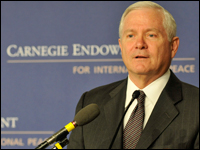
U.S. Secretary of Defense Robert Gates, speaking at Carnegie on October 28, warned that as long as others possess nuclear weapons, the United States must maintain a safe and reliable nuclear arsenal. He urged the development of a Reliable Replacement Warhead program which he said could be done without nuclear testing. Gates further urged the next U.S. president to engage Russia in new arsenal reduction talks.
During the question and answer session, Gates supported ratification of the Comprehensive Test Ban Treaty (CTBT)—which the United States Senate refused to ratify in 1999—if it included adequate verification measures.
Gates also voiced support for deeper reductions in U.S. and Russian nuclear arsenals as part of a new arms control agreement to replace START, set to expire in December 2009. The follow-on agreement, he argued, should preserve the verification provisions of START and reduce the number of deployed warheads to somewhere below the current target of 1700-2200.
Other highlights:
- Gates argued that the arms control process contributes to a safer world. He described Cold War-era arms control negotiations as “a quarter-century seminar for the United States and Soviet Union on how each thought,” and urged the next administration to engage Russia in new arms reduction talks.
- Gates said that a strategic dialogue is underway with China to address its modernization program and advance mutual understanding of the threats each country perceives. Sustained dialogue must underpin any successful arms control negotiations.
- Gates emphasized the “bleak” outlook for the long-term reliability and safety of the aging U.S. nuclear arsenal. At some point the United States will no longer be able to extend the shelf life of current weapons and will either have to test the stockpile or modernize it. The “brain drain” of veteran nuclear scientists at national labs could complicate efforts to update the U.S. arsenal.
- He pushed for the Reliable Replacement Warhead (RRW) program, for which Congress has cut funding. In response to a question, Gates said that the Pentagon could pursue RRW without conducting nuclear tests.
Carnegie does not take institutional positions on public policy issues; the views represented herein are those of the author(s) and do not necessarily reflect the views of Carnegie, its staff, or its trustees.
Event Speaker
Robert Gates