

Paper
Adam Baczko, Gilles Dorronsoro, Arthur Quesnay
{
  "authors": [
    "Gilles Dorronsoro"
  ],
  "type": "other",
  "centerAffiliationAll": "dc",
  "centers": [
    "Carnegie Endowment for International Peace",
    "Carnegie Russia Eurasia Center"
  ],
  "collections": [],
  "englishNewsletterAll": "ctw",
  "nonEnglishNewsletterAll": "",
  "primaryCenter": "Carnegie Endowment for International Peace",
  "programAffiliation": "SAP",
  "programs": [
    "South Asia"
  ],
  "projects": [
    "Eurasia in Transition"
  ],
  "regions": [
    "North America",
    "United States",
    "South Asia",
    "Afghanistan",
    "Western Europe"
  ],
  "topics": [
    "Political Reform",
    "Democracy",
    "Security",
    "Military",
    "Foreign Policy"
  ]
}
Source: Getty
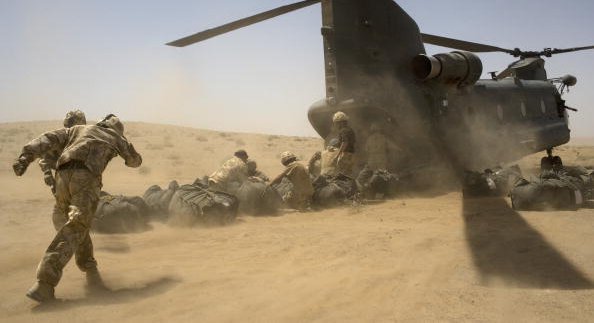
The debate in Washington and European capitals has recently centered on how many more troops will be sent to Afghanistan in 2009 as part of a military surge. The real question, however, is how combat troops should be used - to pursue the Taliban, or secure key areas to allow institutions to develop. The main policy objective must be the development of a government that can survive U.S. withdrawal.
After seven years of war, the international community has failed to create the conditions for a sustainable Afghan state. The reality is that the international coalition now has limited resources and a narrow political time frame to create lasting Afghan institutions. Yet building such institutions is our only realistic exit strategy.
The debate in Washington and European capitals has recently centered on how many more troops will be sent to Afghanistan in 2009 as part of a military surge. Such a tactical adjustment is unlikely to make much of a difference in a country where the basic population-to-troops ratio is estimated at approximately 430 people per foreign soldier.
The real question is how combat troops should be used. The two choices we face are whether to continue playing offense by going after the Taliban, especially in the south and the east, and spreading troops thin; or whether to adopt a new strategy focusing on protecting strategic sites, namely, urban centers and key roads, to allow for the development of a strong core of Afghan institutions.
Key conclusions:
Former Nonresident Scholar, South Asia Program
Dorronsoro’s research focuses on security and political development in Afghanistan. He was a professor of political science at the Sorbonne in Paris and the Institute of Political Studies of Rennes.
Recent Work
Adam Baczko, Gilles Dorronsoro, Arthur Quesnay
Gilles Dorronsoro
Carnegie does not take institutional positions on public policy issues; the views represented herein are those of the author(s) and do not necessarily reflect the views of Carnegie, its staff, or its trustees.
It signals a new era of tech diffusion and warfare.

Steve Feldstein

With its public finances in shambles, the far right polling at 35 percent ahead of the 2027 presidential election, and a growing protest movement, is France’s crisis a threat to the EU’s geopolitical awakening?

Rym Momtaz, ed.

Putin’s conservative staffing policies and search for ever greater control have cemented parliament’s transformation into a bureaucratic appendage of the executive branch.

Andrey Pertsev

Russia’s AI-driven propaganda campaigns operate in a fragmented, chaotic, and often illogical manner. That’s not necessarily a problem for the Kremlin, though: It’s much easier to mimic genuine public debate that way.

Ilya Klishin

Ahead of a tough winter for Ukraine, Donald Trump’s swing back toward Russia bodes ill. But instead of panicking, Kyiv’s European allies are focusing on action.
Rym Momtaz