

Paper
Ashley J. Tellis
{
  "authors": [
    "Ashley J. Tellis"
  ],
  "type": "legacyinthemedia",
  "centerAffiliationAll": "dc",
  "centers": [
    "Carnegie Endowment for International Peace"
  ],
  "collections": [],
  "englishNewsletterAll": "ctw",
  "nonEnglishNewsletterAll": "",
  "primaryCenter": "Carnegie Endowment for International Peace",
  "programAffiliation": "SAP",
  "programs": [
    "South Asia"
  ],
  "projects": [],
  "regions": [
    "South Asia",
    "India"
  ],
  "topics": [
    "Foreign Policy"
  ]
}
Source: Getty
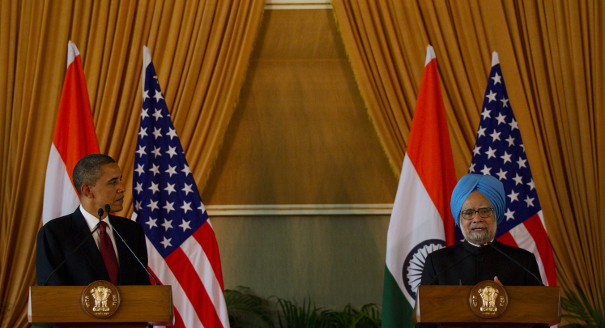
The enduring legacy of President Obama's Asia trip will be his strategic success in India, where he pursued a broad agenda that affirmed India's global importance and deepened the bilateral relationship.
Source: Foreign Policy

In response, some pundits have dubbed Obama's Asia tour a failure. In fact, the exact opposite is true. In India, where the stakes of the trip were highest, the president's visit was a ringing success -- and one that will have repercussions long after these temporary setbacks have been forgotten.
Although the White House advertised the visit as being largely about securing American jobs through increased Indian imports, Obama's words and actions confirmed that he was pursuing a broader agenda: affirming India's importance in the emerging Asian order, affirming its role as a global rather than as a local South Asian power, and deepening its inclusion in the institutions of global governance.
The visit marked the first time that Obama himself provided clear and unmistakable judgments about India. "In Asia and around the world, India is not simply emerging," Obama said both at a news conference and in speaking to India's Parliament. "India has emerged."
Responding to this reality, Obama endorsed, for the first time ever, India's claim to a permanent seat on the United Nations Security Council. His support for India -- over treaty allies like Germany and other claimants such as Brazil -- spoke volumes about the importance that the United States places on its alliance with India as an emerging power. "It can be said definitively now: with US President Barack Obama's India visit, the long shadow that the Cold War cast on India-US ties has been dispelled," the Times of India responded in its lead editorial. "Instead of looking to the past, the relationship has been recast for the 21st century."
Obama also announced a far-reaching initiative that expands India's access to U.S. high-tech equipment. In exchange for an Indian commitment to continually upgrade its export control system, an important step toward tightening the global nonproliferation regime, Obama declared that the United States would permit India to purchase previously restricted commodities, such as systems useful for defense and space applications. He also pledged to support India's membership in the four critical global nonproliferation regimes so that India could become part of the rule-making institutions that oversee commerce in nuclear, missile, chemical, and military technologies.
Perhaps no better assurance of an enduring bilateral relationship exists than the deepening of U.S.-India economic relations. Here, too, Obama's visit did not disappoint: He announced $10 billion in new trade deals, several of which involved the Indian military's purchase of equipment from U.S. manufacturers such as Boeing and General Electric. The U.S. military now conducts more training exercises with India's military than it does with any other partner, and the United States now sits on the cusp of becoming India's largest foreign supplier of weaponry.
Taken together, these initiatives significantly broaden the scope of this important bilateral relationship -- and will help the White House in its quest to jump-start American job growth. The deepening U.S.-India relationship will encourage a virtuous cycle -- as Washington expands its commitment to India's success, it will increase the opportunities for greater political collaboration and stronger economic ties.
Last week's trip improved bilateral cooperation on issues related to counterterrorism as well. Obama's tribute to the victims of the 2008 Mumbai attacks and his pledge that the two countries "stand united" against terrorism was received warmly in India. His statement emphasized U.S. support for India in its struggle against foreign terrorism and authorized increased cooperation between the intelligence, counterterrorism, and homeland security communities in both countries. These steps to increase joint training exercises and expand information and technology sharing will yield high payoffs in the future.
The intensifying security cooperation between the two countries will not only enhance India's domestic security -- it will redound to the benefit of the United States in Afghanistan. The commitment to deepen cooperation in this war-torn country signifies that Obama has rejected the Pakistani claim that India's involvement in Afghanistan undermines the U.S.-led international mission and threatens Pakistan -- a common assertion heard in Islamabad and sometimes even in Washington. And for the Indian government, the new commitment signifies a momentous shift in the traditional Indian position, which cheered the United States on in Afghanistan but sought to distance itself from any collaborative effort with Washington in Afghanistan. India is now signaling its willingness to not only support the U.S.-led effort from the sidelines, but to play an active role in pursuing their shared goals in the country.
As Obama noted during his trip, the relationship between the United States and India is one of the "defining and indispensable partnerships of the 21st century." His visit there has helped bring the two countries together on shared interests and moved their relationship forward significantly. The setbacks in Seoul will quickly fade from the public's mind -- it's Obama's strategic success in India that will be the enduring legacy of his Asia trip.
Former Senior Fellow
Ashley J. Tellis was a senior fellow at the Carnegie Endowment for International Peace.
Recent Work
Ashley J. Tellis
Ashley J. Tellis
Carnegie does not take institutional positions on public policy issues; the views represented herein are those of the author(s) and do not necessarily reflect the views of Carnegie, its staff, or its trustees.

Funding Ukraine remains a priority for European leaders. As Russia’s war of aggression heads into another winter, two feasible options to mobilize support for Kyiv should be fast-tracked.


Vladyslav Rashkovan, Gregory P. Wilson

While the EU and European governments are embracing the much-lauded middle-power moment, this entails three difficult conundrums.

Richard Youngs
The middle power moment will not be defined by sovereign states alone, and California stands out for its potential contributions to international cooperation.


Ian Klaus, Stewart Patrick

Much has been said of the changes Brussels is trying to make to the EU enlargement process. Here’s why gradual integration might—or might not—be the answer.

Dimitar Bechev
Economic recovery has brought Sri Lanka a modicum of stability, but domestic strains and great-power rivalry could test how long it lasts.

Avinash Paliwal