

Two experts discuss how drone technology is shaping yet another conflict and what the United States can learn from Ukraine.
Steve Feldstein, Dara Massicot
{
"authors": [
"Amr Hamzawy",
"Marina Ottaway"
],
"type": "other",
"centerAffiliationAll": "dc",
"centers": [
"Carnegie Endowment for International Peace",
"Malcolm H. Kerr Carnegie Middle East Center"
],
"collections": [
"Arab Awakening"
],
"englishNewsletterAll": "menaTransitions",
"nonEnglishNewsletterAll": "",
"primaryCenter": "Carnegie Endowment for International Peace",
"programAffiliation": "MEP",
"programs": [
"Middle East"
],
"projects": [],
"regions": [
"Middle East",
"North Africa",
"Egypt",
"Algeria",
"Morocco",
"Tunisia",
"Gulf",
"Levant",
"Maghreb"
],
"topics": [
"Political Reform"
]
}Source: Getty
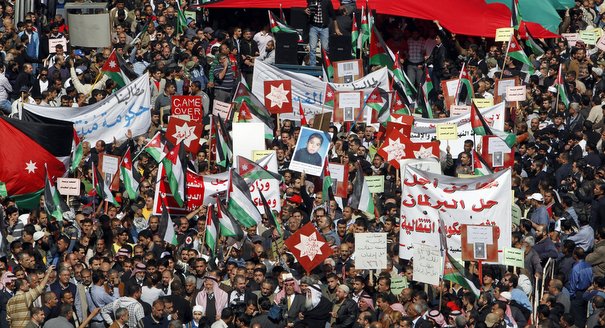
The uprising that started in Tunisia in late 2010 was not a completely new development, but rather a more dramatic example of the unrest common across the region, particularly in Egypt, Morocco, Algeria, and Jordan.
Over the past decade, the Arab world has seen an increase in protests, strikes, demonstrations, and other forms of social protest. The uprising that started in Tunisia in late 2010 was not a completely new development, but rather a more dramatic example of the unrest common across the region, particularly in Egypt, Morocco, Algeria, and Jordan.
But the protest movements in the region have severe limitations. The various organizations involved—labor groups, youth organizations, bloggers, political parties, and Islamist movements—have different constituencies, demands, and organizational styles. Indeed, in some countries there has been, until recently, a deliberate decision not to coordinate and particularly to keep socioeconomic and political demands separate. This helps incumbent authoritarian and semi-authoritarian regimes stay in power despite the high levels of discontent in many countries.
Despite the absence of large cohesive movements, Arab regimes are right to worry about the possibility of an uprising in their countries. The underlying conditions of difficult social and economic conditions coupled with political repression, lack of political freedoms, and corruption exist everywhere. Publics in Arab countries are also right in feeling inspired by events in Tunisia and in believing that they can force change. Ultimately, however, change depends not on Tunisia’s example, but on the ability of protesters to coordinate their efforts and link socioeconomic with political demands and on the governments’ response, plus the imponderable catalyst.
Director, Middle East Program
Amr Hamzawy is a senior fellow and the director of the Carnegie Middle East Program. His research and writings focus on governance in the Middle East and North Africa, social vulnerability, and the different roles of governments and civil societies in the region.
Former Senior Associate, Middle East Program
Before joining the Endowment, Ottaway carried out research in Africa and in the Middle East for many years and taught at the University of Addis Ababa, the University of Zambia, the American University in Cairo, and the University of the Witwatersrand in South Africa.
Carnegie does not take institutional positions on public policy issues; the views represented herein are those of the author(s) and do not necessarily reflect the views of Carnegie, its staff, or its trustees.
Two experts discuss how drone technology is shaping yet another conflict and what the United States can learn from Ukraine.
Steve Feldstein, Dara Massicot
As Iran defends its interests in the region and its regime’s survival, it may push Hezbollah into the abyss.
Michael Young
The use of technology to mobilize Russians to vote—a system tied to the relative material well-being of the electorate, its high dependence on the state, and a far-reaching system of digital control—is breaking down.
Andrey Pertsev
For climate-focused civil society in countries like Morocco, Algeria, and Tunisia to be most effective, organizations should work together to develop networks that extend their reach beyond their local area and connect across borders to share best practices and amplify each other’s work.
Sarah Yerkes
The recent African Cup of Nations tournament in Morocco touched on issues that largely transcended the sport.
Issam Kayssi, Yasmine Zarhloule