

Article
- +1
Toby Dalton, Mark Hibbs, Nicole Grajewski, …
{
  "authors": [
    "Mark Hibbs"
  ],
  "type": "legacyinthemedia",
  "centerAffiliationAll": "dc",
  "centers": [
    "Carnegie Endowment for International Peace"
  ],
  "collections": [],
  "englishNewsletterAll": "ctw",
  "nonEnglishNewsletterAll": "",
  "primaryCenter": "Carnegie Endowment for International Peace",
  "programAffiliation": "NPP",
  "programs": [
    "Nuclear Policy"
  ],
  "projects": [],
  "regions": [
    "East Asia",
    "Japan"
  ],
  "topics": [
    "Nuclear Policy",
    "Nuclear Energy"
  ]
}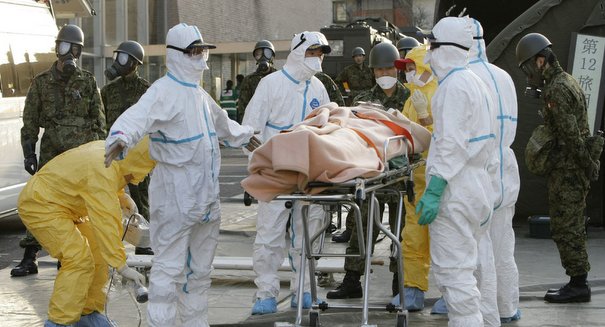
Source: Getty
The incident at Fukushima has reminded Japan that a serious accident in an advanced country can happen at any time. While Japan should reassess how dependent upon nuclear power it should be in the longer term, the Fukushima accident is not a blanket verdict against its use.
Source: Kyodo News

A partial meltdown at Three Mile Island happened three decades ago on the other side of the globe and Japan's memory of it was faint.
The nuclear industry provided assurance that steps had been taken to virtually exclude such an event happening again. The Chernobyl disaster didn't really dent that confidence because it was its unique design that triggered the explosion, and, unlike Japanese reactors, Chernobyl had no containment to hold back deadly radiation.
Beginning half a century ago, technocrats running Japan's knowledge-based economy were drawn to nuclear energy's seductive promise and quickly mastered its techniques.
But Japanese culture is in some respects profoundly risk-averse, and nuclear power unsettled many people because the price tag included an unquantifiable portion of uncovered residual risk.
The incident at Fukushima has reminded Japan that a serious accident in an advanced country can happen at any time. Newly aware of this, the Japanese nation will surely reassess its commitment to nuclear power.
But this reassessment will not put an end to Japan's nuclear program. For many years Japan will continue to produce much of its base load electricity with reactors as it has no real choice.
Nonetheless, Japan will draw important, expensive, and likely painful lessons from this accident in the coming months. The precarious balance of power in nuclear decision making between central government bureaucrats, utility companies, and local politicians will not make it easy for Japan to translate what it learns into actions.
Any future decisions to extend the lifetimes of Japan's nuclear power plants after 40 years of licensed operation should take into account the forthcoming technical evaluation of the Fukushima accident.
Japan should candidly review the willingness of Japanese authorities, not long before this month's accident, to permit the oldest reactor at Fukushima to operate for an additional 10 years after its 40-year license expired this year.
Fundamental questions must be asked about the role of geoscience in finding locations for nuclear power plants. A 2007 earthquake and this month's tsunami exceeded the design basis calculated for reactors at Kashiwazaki-Kariwa and Fukushima, respectively.
A magnitude 9.0 quake was not expected in the vicinity of Fukushima. More attention had been focused instead on the Hamaoka nuclear power plant site, located south of Tokyo, as the likely target of a massive earthquake.
Japan should reassess how dependent upon nuclear power it should be in the longer term. The earthquake in 2007 and this month's tsunami disenabled all but two of Tokyo Electric Power Company's 17 reactors at two sites, provoking a lengthy electricity supply crisis. That might prompt Japan to take measures to improve the effectiveness of the country's power grid.
But the Fukushima accident is not a blanket verdict against nuclear power. The reactors at Fukushima were apparently well-maintained and safely operated.
Unlike at Three Mile Island, Fukushima was not caused by poor safety judgment of operating personnel but by a crippling external event. For that reason, Japan -- and other nuclear energy countries -- should take additional steps as appropriate to protect nuclear installations against external events, including station blackouts, attacks by terrorists and plane crashes.
Finally, in its own self-interest, Japan should impart to its neighbors, and especially those countries located along the Pacific ''Ring of Fire'' which now operate or want to deploy reactors, what it learns from the accident.
Japan should support and encourage other states to back new international guidelines which would discourage nuclear power plants from being located on coastlines in areas where tsunamis can be anticipated.
Fukushima shocked people because it happened in a country with one of most advanced nuclear power programs in the world.
Without Japan's deep infrastructure, logistical capabilities, emergency preparedness, management resources, and dedicated personnel on site -- combined with a central government which commanded authority -- it could not have prevented a triple meltdown.
Japan and other nations need to communicate this sobering fact to all nuclear newcomer states, and ensure that they comprehend that they must incorporate this standard into their nuclear aspirations.

Nonresident Senior Fellow, Nuclear Policy Program
Hibbs is a Germany-based nonresident senior fellow in Carnegie’s Nuclear Policy Program. His areas of expertise are nuclear verification and safeguards, multilateral nuclear trade policy, international nuclear cooperation, and nonproliferation arrangements.
Recent Work

Toby Dalton, Mark Hibbs, Nicole Grajewski, …
Mark Hibbs
Carnegie does not take institutional positions on public policy issues; the views represented herein are those of the author(s) and do not necessarily reflect the views of Carnegie, its staff, or its trustees.

Alongside official pushback, Chinese tech and policy communities are meeting calls for a slowdown with skepticism—rather than rejection—that mirrors the reactions in the United States.


Matt Sheehan, Sophie Zhuang
As the nuclear order rapidly evolves, what can Europeans and other key players do to strengthen deterrence and reduce risks?

Jamie Kwong, ed.
Democrats now have the gavel and the purse, but the executive branch still pulls the levers on the U.S. role in the world.



James M. Acton, Dan Baer, Mark Baldassare, …
Individual leaders and public attitudes—especially in democracies—matter for credibility.


Lauren Sukin, Samuel Seitz
Latvia and Lithuania have been considering whether they could temporarily host NATO nuclear weapons in the event of war or a similar crisis.

Sergejs Potapkins