{
  "authors": [
    "Henri J. Barkey"
  ],
  "type": "legacyinthemedia",
  "centerAffiliationAll": "dc",
  "centers": [
    "Carnegie Endowment for International Peace",
    "Malcolm H. Kerr Carnegie Middle East Center"
  ],
  "collections": [
    "Arab Awakening"
  ],
  "englishNewsletterAll": "menaTransitions",
  "nonEnglishNewsletterAll": "",
  "primaryCenter": "Carnegie Endowment for International Peace",
  "programAffiliation": "MEP",
  "programs": [
    "Middle East"
  ],
  "projects": [],
  "regions": [
    "Middle East",
    "Türkiye",
    "North Africa",
    "Libya",
    "Syria",
    "Levant"
  ],
  "topics": [
    "Political Reform",
    "Democracy"
  ]
}
Source: Getty
In The Media
Turkey's Neighborhood Troubles
It is in Turkey’s interests to support democratic protesters in Syria and across the region, and to work with the West to find resolution to the violent conflict in Syria.
Turkey's Neighborhood TroublesSyrian President Bashar Assad is in deep trouble. His murderous use of deadly force against his own citizens, reportedly killing hundreds, has not quelled the growing defiance to his regime. Images from Syria tell gruesome stories of snipers and security forces shooting unarmed demonstrators. About 200 members of his Baath Party have resigned in protest.
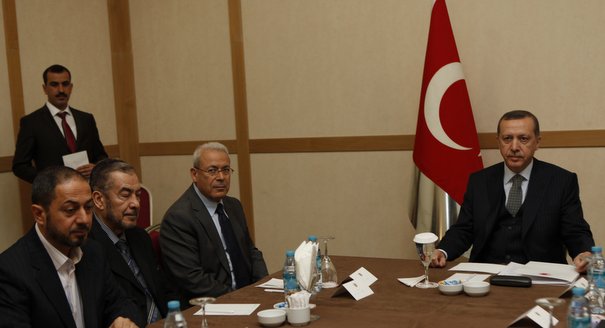
Assad's troubles, however, also spell trouble for neighboring Turkey. Its prime minister, Recep Tayyip Erdogan, had embraced Syria and its inexperienced leader. Turkey may be able to help itself and Syria, but it will need to work closely — and may even have begun to do so — with Washington.
At Erdogan's initiative, Syria and Turkey in 2009 abolished visas for their citizens traveling between the countries, held joint cabinet meetings and conducted small-scale military exercises. Turkish exports to Syria are booming. This type of integration has been the cornerstone of Turkey's much-heralded "zero problems with neighbors" policy.
But the Arab Spring has caught Ankara off guard. Self-styled champions of democracy and human rights, Turkish leaders have been slow to criticize the murderous rampages of Moammar Kadafi in Libya and now Assad in Syria. Unsure whether Kadafi would survive, Ankara hedged its bets. On Tuesday, Erdogan finally called for Kadafi to step down.
Syria, though, holds a unique place in Erdogan's imagination. He has genuine affection for Assad and has made a friend of a country that Turkey almost went to war with in 1998. The demise of Assad's regime could undermine those gains. Moreover, the unraveling of Syria would not be pretty. It is a deeply sectarian country in which the small Alawite minority controls all the levers of power — the army, the intelligence and other security services, the sole political party (the Baath) and much of the economic base. There would be many scores to settle. With no visa requirement, tens of thousands of Syrians could end up at Ankara's doorstep if the conflict escalates or gets out of control. All this makes continuing Turkey's current policy very difficult.
Although such a policy may be understandable for primarily economic reasons in the region, Erdogan and Turkey risk losing much credibility. Turkey's popularity with its neighbors is a function of the stridency with which Ankara has criticized Israel. Ankara's silence in light of massacres in the Libyan city of Misurata and Homs in Syria has disillusioned many and made it look opportunistic. And ordinary Turks were shocked to see crowds of Libyans gather in Benghazi to protest at the Turkish consulate, burn the Turkish flag and accuse Ankara of being in league with Kadafi.
In the West, Turkey's stand does not win it many friends. On Libya, the French and Turks openly clashed in public as recriminations abounded in both directions. In the United States — especially on Capitol Hill, where doubts about Turkish foreign policy have ruled the day — Ankara's silence has been further proof of Erdogan's insincerity and blatant one-sidedness.
Despite its imperfections, a democratic Turkey represents Syria's antithesis, and Ankara could easily have taken a more principled stand. Erdogan has said that he has urged Assad to relax his iron grip. He sent his intelligence chief and foreign minister to Damascus to no avail. But he needs to do much more.
Erdogan might be sorry to see his "brother Bashar" leave, but he must also understand that a Rubicon was crossed when Syrian tanks invaded civilian neighborhoods. It is in the interest of Turkey and the United States that an orderly transition to a post-Assad era begin soon. The White House's measured statements on Syria indicate that the Obama administration is worried that a bloodbath may follow any sudden collapse of the regime.
This is where Turkey can potentially play a crucial role by working closely with the West, and the U.S. in particular. There already are some signs of that. It is not a coincidence perhaps that Erdogan's first, though still muted, personal criticism of Assad came after a telephone conversation with President Obama.
Few in the region can match Ankara's assurances to Assad, who does not want to see a repeat of the Hosni Mubarak saga in Egypt. He needs a dignified exit strategy that ensures his family's and the Alawite leadership's well-being. This will require time to arrange — while Ankara works on this with the U.S. and Europe — and careful orchestration, because if hard-liners in Syria were to smell a sellout, they are quite capable of turning on Assad.
Turkey also possesses an important card to play with Assad. Were Erdogan to turn on the Syrian leader, the psychological and material impact on the regime would be dire. Turkey's relationship with Syria had provided an isolated Damascus with additional breathing room and an alternative to sole reliance on its traditional ally Iran. Turkey, therefore, has an opportunity to demonstrate that its new clout is real and can be deployed for the greater good.
Barkey served as a member of the U.S. State Department Policy Planning Staff, working primarily on issues related to the Middle East, the Eastern Mediterranean, and intelligence from 1998 to 2000.
Carnegie does not take institutional positions on public policy issues; the views represented herein are those of the author(s) and do not necessarily reflect the views of Carnegie, its staff, or its trustees.
More Work from Carnegie Endowment for International Peace
The domestic impacts of how long it is taking to end the war in Ukraine have pushed the French electorate to the political extremes and compromised the country’s diplomatic capacity.
Sergei Kiriyenko used Russia’s parliamentary vote to further hone his strategy of corporate mobilization that is designed to maximize votes for United Russia.